
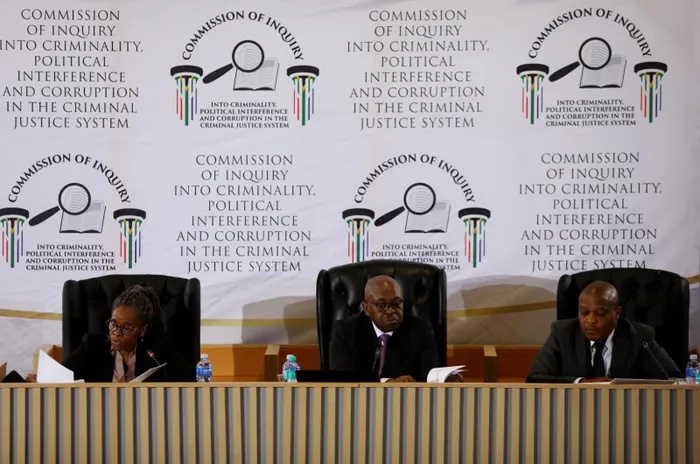
Witnesses at the Madlanga Commission of Inquiry are increasingly demanding for proof to be produced, even when presented with overwhelming evidence. The writer says savvy legal strategists are exploiting a significant lag in South Africa’s Criminal Justice System (CJS) to evade accountability.
Image: Oupa Mokoena / Independent Newspapers
As the Madlanga Commission of Inquiry enters its critical final phase in April 2026, it has become a laboratory for a disturbing new form of legal defence: digital denialism.
From the high-stakes testimony about the "Big Five" cartel to the shadowy dealings of figures like Vusimuzi "Cat" Matlala, a familiar, defiant refrain echoes through the hearings: "Produce the evidence". This defiance often comes even as the Commission is presented with clear, timestamped WhatsApp conversations and geolocated data. To the layperson, this is disputing the obvious. To the legal strategist, it is an exploitation of a systemic lag in South Africa’s Criminal Justice System (CJS).
As we stand in the 5th Industrial Revolution (5IR), we must ask: why does our legal system treat a digital footprint as a ghost rather than a solid track in the mud?
The 5IR Imperative and the South African Lag
The 5IR is no longer a futuristic buzzword; it is an inevitable global shift toward integrating human-centric values with smart technologies. While 2026 has been hailed by technology analysts as the "Year of AI Execution" for South African businesses, our CJS remains a laggard. Our courts are still largely tethered to a 19th-century reliance on paper dockets, dockets that can sit at national offices for months without action, or simply "go missing". This is the antithesis of 5IR. If we are to embrace the transparency that Justice Mbuyiseli Madlanga’s commission demands, we must transition to a "Forensic Blueprint" where evidence is technically and legally undisputed.
The Scourge of ‘Docket Shopping’
One of the most damning revelations of the Madlanga Commission has been the practice "Docket Shopping". Official testimony from February 2026 detailed how 121 case dockets from the Kwazulu-Natal (KZN) Political Killings Task Team (PKTT) were moved to Pretoria for what Justice Madlanga labelled a "nonsensical" audit, only to gather dust for months while suspects remained at large. This manual "shopping" of dockets is only possible because our system lacks digital permanence. In a 5IR framework, the "Brown Donkey" paper file must be replaced by a blockchain-secured e-Docket.
The Architecture of Silence: Politicians and the ‘Big Five’
The demand for "evidence" has become the standard shield for a diverse array of powerful actors. We have seen senior politicians, including suspended Cabinet members and high-ranking members of the South African Police Service (SAPS), indignantly challenge the Commission to "produce the proof". They rely on the fact that, currently, proof often resides in a paper docket that can be "shopped" or a witness who can be silenced.
Most chilling, however, is the testimony regarding the "Big Five" cartels. While figures like "Cat" Matlala have been named, there is a pervasive sense that we are still only guessing at the true identities of the other four kingpins. Even within the safe harbour of the Commission, senior police officers have hesitated, their voices trailing off when asked to "unmask the octopus" by naming the cartels' members including generals and directors who allegedly provide the cartels with their state-sanctioned immunity.
This fear is not unfounded. When a Forensic Blueprint is absent, the burden of proof falls entirely on the shoulders of whistle-blowers. In an environment where dockets go missing and witnesses are eliminated, the demand for evidence from the implicated is not a request for truth; it is a taunt.
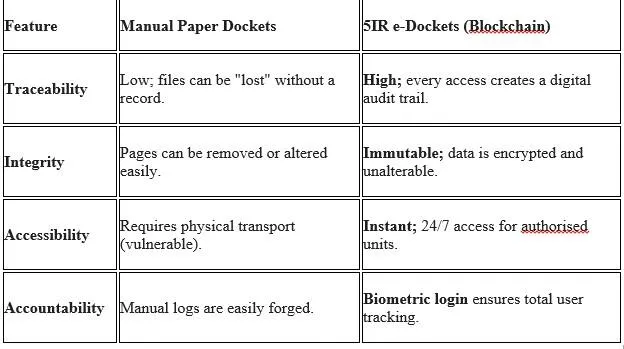
The advantages of a blockchain-based digital trail over outdated paper records.
Image: Supplied
The ‘Octopus’ Effect: A Shadow State Unmasked
The true horror emerging from the Madlanga Commission is the realisation that we are not dealing with a few bad apples but with an Octopus of Corruption. This syndicate’s tentacles have spread far beyond the police stations and prison cells; they have reached into the heart of our political structures, municipalities, the business sector, and even our educational and institutional frameworks. The implication is devastating: the rot is deeper than we anticipated. When a cartel like the "Big Five" can allegedly influence a R360-million SAPS tender or place senior generals on a million-rand monthly retainer, it suggests that the criminal apparatus has become stronger than the State apparatus itself.
The Double-Edge of Technology: Prisons as Crime Hubs
Technology in our CJS is a double-edged sword. While it offers the path to conviction, it is currently being weaponised by those it is meant to restrain. According to the Department of Correctional Services (DCS) data for the 2025/26 period, officials seized over 41 000 cellphones from inmates, roughly one device for every four prisoners. These are not tools for social connection; they are tools for extortion and syndicate management. The "enemy within", the corrupt official, is the ultimate weakest link. With DCS reports confirming over 180 officials dismissed in the last year for smuggling contraband, technology is being smuggled in to facilitate "digital denialism" from behind bars.
Disputing the Obvious: The WhatsApp Paradox
The most common defence used by those implicated is the challenge to the authenticity and integrity of digital communication. When a witness says "Show me the evidence" while staring at a screenshot of a WhatsApp message, they are betting that the State cannot prove the record is unmanipulated under the Electronic Communications and Transactions Act (ECTA) standards. To move from "disputable" to "undisputed", the CJS must adopt forensic standards that treat mobile devices as crime scenes. We need specialised 5IR Forensic Analysts who use tools to prove the metadata, who sent it, from what GPS co-ordinate, and at what millisecond. This turns a casual chat into an admission against interest.

Unisa Professor Jacob Mofokeng
Image: Supplied
The Forensic Blueprint: A Call to Action
To bridge this gap, my proposed "Forensic Blueprint for Accountability" suggests three radical shifts:
1. Signal Tracing, Not Just Jamming: As Minister Pieter Groenewald recently proposed in a March 2026 briefing, the DCS must pivot toward real-time signal-tracing technology that traces illicit devices to their exact cell location.
2. Mandatory 5IR Integrity Audits: We must use AI-driven lifestyle audits to identify officials whose spending does not match their salaries, closing the corruption loophole that allows the Big Five to purchase the silence of the State.
3. Legislative Realignment: We must amend the Cybercrimes Act to create a Presumption of Authenticity for digital evidence extracted via certified forensic protocols.
Severing the Tentacles of the Octopus
The revelations from the Madlanga Commission suggest that we are no longer merely fighting a criminal syndicate; we are battling a predatory "Octopus of Corruption". Its tentacles have wound themselves around our political leadership, our municipalities, our business procurement, and the very heart of the CJS. This "Shadow State" has become so entrenched that it often appears stronger than the state apparatus itself, thriving in the dark corners of manual dockets, shopped" files, and the silence of intimidated witnesses. However, even the most powerful octopus cannot survive if the water is drained, and the lights are turned on. My proposed Forensic Blueprint is that light. By embracing the 5IR, replacing paper with Blockchain e-Dockets and human testimony with immutable forensic metadata, we create a system where accountability is "baked into the code".
Jacob Tseko Mofokeng is a Professor of Criminology and a member of the Council of the Criminological and Victimological Society of Southern Africa (CRIMSA).