
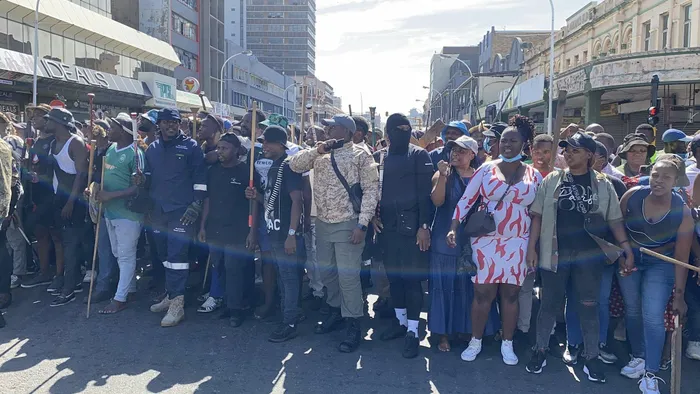
The March and March Movement's supporters on the streets of Durban's CBD. The writer says South Africa's anti-immigrant sentiment must be understood against the backdrop of a complex interplay of socio-economic challenges and the quest for belonging amidst rising political tensions.
Image: Sipho Jack
South Africa has, over the past two decades, witnessed periodic waves of anti-immigrant sentiment expressed through marches, protests and, at times, violent outbreaks. These developments are often simplistically framed as xenophobia, yet such a characterisation risks overlooking the complex socio-economic and political dynamics that underpin these expressions. Rather than attributing blame solely to protestors, it is necessary to understand these actions within a broader context of governance failures, economic pressures, and political contestation.
Migration politics in South Africa has become a central axis through which issues of national identity, party competition, and social cohesion are negotiated. Central to the matter lies a set of genuine grievances embedded in socio-economic realities.
South Africa continues to grapple with high levels of unemployment, inequality, and pressure on public services such as housing, healthcare, and education. These challenges are most acutely experienced at the local level, where residents often interact directly with municipal structures.
In many communities, particularly in urban townships and informal settlements, frustrations over limited resources and opportunities have intensified. Within this context, foreign nationals, especially undocumented migrants often become a visible and immediate point of contestation. This is not necessarily because they are the primary cause of these challenges, but because they are perceived as competitors for scarce resources in an already constrained environment.
Local councillors and metropolitan governments often find themselves at the frontline of these tensions. As elections approach, ward-level politics becomes increasingly contested, and migration-related issues are often politicised. Residents demand accountability for service delivery failures and, in the absence of effective responses, frustration can be redirected toward migrant communities. Political actors at the local level may, either explicitly or implicitly, capitalise on these sentiments to mobilise support. In this way, migration becomes not only a socio-economic issue, but also a political resource in electoral competition.
At the national level, political parties differ significantly in how they frame and respond to migration. Some parties advocate for stricter immigration enforcement, tighter border controls, and more aggressive deportation policies, often citing the need to protect jobs and national resources. Others emphasise constitutional values and human rights, warning against scapegoating migrants for systemic failures and advocating for more humane and regulated migration policies.
These divergent positions reflect broader ideological differences, but also strategic calculations aimed at appealing to different segments of the electorate. Resultantly, migration politics has become deeply embedded in party platforms, shaping public discourse and influencing voter behaviour.
A critical dimension of the current crisis lies in the role of the Department of Home Affairs. Persistent allegations of corruption, inefficiency, and administrative backlogs have undermined the credibility of the immigration system. The handling of asylum permits has been widely criticised for delays, inconsistencies, and lack of transparency. This has contributed to a situation in which many migrants remain in legal limbo, neither fully documented nor formally integrated into the economy. Such administrative failures not only complicate enforcement, but also fuel perceptions of disorder and illegality, further worsening tensions at the community level.
In addition, concerns about porous borders and weak immigration control have been repeatedly raised in public discourse. While migration is a regional and global phenomenon, South Africa’s relative economic position within the Southern African Development Community makes it a major destination for migrants from neighbouring countries. Failures by other states in the region, particularly in addressing economic instability, governance challenges, and conflict have contributed to increased migration flows.
However, the absence of co-ordinated regional migration policies and effective border management have placed disproportionate pressure on South Africa’s domestic systems. This has created a feeling among citizens that the state is unable to manage migration effectively, further intensifying public frustration. The intersection between migration and national identity is also significant.
Post-1994 South Africa has been built on the ideal of “unity in diversity,” a vision enshrined in the Constitution that seeks to promote inclusivity and social cohesion. However, periodic anti-immigrant marches and tensions challenge this vision, raising questions about who belongs and on what terms. Migration politics thus becomes a site where competing narratives of identity are negotiated between inclusive constitutionalism on the one hand, and more exclusionary, protectionist sentiments on the other.
Fundamentally, these tensions are not uncontested. Civil society organisations, religious institutions, and non-governmental organisations have played a crucial role in countering anti-immigrant sentiment. Through advocacy, community engagement,and public campaigns, these actors have sought to promote tolerance, highlight the contributions of migrants, and defend human rights. Their efforts reflect an ongoing struggle to sustain social cohesion in the face of economic and political pressures.
The role of media, particularly social media and talk radio, has further complicated the landscape. These platforms serve as spaces where grievances are articulated, amplified, and contested. On the one hand, they provide an outlet for communities to express legitimate concerns about crime, unemployment, and inequality. On the other hand, they can also reinforce negative stereotypes and fuel anti-foreigner sentiment through selective framing and misinformation. At the same time, alternative narratives such as stories of migrant entrepreneurship and contribution to local economies also circulate, demonstrating the contested nature of public discourse.
The way in which migration is framed in these platforms significantly shapes how communities interpret broader socio-economic challenges. The tensions surrounding migration are further worsened by institutional complexities within the state. The enforcement of immigration laws, including the Immigration Act, often involves multiple actors, including national departments, the South African Police Service, and local governments. This creates co-ordination challenges and sometimes conflicting mandates. While the Constitution guarantees certain rights to all individuals within South Africa, regardless of nationality, the practical implementation of these rights is often uneven. This disjuncture between legal principles and administrative realities contributes to ongoing political and social tensions.
The “xenophobic” marches /protests in South Africa can therefore not be understood in isolation from the broader socio-economic and political context in which they occur. They reflect a convergence of genuine grievances, governance failures and political dynamics that shape how migration is perceived and contested. Political parties, state institutions, and regional factors all play a role in shaping this landscape, while civil society and media actors influence how these issues are framed and understood.

Sifiso Sonjica
Image: File
Addressing these challenges requires a balanced and integrated approach. This includes improving governance and service delivery, strengthening immigration management systems, enhancing regional co-operation within SADC, and promoting inclusive narratives of national identity. Most importantly, it also requires recognising that public frustrations are rooted in real material conditions, and that sustainable solutions must address these underlying issues rather than merely their symptoms. Only through such a comprehensive approach can South Africa navigate the complex interplay between migration, politics, and social cohesion in a manner that upholds both stability and constitutional values.
Therefore, those South Africans leading these protests should not be dismissed as being xenophobic. A serious conversation must be held with them with the aim of finding sustainable solutions. Equally, leaders of these protests must denounce violence and criminality in the name of their cause and guard against agent provocateurs who may hijack their genuine cause.
Finally, we should all agree that illegal immigrants are not desirable in any country, including South Africa.
*The views expressed do not necessarily reflect the views of IOL, Independent Media or the Independent on Saturday.
** Sifiso Sonjica is an ANC Member in Ward 13 Mtubatuba Sub-Region. He writes in his personal capacity.