
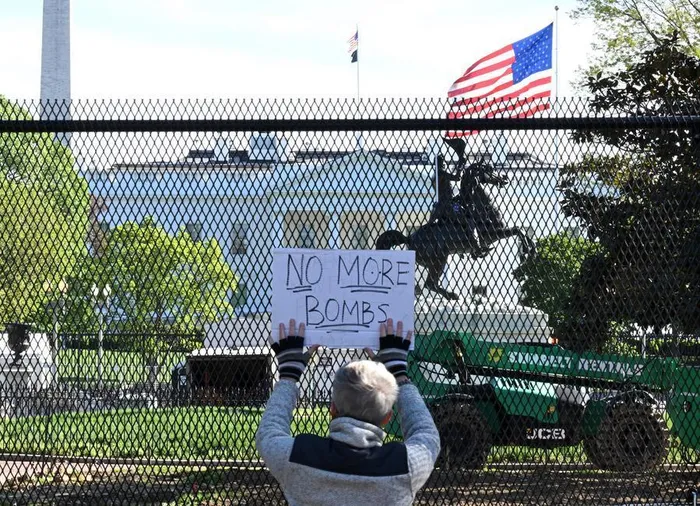
A demonstrator holds a placard in front of the White House in Washington, D.C., on April 7, 2026. The writer says concerns over access, governance, and ethical integrity are brought to the forefront as President Trump pushes his grand vision for the White House ballroom.
Image: XINHUA
Philip Kennicott
Within the first few minutes of an impromptu news conference after Saturday’s attempted attack on the White House Correspondents’ Association dinner, President Donald Trump glided on wings of non sequitur from details of the averted disaster to his all-consuming favorite project, the giant ballroom he wants to build on the ruins of the White House East Wing.
“We need the ballroom,” he said, still dressed in his tuxedo. “That’s why Secret Service, that’s why the military are demanding it.” In a court filing Monday that reads like one of the president’s Truth Social posts, he again connected the two issues in a rambling diatribe that also mentioned, apropos of nothing, that he was a “highly successful real estate developer, who has abilities that others don’t.”
But Trump’s acting attorney general, Todd Blanche, had already confirmed on Sunday that the security protocols at the Washington Hilton, where Trump, Vice President JD Vance and top Cabinet officials were having dinner, had worked as designed. It was, he said, “a massive security success story.”
Security, in Washington, is the shibboleth that opens all doors. Or rather, that closes them. By recasting the gargantuan $400 million (R6.8 billion) gilded ballroom as a security project, the president hopes to convince not just a sceptical federal judge adjudicating its legality but also his fellow Republicans in Congress that this isn’t a mere amenity but an urgent necessity. He has previously been unable to convince the American public that the White House needs an ornate entertainment venue that would dwarf the historic mansion. Now, he seeks to convince them that he can’t be safe without one.
This suggests that he plans to leave behind not just a radically transformed White House complex but a different conception of the presidency. The regal trappings Trump favors in design and architecture will now be mirrored by an essentially regal protocol for seeing the president. If the president can safely mingle with others only within a fortress-like ballroom on the White House grounds, then he will no longer be out among the people, no longer in touch with ordinary life. The presidential bubble will be bulletproof - and bombproof and drone-proof - but it will also impede the free flow of information from the grass roots to the executive.
Washington has seen security panics before, and they leave indelible marks of fear and authoritarianism on the landscape. After the attacks of September 11, 2001, the beauty and symbolism of essential civil landmarks in Washington were grossly corrupted by a rush to “harden” the town. Bollards grew like mushrooms, and the public was excluded from places it once had a right to freely access. The west terrace of the Capitol, one of the few places where the city’s meticulously meaningful urban design can be comprehended in a glance, was closed to the public forever. The massive sculptural doors of the Supreme Court also swung shut; the public now enters from a lower level and never experiences the most important element of architect Cass Gilbert’s design: the thrilling proximity of the courtroom to the front entrance, as if justice were immediate, accessible and open to everyone.
Trump has said that every president has wanted a ballroom and that the lack of one has been a problem for more than a century. But there’s no reason that state dinners can’t be held in the existing State Dining Room, if limited to 140 or so guests, or in the East Room, which accommodates some 200 people. Local developer Ronald Eichner and architect Matthew Bell, who teaches architecture at the University of Maryland, point out that the Treasury Building, adjacent to the former East Wing, includes two courtyards of some 20,000 square feet, which could be converted into a ballroom within the White House security perimeter.
State dinners are meant to establish an intimacy and communion with foreign leaders that aren’t possible in larger, more ceremonial encounters. Their purpose is subverted when the guest list grows to convention-centre proportions. But, of course, the real function of this ballroom isn’t about governance or diplomacy. It’s about fundraising, about endless rubber-chicken dinners for cadres of donors seeking influence and business leaders hungry for government contracts. Both political parties are guilty of selling access to the president through legal and quasi-legal forms of pay-to-play. But it sets a terrible precedent to institutionalise this industrial-scale deformation of democracy through architecture, which ensures its perpetual presence in civic life.
What is obviously a fundraising space will become America’s version of the infamous Salon de l’Oeil-de-Boeuf, the antechamber to royal access at Versailles, where courtiers, sycophants and supplicants came to wait upon the kings of France. Trump has suggested it also will be the site of future inaugurations. And thus inaugurations will evolve from an oath-taking at the People’s House on Capitol Hill - a ceremony enacted in front of the American public and witnessed by the world - to a spectacle tightly controlled and entirely choreographed by the executive branch, something more like a coronation.
And perhaps the ballroom will be rented out for private events, another revenue stream with deeply worrisome ethical implications. The sky is the limit when, like the fallen angel Mammon, your eyes are focused only on what glitters.
Congress should take up the question of the ballroom, but it shouldn’t rubber-stamp it. Now is the chance to repair some of the damage done when Trump unilaterally destroyed the East Wing, where Franklin Delano Roosevelt once watched newsreels during the Second World War and Letitia Baldrige helped orchestrate the glamour of Camelot. Something must be built on the wreckage, something of the same scale as the old East Wing, something that won’t destroy the historic landscape designed by Frederick Law Olmsted Jr. Send the architects back to the drawing board with a basic mandate: Respect the history of the White House and the aesthetic norms of democracy, and build an East Wing that will benefit and serve the American people, not our oligarchs.