
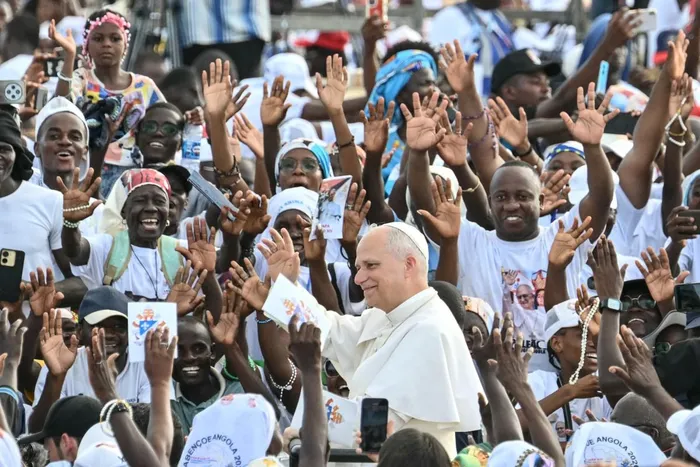
Pope Leo XIV waves to the crowd in front of the "Mama Muxima" Shrine in Angola during an 11-day apostolic journey to Africa, last month. This week marks a year since he was elected.
Image: AFP
Howard Chua-Eoan
In early January, as I was pulling together a column on Pope Leo XIV, I asked a couple of AI chatbots to find the text of his first Christmas message. Gemini - the Google interlocutor - responded by telling me that any news or social media reference to “a Pope Leo XIV… appears to be a digital hallucination or fictional placeholder” because the current pope was Francis. Even though we were eight months into the new pontificate, it insisted: “There is no Pope Leo XIV.”
OpenAI’s ChatGPT wasn’t any more cognizant. “As of now, there is no reigning Pope Leo XIV,” it declared, though it was willing to project what commentators might say about a “hypothetical ‘Leo XIV.’”
Were Gemini and ChatGPT trying to erase Leo even before he reached his first anniversary? Maybe they were mad at him because he’d been wary - even critical - of AI, calling it a “challenge to human dignity, justice and labor.” Regardless, the events since January give them no excuse for ignorance. As he reached his 365th day on the Throne of St. Peter on May 8, Pope Leo XIV is far from hypothetical or hallucinatory. Indeed, his very real presence will continue to disturb princely politicos and potentates of pixels around the world.
Most of those engagements will be quiet. The Holy See has perfected the art of the non-committal but clear condemnation. And so the pope will deliver soothing and instructive sermons full of words like “likely” and “perhaps” that provide his views on the teachings of the Catholic Church. The global hierarchy will then carry out implementation among the faithful. It won’t be smooth: Some priests and nuns may go too far; others not far enough. It is, after all, a human organization with all the attendant management headaches. But Leo - unlike Francis- has at least two decades of experience running global components of the church.
Should we expect more encounters like the April tussle between the Holy See and Washington DC - where the US president went in with headbutts only to be parried elegantly by the first American pope? Probably not, given the church’s proclivity for avoiding direct confrontations. But that conflict revealed what’s at stake for both pope and president.
For Donald Trump, it was a brutish attempt to reassert primacy over the US Catholic vote, which polls indicated was falling out of love with the administration. For Leo, it is part of the slow recalibration of the US Catholic hierarchy begun 13 years ago under Francis - not necessarily from right to left, but back to its vocation to alleviate the suffering of the poor.
Leo’s inaugural trip abroad was to Africa, where his message about autocracy and economic inequality pricked as many consciences as it did in America. There he issued his one direct quote on Trump’s social media attack: “I have no fear of the Trump Administration or speaking out loudly about the message of the gospel.”
In December, the pope replaced retired Archbishop Timothy Dolan of New York - whom Trump had called his choice to become pope back in April 2025 - with Ronald Hicks, the bishop of Joliet, Illinois. Last week, he named Evelio Menjivar-Ayala, a former undocumented immigrant from El Salvador, as bishop of West Virginia. There are likely to be more appointments that will rankle the MAGA class.
Will Trump take the bait again? He may just move on to one of his many other targets and peeves. But high-profile American Catholics like Secretary of State Marco Rubio - who visited the Vatican this week - and Vice President JD Vance will have trouble ignoring the Vicar of Christ. Vance - who converted to Catholicism in 2019 and has a book on that process publishing next month - will probably have more trouble than the others.
Leo is framing his reign as consistent with his predecessor. But he is subtly allowing for contrast. To a large extent, the late pope’s tenure was defined as woke-ish because of his 2013 quote “Who am I to judge?” about gay Catholics. Asked about that remark on the plane back from Africa, Leo said his predecessor was expressing “the Church’s belief that all are welcome, all are invited, all are invited to follow Jesus, and all are invited to seek conversion in their lives.” He clarified that Francis’ final formulation excluded same-sex relationships from being blessed and said he wanted to move beyond the issue.(1)
“We tend to think that when the Church is talking about morality, that the only issue of morality is sexual. And in reality, I believe there are much greater, more important issues, such as justice, equality, freedom of men and women, freedom of religion, that would all take priority before that particular issue.”
This extends to matters of waging war - which conservative US pundits and politicians insist the pope shouldn’t have an opinion on.(2)
American Catholics like Vance who may argue that the US assault on Iran is defensible according to the Christian formulations of a “just war” must remember the history of the concept. It was first set out by Saint Augustine, the theologian who gave his name to the monastic order led by Leo from 2001 to 2013. The pope and high-ranking clerics have said those proponents of the conflict are very likely wrong. Virtually all the pontiffs since World War II have condemned fighting as a solution to anything(3).
But Leo has other opponents. Already, he has seen theological intrusions by Peter Thiel, the billionaire co-founder of a host of data companies including Palantir Technologies Inc., which services the US Immigration and Customs Enforcement agency. Thiel, who fancies himself an expert on apocalypse and the Antichrist, has brought his exclusive lectures to the front door of the Vatican. Plutocrats feel threatened by the church’s constant reminders that Jesus teaches a “preferential option for the poor” - whom the church must serve, whether they be unemployed, hungry or homeless.
In his first Apostolic Exhortation, Leo reminded believers that the church has not completely rejected the so-called “liberation theology” - an ideology that says the mission of the church is to work toward the liberation of the poor, which was espoused by many priests and nuns in the 1970s and 80s and is viscerally opposed by US-backed right-wing regimes in Latin America. Instead, it has simply purged that revolutionary outlook of its communist underpinnings. He cites the church’s de-Marxed line: “The concern for the purity of the faith demands giving the answer of effective witness in the service of one’s neighbor, the poor and the oppressed.”
How does Leo contend with the principalities and powers of this world? As Joseph Stalin probably knew back when he sniffed at finger-wagging from the Vatican, the last Papal armies were effectively extinguished in 1870. Today, Catholic religious workers have been attacked in the Middle East and elsewhere. The Vatican is also still dealing with decades of financial mismanagement and the ugly stain of priestly sexual abuse. The church’s own history has enough bleak and callous episodes to provide grist for accusations of hypocrisy. The US Catholic hierarchy - and those elsewhere - may appear more unified with the Vatican now, but politics and nationalism may prove disruptive once more.
But Leo isn’t afraid or dismayed. His church has spent the last century-and-a-half reconfiguring itself, and the theocracy that once was the virtual hegemon of Western Europe has returned to the world stage. It doesn’t have much physical clout, but it possesses heightened powers of persuasion, from the atavistic adoration of old and new saints to the moral high ground of universal brother- and sisterhood. His first Apostolic Exhortation was actually begun by the dying Francis; but he has made it his own. It opens with a quote from the apocalyptic book of Revelation. “You have but little power… I will make them come and bow down before your feet.”
It’s the kind of omniscience Leo aligns himself with in contrast to the artificiality now passed off as intelligence. In September 2025, he rejected a proposal to create an AI embodiment of himself that would answer questions about the Roman Catholic Church. He said, "If there’s anybody who should not be represented by an avatar, I would say the pope is high on the list.” He wants his presence and influence to be compassionately human. And that is a bigger challenge to our world than words can relay.
(1) Though he has to deal with German clerics who are blessing same-sex unions.
(2) Trump said the Pope's opposition to the war in Iran is "endangering a lot of Catholics" because of what the US president insists is Tehran's nuclear weapons agenda.
(3) The exception was Pope John Paul I, who died after only 33 days as the Successor of St. Peter.