
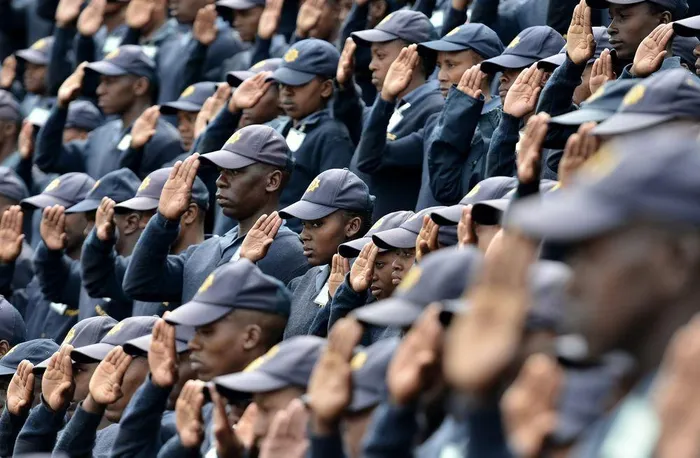
As the crisis deepens within the SAPS, the public's cry for reform intensifies. The writer asks if South Africa will find the resolve to confront its systemic rot, or continue to watch as its pillars of safety collapse.
Image: FILE PHOTO
In the study of criminology, we often look for the tipping point, that specific moment when a system transitions from being flawed to being fundamentally broken. As of May 2026, the SAPS has crossed that threshold. They say a house is only as strong as its foundation, but we are past the point of worrying about the floorboards. The roof is not just leaking; it is structurally failing. This is not a natural disaster; it is a meticulously executed inside job. While the public huddles in the corners hoping for protection, the very people paid to maintain the structure have been stripping the lead off the roof and selling the support beams for scrap.
We are witnessing a perfect storm where institutional decay, factional warfare, and criminal capture have collided. The arrests of Major General Ebrahim Kadwa (Gauteng Hawks Head) and Major-General Feroz Khan (Head of Counter and Security Intelligence), followed by the precautionary suspension of Lieutenant-General Molefe Isaac Fani (Divisional Commissioner for Supply Chain Management), are not isolated incidents of bad apples. They are the final, deafening confirmation that the Big Five Cartel has not just knocked on the door, it has successfully moved into the master bedroom, the kitchen, and the treasury.
The Trust Deficit Flood: A Crisis of Moral Compass
When a National Commissioner is suspended and the Head of Crime Intelligence is arrested, the 180,000 rank-and-file officers on the ground lose more than just a leader; they lose their moral compass. We call this organisational cynicism. It is a psychological rot that sets in when the gap between the official mandate and the reality of leadership becomes an unbridgeable chasm.
Consider the constable at a local station in Bohlokong, Diepsloot, Nyanga or Soshanguve. They are expected to maintain the highest ethical standards while working with broken vehicles, empty dockets, and a lack of basic forensic kits. Yet, they see their generals, men like Khan and Kadwa, arrested for dealing in precious metals while living in luxury Houghton apartments. When the top brass is allegedly trading in gold and diamonds, a R50 bribe at a roadblock stops looking like a crime to a junior officer; it starts looking like a dividend. This trust deficit is a flood that is drowning the integrity of the blue uniform from the bottom up.
The Collapse of the Secret Service Shield
For decades, the Secret Service Account (SSA) acted as the attic of the SAPS, a dark, unventilated space where senior generals could hide transactions away from public oversight under the guise of National Security. For years, this was used as a private slush fund to reward political loyalty and punish dissent. However, the recent raids and the explosive testimonies at the Madlanga Commission have finally pulled back that curtain.
The roof of secrecy has blown off. We now know, through the testimony of Lieutenant-General Dumisani Khumalo, that the SSA did not just fund intelligence; it funded a shadow state. When high-ranking officials can no longer hide their luxury vehicle leases or their safehouse rentals behind the veil of secrecy, the pressure reaches a breaking point. The arrests of Khan and Kadwa over illegal precious metals is the first major fallout from this loss of cover. The cartel members can no longer rely on the silence that black budget money once bought.
Factional Warfare: A House Divided
The SAPS is now a house divided: camps loyal to suspended commissioners, reformist generals like Nhlanhla Mkhwanazi and Manamela, and cartel-aligned officers. This is not healthy debate but cannibalistic attrition. Crime Intelligence is weaponised for blackmail, whistle-blowers are silenced, and truth sacrificed.
Factionalism corrodes cohesion. When questioning a command becomes taboo, professional judgement gives way to criminal allegiance. In such an environment, loyalty is no longer to the Constitution but to whichever faction offers protection. A house divided cannot stand, and the SAPS is crumbling under its own contradictions.
Scripture itself confirms this truth: “Every kingdom divided against itself is brought to desolation; and every city or house divided against itself shall not stand.” The moral decline and abuse of leadership within the SAPS is not an isolated phenomenon. It signals a broader crisis of ethical leadership across the public sector. The same corrosion that eats away at policing might be visible in other state institutions, from education and rail infrastructure to state-owned enterprises.
Leadership Crisis: The Rotten Timber at the Core
South Africa’s policing crisis is no longer about corruption alone; it is about the collapse of leadership itself. The SAPS, once entrusted with safeguarding the nation, now stands as a condemned house, stripped of its moral authority and hollowed out by criminal capture. The arrests of senior generals and the suspension of key commissioners are not isolated scandals; they are the unmistakable signs of a leadership vacuum where ethical authority has evaporated. When those at the helm trade in contraband and manipulate procurement pipelines, the rank-and-file lose their compass, and the public loses its faith. This is not just a policing failure; it is a national emergency. Unless the SAPS is demolished and rebuilt on transparency, accountability, and professional integrity, the collapse of leadership will not only bury the police; it will bury the state itself.
At the heart of this collapse lies a leadership crisis. Leadership is not merely about command; it is about moral authority. When generals trade in contraband and commissioners are suspended for corruption, the symbolic spine of the organisation snaps.
Leadership failure manifests in three ways:
This leadership vacuum is more dangerous than any single scandal. It creates a culture where corruption is not an aberration, but the norm. Without ethical leadership, reform becomes impossible, because the very architects of change are themselves compromised.
In criminological terms, the water that flows from the high tap must always be tested to ensure it is not acidic. If the leadership at the top is poisoned, the contamination spreads downward, corroding every level of the organisation. The SAPS today is living proof of this principle.
When leadership at the top is compromised, the rot spreads horizontally across sectors. Schools lose their compass when education leaders are embroiled in scandals. Rail collapses when executives prioritise patronage over service. State-owned entities falter when boards are captured by political factions. The crisis of the SAPS is therefore not just about policing; it is a mirror reflecting the wider decay of governance in South Africa.
From Structural Rot to Parallel Shelters
The corrosion at the top does not stay at the top; it drips down until the floorboards give way. When the command structure is exposed as a cartel slush fund and its generals are led away in handcuffs, the social contract dissolves. With the state’s house condemned, citizens are building their own shelters.
We are witnessing a frantic, bifurcated exodus from public safety. On one side, the wealthy retreat into the gated fortress states of private security, which now outnumbers the SAPS four-to-one. On the other, in the townships and rural heartlands where the police have become ghosts, the poor are forced to turn to vigilante groups for a brutal, immediate form of order.
This dual system of protection is the ultimate symptom of the structural collapse. It entrenches a dangerous inequality, creating one South Africa where safety is a luxury commodity and another where justice is improvised in the streets. When we are forced to rely on the SANDF for basic policing, we are no longer managing crime, we are signing a declaration of surrender.
When the state loses its monopoly on legitimate force because its uniformed timber has rotted through, the perfect storm is complete. We are no longer just living in a condemned building; we are watching the neighbourhood burn because the fire brigade has sold its water to the highest bidder.
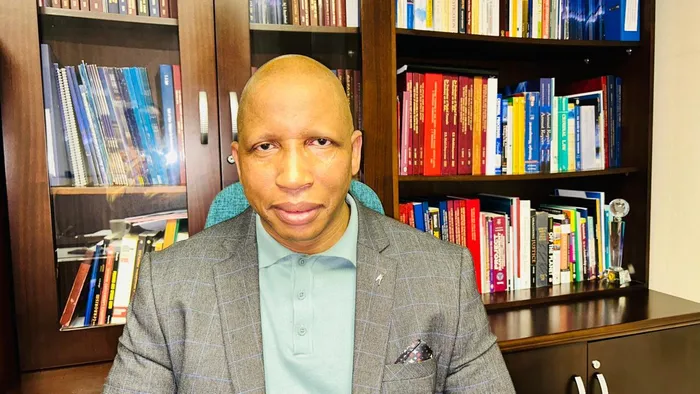
Jacob Tseko Mofokeng is a Professor of Criminology at UNISA.
Image: Supplied
The Architects of Capture: The Big Five Cartel
The Big Five Cartel is no street gang. It is a corporate criminal empire, embedding itself into the SAPS’s command structure. Evidence shows cartel architects placed themselves in Crime Intelligence, the Hawks, and Supply Chain Management.
Their goal was not destruction but repurposing, turning the SAPS into a logistics arm for contraband. Whether through sabotaged drug busts or fraudulent tenders, the cartel’s fingerprints are everywhere. They did not bribe officers; they embedded them. This is capture, not corruption. And capture requires demolition, not reform.
Conclusion
The arrests of Khan and Kadwa, and the suspension of Fani, are not the final act, they are the emergency sirens of a failing system. For too long, we have allowed the SAPS to operate under the delusion that rank is a substitute for virtue. We have mistaken the silence of the ranks for stability, when it was the sound of an institution drinking the acid of blind loyalty until its very core dissolved.
A police service cannot be a private fiefdom where procurement and intelligence are treated as cartel assets. You cannot fix a roof with the same rotten timber that caused it to collapse, and you cannot restore trust by simply reshuffling the same compromised deck.
Call to Action
The time for whispering in the dark is over. I call upon the President, Acting Police Minister and Joint Standing Committee on Intelligence (JSCI) to move beyond damage control and initiate a radical, structural demolition:
We stand at a crossroads: we can either swing the wrecking ball now to clear the rot, or we can wait for the roof to fall on the state itself. South Africa deserves a foundation of truth, not a condemned building of secrets.
*Jacob Tseko Mofokeng is a professor of criminology at UNISA and a recipient of the UNESCO Chair and University of Connecticut award for his contribution to human rights and global solidarity.
** The views expressed do not necessarily reflect the views of IOL, Independent Media, the Independent on Saturday, or UNISA.