
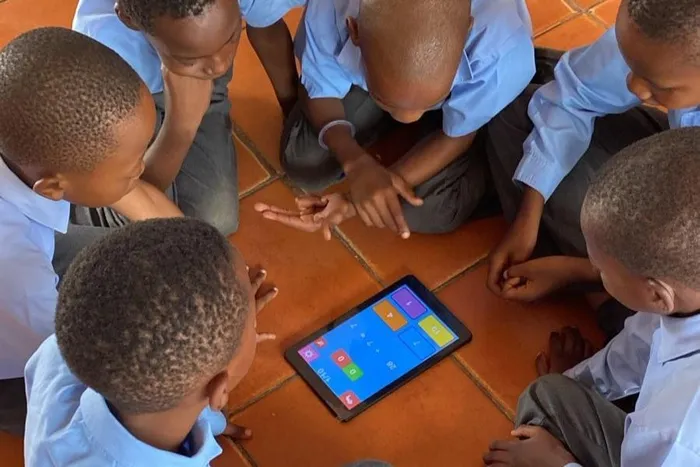
Rural learners gather around a tablet during a guided lesson, as technology opens new pathways to education and future opportunities.
Image: Good Work Foundation
A pattern is emerging within our schooling system that needs highlighting as South Africa faces its next major technology decision. In coding and robotics, with the best intentions, directives were given, curriculum was developed, and then the move forward stalled. We are beginning to see the same pattern with artificial intelligence (AI).
Globally, the question is no longer whether AI should be used in schools, but how it can be integrated responsibly, ethically and effectively. Most countries entered the generative AI debate with national AI or digital strategies already in place, many updated since 2023.
The OECD’s Digital Education Outlook 2026 notes that the most common immediate policy response has been national or system-level guidance covering ethical use, academic integrity, data protection, and the roles of teachers and students. In South Africa, we are still waiting for that conversation to properly begin.
Without direction from the Basic Education Department, teachers are experimenting with AI tools on their own because pupils are already using them, and pretending otherwise is not a strategy. Without a shared framework, the outcome will be uneven – some pupils receiving structured exposure, others receiving none, with no curriculum designed to build progressively from one year to the next.
AI literacy cannot be introduced through a once-off lesson or isolated workshop. Like mathematics or language, it needs to develop over time, with foundational skills built grade by grade. Teachers also need training to help pupils use these tools in ways that strengthen thinking rather than simply outsource it.
My concern is that we are slipping into a familiar pattern. The DBE spent years building momentum around Fourth Industrial Revolution skills such as coding, robotics, future-readiness. Curriculum pilots were launched, timelines announced, and teachers, myself included, invested considerable time writing manuals and preparing classroom material.
Then the focus shifted back to foundational literacy and numeracy because the system was not ready for what had been promised. Teachers were left holding work prepared for programmes that never fully materialised.
That is not a criticism of prioritising literacy and numeracy; those challenges are real and urgent, and we cannot progress when children cannot read. That a September 2025 promised revision of the White Paper on e-Education, first developed in 2004, has not happened is concerning in an era in which technological advances are moving at lightning speed.
Since AI cannot be policed, just like Google cannot, pupils need to be taught how to interact with and integrate these tools critically and honestly. Without that, we are doing our children a disservice. They will enter a world where AI is embedded in everyday systems, processes and decision-making, without the building blocks to navigate it.
For parents, no policy means no clarity on what their children are being exposed to or how. For teachers, it means navigating fast-moving technology without standards, training or support.
The question is no longer whether AI should feature in education, as it already does. The real issue is whether South Africa can move beyond discussion and provide the clarity, consistency and implementation that schools, teachers and pupils need.
*Celeste Labuschagne is a mathematics lecturer at Belgium Campus iTversity.