
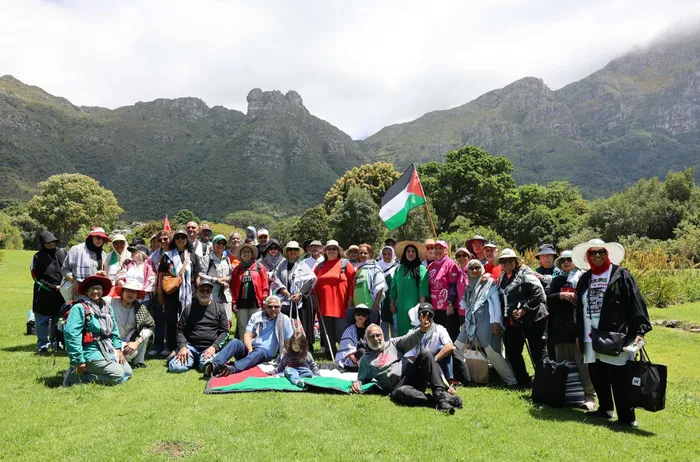
Members of the Palestine Solidarity Campaign and Mothers4Gaza staged a sit-in at Kirstenbosch to protest The Kiffness' addition to the Summer Concert series.
Image: Supplied
The recent peaceful sit-in at Kirstenbosch National Botanical Garden (Kirstenbosch), organised by the Palestine Solidarity Campaign (PSC) Cape Town and Mothers4Gaza, was not merely a protest against a concert; it was an urgent intervention into the very meaning of free expression and public accountability in South Africa. The action calls for the cancellation of a performance at the Botanical Gardens, later this month, by musician David Scott, known as The Kiffness, citing his long record of inflammatory and defamatory statements described as divisive, racially charged, Islamophobic and apartheid and genocide denial.
The inevitable pushback against such protests often portrays them as a moral drama of “censorship” and “persecution,” a narrative that fundamentally misunderstands the true nature of free speech in a constitutional democracy. Framing the criticism as an “attack on freedom of speech” fails to understand crucial distinctions.
According to our Constitution, free speech prevents the government from punishing us for our views as a means to protect society, something every South African should not take for granted. Scott remains entirely free to post his opinions on X, to make music, and to cultivate an affirming audience. However, the cost of that comes at the protection of our society and fledgling democracy.
Community response is also free speech. When individuals and civil society groups object to giving a proud heritage platform to someone whose commentary they find bigoted and inflammatory, their opposition, their lobbying, and their decision to withdraw support are all legitimate, protected expressions of freedom.
Free speech that violates our constitutional values is not a guarantee. The right to speak is not automatically bundled with the right to a stage, a public space, and, in this case, a reserved slot in the Kirstenbosch Summer Sunset Concerts 2025-26, or protected from criticism. Kirstenbosch, a public heritage institution managed by SANBI, is not constitutionally obliged to platform anyone.
To confuse public disagreement or the loss of a commercial contract with government censorship is to ignore that other people also have voices. Counter-speech is the lifeblood of freedom.
Public institutions must protect our Constitution. Kirstenbosch is a national treasure, a symbol of our natural heritage and a public space that should embody the highest ideals of the South African project: unity in diversity, reconciliation and social cohesion. It is funded and maintained in the public trust. The decision to stage The Kiffness betrays this trust and contradicts the values SANBI purports to uphold.
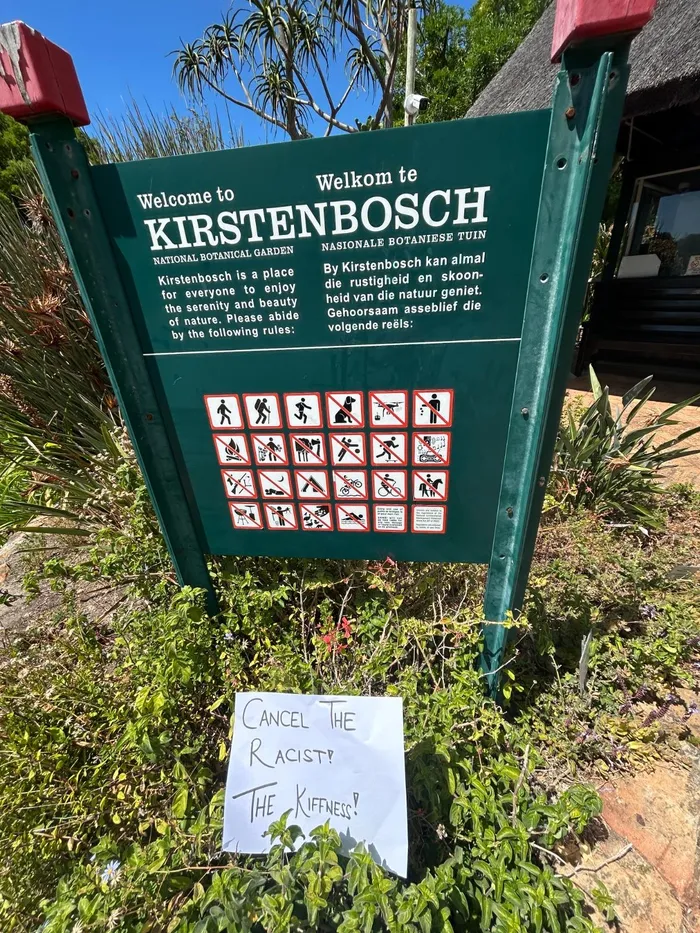
The public has a right to know the criteria Kirstenbosch uses in choosing its annual lineup, says the writer.
Image: Supplied
The PSC’s detailed letter, delivered to SANBI officials outlining Scott’s anti-black, Islamophobic and genocidal denial rhetoric and divisive political speech, raises urgent questions about why a national heritage institution would platform such an artist.
The price today, and more importantly, for future generations, of the division being relentlessly fuelled is the sabotage of South Africa's already fragile national narrative. The country simply does not need the amplification of political right-wing rhetoric, which is aimed at legitimising white, Afrikaner victimhood and cynically fuelling racist narratives, such as the deeply misleading, misinformed, and dangerous claims that South Africa has “143 race laws”, which discriminate against white people. A figure sourced from right-wing lobby groups and commentators, which legal analysts and academic researchers have proven to be methodologically flawed and ideologically driven, and which misclassifies many constitutional redress and equality measures as “anti-white” race laws. By endorsing these myths, Scott not only distorts the realities of violence and inequality in South Africa but also undermines the constitutional project of non-racialism and redress for those historically disadvantaged by apartheid. This divisiveness is compounded by his public statements, widely seen as promoting Islamophobia and engaging in genocide denial regarding Gaza.
Framing this public dissent as oppression equivalent to apartheid is false and trivialises historical suffering and exploits a psychological loop where opposition is recast as persecution. In a nation still striving to overcome the profound legacy of legislated racial oppression and apartheid, these attempts to sow discord and cling to separatist identities undermine the concepts of diversity, inclusion and non-racialism. South Africa needs voices that champion unity, dignity, respect and equality, rather than those who actively work to re-entrench the racial divides our democracy fought so long and so hard to dismantle. Standing in the voting queues in 1994, we knew true democracy wouldn’t be an overnight fix – we need endurance now more than ever.
SANBI’s own mandate includes a commitment to “benefit, educate and inspire the people of South Africa.” Its values undoubtedly speak to integrity, respect, and national service. Yet, Kirstenbosch remains largely inaccessible to the majority of South Africans and is viewed as a haven for the privileged few. Unaffordable entrance fees and limited public transport access contribute to excluding the majority and create the impression that the botanical garden is preserved for the privileged. Many forget that the area around Kirstenbosch was once called Protea Village. A lesser-known site for forced removals, which destroyed lives, broke up families, tore apart communities and separated people from their access to the natural environment and to their livelihoods.
As a national heritage institution, Kirstenbosch has a mandate beyond ticket sales. It must align its programming with South Africa's constitutional legacy of human dignity, freedom and equality. The time has come for transparency. The public has a right to know the criteria Kirstenbosch uses in choosing its annual lineup. Furthermore, the public has a right to demand that Kirstenbosch excludes any individual or entity that incites racism and white supremacy, recognising that the Boycott, Divestment and Sanctions (BDS) movement was a key vehicle to dismantle apartheid in the first place. It has a responsibility to redress old apartheid wounds that it too was complicit in upholding.
SANBI must begin the transformation process, starting by cancelling this performance. In the words of the anti-apartheid veterans and activists who participated in the sit-in: public institutions cannot platform racism, not then, not now, and not ever again.
Irene Knight
Mothers4Gaza
* The views expressed do not necessarily reflect the views of IOL or Independent Media.