
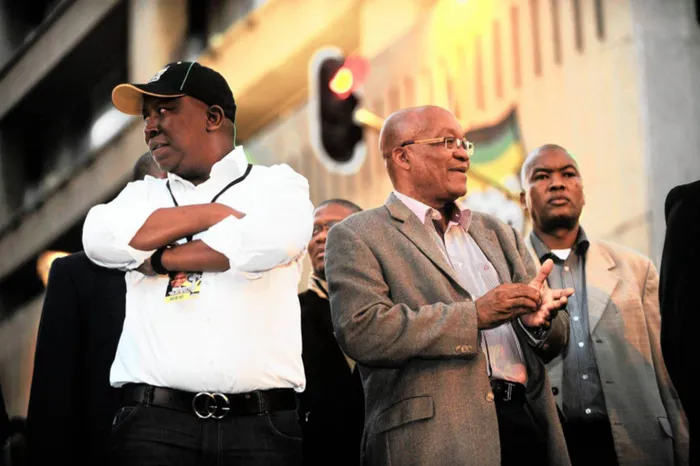
ANC Youth League leader Julius Malema, who lost his appeal against a disciplinary guilty verdict, stands next to President Jacob Zuma at a party function. Picture: Cara Viereckl ANC Youth League leader Julius Malema, who lost his appeal against a disciplinary guilty verdict, stands next to President Jacob Zuma at a party function. Picture: Cara Viereckl
Right now Julius Malema is being challenged by a common front within the ANC, but it is wrong to suggest that “the” party has moved against him. There is no longer a united ANC or single political movement, but instead several factions that make up the house that calls itself the ANC.
So, while President Jacob Zuma, ANC secretary-general Gwede Mantashe and many more like them are looking mighty, the common front that is moving against them is the one that offers the best reading of Malema’s fate.
His political annihilation has not rid the ANC of its own challenges, nor has it created the kind of leadership that has been lacking.
If anything, Malema’s presence these past few years cast a sharp light on the ANC’s own weaknesses and the inability on the part of the current leadership to rise above and preside over the fighting factions.
Malema is a part of the lobby for change, which is bigger than Malema and still very much on track.
It’s an underground initiative in which Malema merely played a visible role.
He took it upon himself to become the face of the anti-Zuma lobby and in so doing the Antichrist in the run-up to Mangaung, where the new leaders will be elected in December.
He single-handedly defied all party directives to keep a lid on the succession battle and found his own way to push for the incumbent’s demise.
His style was not always subtle, least of all towards the end. But toppling him from the podium will not erase the platform or the other cadres who discreetly occupy it.
If anything, by forcing Malema out of the party, Zuma has unwittingly (or perhaps not) forced his challenger to emerge.
If that challenger – recently described as he “with a grey goatee in a balaclava who prefers to be called Anonymous until he has support from a clear majority of ANC branches” – is not prepared to do so at this stage, then a Malema-type character will surely step forward before long to maintain the momentum for change.
That much was evident on Sunday when Lebogang Maile announced that the youth league would continue to push for “economic freedom in our lifetime”.
Maile, the league’s chairman in Gauteng and the man who tried to derail Malema last year when he was running for a second term, was not punting for nationalisation (he is, in fact, against it). Nor was he suddenly flaunting a pro-Malema placard or suggesting he is about to step into Malema’s shoes (he is against that, too).
Instead, he was showing that the nature of the race to Mangaung has now changed.
The young ones will push for policy while the grown-ups will tackle the leadership race, but their efforts will be harmonised. For now, Malema will have to find a new cap to wear as he takes up his place on the fringes of ANC politics and over the next few days he will prepare himself for the next round in the disciplinary saga when he will argue for a lesser sentence.
That’s wishful thinking at this stage and it raises the immediate question about his place on the executive of the mother body in Limpopo, where Zuma has amassed an army of enemies who are also adamant to bring him down.
While Premier Cassel Mathale and his men decide how to deal with the Malema matter, Malema’s mind will swiftly turn to the probe of his business and money affairs that the country’s criminal investigators are now wrapping up.
But he can count on big support from his fellow cadres as he prepares for that bigger challenge because whatever it is that Malema is allegedly guilty of, he did not act alone.
And it is inconceivable that he will take the hit for all those who were in that money mix with him.
The chief, if anyone, should know that.
In the meantime, he will play the role he knows best: Malema.
Let’s see if he graces the main chamber of Parliament when his political nemesis delivers his State of the Nation address on Thursday.
And let’s see if he will arouse the same applause he got in Mangaung on January 8.
Even if he doesn’t, there is still plenty of mileage left in him.
A character so vivid as his does not disappear overnight.
And this is only February. The contours will change a thousand times between now and December, when the party’s delegates descend on Mangaung for a second time this year.
When they do, it won’t be to celebrate, but to fight what is fast becoming an ugly battle.
Malema’s future is inextricably linked to the outcome of that conference when the rank and file – rather than the leadership – will speak in the name of the ANC, which now has twice the number of members it had when the last elective conference took place in 2007.
No one really knows what these new cadres are made of, or which way they are likely to cast their vote.
That much was evident in Durban in September 2010, when a sizeable number of delegates attending the national general council pushed so hard for nationalisation to become policy that the leadership was forced to commission a feasibility study on the matter to keep them at bay.
Only time will tell whether they will also call for the return of one of the party’s most notorious cadres.
And only then will Malema’s fate really be known.
If there was a betting culture in this country, someone could make a small fortune in the meantime.
l Forde is the author of An Inconvenient Youth: Julius Malema and the ‘New’ ANC.