

Businessman Siyabonga Moses Goodwill Nkosi.
Image: SIU/IOL Graphics
On the morning of October 9, 2025, investigators arrived at a Sandhurst mansion and an Mpumalanga car dealership. What they found, Lamborghinis, Aston Martins, a Ferrari, a Rolls-Royce, and a R70 million home, was the physical residue of R2 billion stolen from a public hospital serving some of Gauteng's most vulnerable patients.
Luxury cars, multi-million rand homes and exotic holidays, long viewed as markers of success, are increasingly linked to the misuse of public funds in South Africa.
It has become increasingly common to see these highly visible displays of wealth reflect a pattern in which public funds are channelled by trusted individuals into personal spending for private gain.
The Special Investigating Unit (SIU) says beneficiaries of ill-got public funds commonly splurge on high-end properties, luxury vehicles, and designer clothing.
"We've seen a pattern between the misuse of public funds and opulent lifestyles," said spokesperson Selby Makgotho.
In response to this pattern and the scale of the abuse, the SIU has offered to conduct lifestyle audits covering government officials and "state-linked actors."
A yearly transparency mechanism is already in place for parliamentarians, who must declare their financial interests in the Register of Members' Interests.
Makgotho says the SIU has frozen the multi-million rand assets of contractors and entrepreneurs doing business with the government.
Recently, they obtained a preservation order freezing the assets of Siyabonga Moses Goodwill Nkosi, valued at R76.5 million, which included seven luxury cars and 17 immovable properties.
The scale of the Tembisa Hospital case, however, dwarfs even that.
Last year, the SIU obtained a separate order to preserve assets worth R900 million linked to one of the syndicates alleged to have operated at Tembisa Hospital, a syndicate the unit says was led by tender tycoon Hangwani Morgan Maumela.

The Madlanga Commission testimony by Suliman Carrim, bottom of picture, has revealed the financial links between himself and Hangwani Morgan Maumela, top left, and Vusimuzi 'Cat' Matlala, top right.
Image: File and Oupa Mokoena / Independent Newspapers
On October 9, 2025, the SIU and a court-appointed curator, supported by the South African Police Service and the Johannesburg Metro Police, initiated the preservation of assets connected to the Maumela syndicate. On day one alone, assets valued at approximately R133.5 million were secured across two locations: a luxury property in Sandhurst, Sandton, and a dealership in Emalahleni, Mpumalanga.
The Sandhurst property was estimated at R70 million. Three Lamborghinis valued at approximately R25 million and household contents worth around R3 million were also seized. At the Emalahleni dealership, the curator attached two Aston Martins, a Ferrari, and a Rolls-Royce.
The SIU says Maumela used 41 companies to extract more than R816 million from the hospital over two years through fraudulent procurement contracts. He allegedly registered vehicles and assets in the names of proxies and family members to conceal true ownership — including, the SIU found, through a company owned by his sister, who reportedly had no knowledge of the purchases or payments made into her company's account.
The Tembisa looting was not confined to a single syndicate. The SIU's interim report identified at least nine coordinated syndicates that manipulated the hospital's procurement systems, collectively siphoning off more than R2 billion earmarked for healthcare services. The investigation has implicated 15 government officials and triggered more than 100 disciplinary referrals.
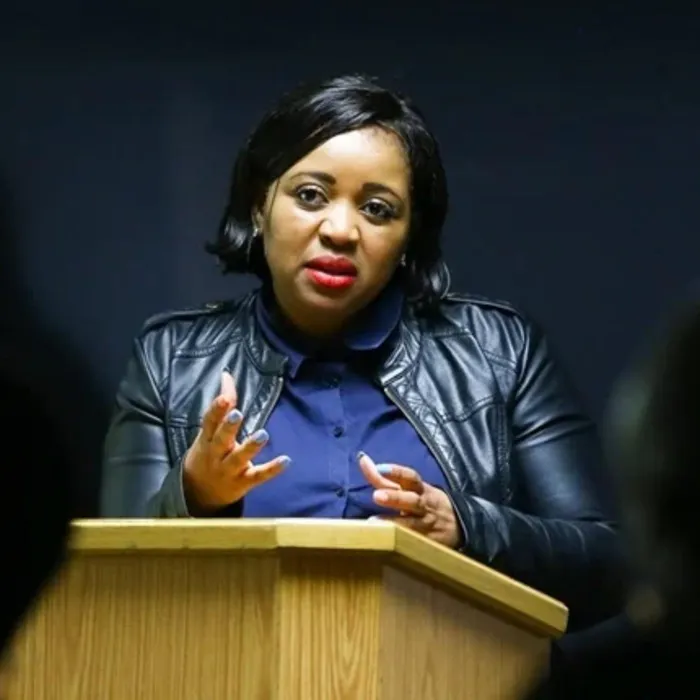
Former Gauteng Health CFO Lerato Madyo was allegedly paid a settlement amount to leave the department after she was implicated in the looting of more than R2 billion at Tembisa Hospital.
Image: Democratic Alliance / X
Among those criminally charged is Lerato Madyo, former chief financial officer of the Gauteng Department of Health. Prosecutors allege she permitted R104 million in questionable payments to proceed despite prior warnings and failed to report the corruption. She faces charges including fraud, theft, conspiracy, and violations of public finance and anti-corruption legislation.
A Tembisa Hospital employee, Zacharia Tshisele, was also arrested after investigators established that he received unlawful payments from service providers between January 2020 and September 2023. A further associate, Vusimuzi Matlala, had three companies linked to the Maumela syndicate that were awarded contracts worth R13.5 million.
Maumela has not responded publicly to the SIU's allegations.
Makgotho says the preservation order also covered jewellery, art, cash, electronic devices, cryptocurrency, and financial instruments, among the most comprehensive asset preservation actions in recent South African legal history.
The SIU stressed that corruption has a significant impact on service delivery.
"In many cases, programmes are either not executed or are incomplete. We have established a clear connection between poor service delivery and corruption, as demonstrated in our inquiries related to health, water, and local government services," said Makgotho.
He said diverting public funds for private luxury constitutes a grave violation of human rights, but following the paper trail is often complex because of diversion tactics. Creating offshore accounts in jurisdictions with strict privacy laws is common, as tracing financial transactions becomes difficult.
"They may also establish shell companies to further conceal their financial activities, hiding the true ownership of assets and protecting the identities of the actual owners. Additionally, people often create decoys to disguise their assets, such as setting up trusts, registering assets in the names of family members, or failing to register vehicles purchased from dealerships," said Makgotho.
Martin Ewi, a senior researcher at the Institute for Security Studies, said it is not illegal to display wealth, but many who do so are often associated with organised crime or corruption.
"Each time they receive illegal money, it's a victory for them. If your aim is to get rich, without caring where the money comes from, why would you be ashamed?" Ewi said.
Keletso Ramannya, forensic investigator at Corruption Watch, says one of the biggest challenges with corruption is that it is not easily quantifiable, but it mostly stems from the public procurement environment, spanning municipalities, schools, police, health, and other critical sectors, with marginalised communities bearing the heaviest cost.
Ramannya says visible luxury lifestyles raise concerns about transparency, fairness, and consequence management in the public services.
"It creates an environment where lack of accountability is normalised despite questionable lifestyles tied to unethical behaviour."
But he believes it is not too late for change.
"We also need to see meaningful accountability of high standards from elected leaders and a clear message that we do not tolerate corrupt acts that take resources from communities that need them."
Tebogo Mashilompane from the civil society organisation Forum for South Africa says the public display of unexplained wealth is a direct insult to law-abiding citizens and reinforces the dangerous perception that corruption is not only tolerated, but rewarded.
"This brazen visibility reflects a collapse of ethical leadership and institutional credibility. For millions facing economic hardship, it confirms that the system shields the powerful while neglecting the vulnerable. Trust in public institutions is not just declining — it is being actively destroyed."
He says it is no longer about administrative gaps but a deeply entrenched culture of impunity.
"Public resources are looted because those responsible operate with the understanding that consequences are either weak or non-existent. Oversight institutions have been hollowed out, and in many instances, those mandated to enforce accountability are captured, intimidated, or simply unwilling to act. What South Africans are witnessing is not accidental failure; it is systemic and deliberate."
Lifestyle audits gather momentum
The issue of lifestyle audits recently came under the spotlight when the Portfolio Committee on Public Service and Administration convened to assess whether provinces had made progress on the audits and on efforts to enhance accountability.
The committee met with the premiers of KwaZulu-Natal, Gauteng, the Northern Cape, the Western Cape, and North West.
In KZN, ethics officers and investigators were trained, and all 13 departments submitted declarations in full compliance. Gauteng extended its audits beyond the Premier and MECs to directors-general, heads of agencies, and CEOs of state-owned institutions, and further to officials involved in supply chain management, contracts, procurement, and tenders.
In the Western Cape, the premier, cabinet members, and their spouses will undergo lifestyle audits conducted by independent forensic providers, who will assess whether their lifestyles match their declared incomes and identify potential conflicts of interest.