
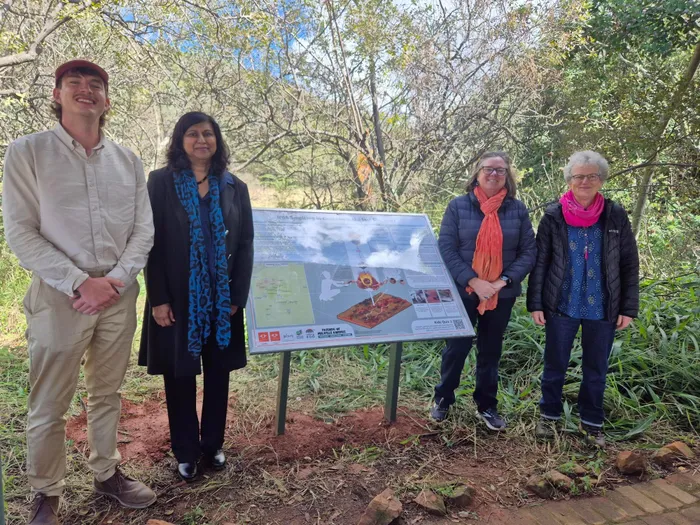
Dr Izak Potgieter, Prof Kammila Naidoo, Prof Natasha Erlank, and Jenny Grice stand next to the unveiled AR heritage experience.
Image: Supplied
In a bid to bring history to life through technology, the University of Johannesburg (UJ), in collaboration with the Melville Koppies Management Committee, has launched an innovative augmented reality (AR) project at the Melville Koppies Nature Reserve.
Unveiled on Workers’ Day, May 1, 2026, the project digitally resurrects a 500-year-old African smelting site, offering visitors a unique, interactive way to explore South Africa’s rich heritage.
The initiative shines a spotlight on the advanced metallurgical skills of pre-colonial African communities, particularly the ancestors of today’s Sesotho and Setswana speakers. Through the AR experience, UJ aims to showcase the ingenuity and craftsmanship at the heart of indigenous African cultures.
Led by Dr Izak Potgieter and Dr Herman Myburgh of UJ’s Metaverse Research Unit (MRU), the AR technology allows visitors to use their smartphones to view a 3D reconstruction of the ancient smelter overlaid on the existing remains of the site. The project is designed to transform the historical location into an immersive learning environment, complete with animation and narration that provide deeper insights into early African engineering, resource use, and environmental consciousness.
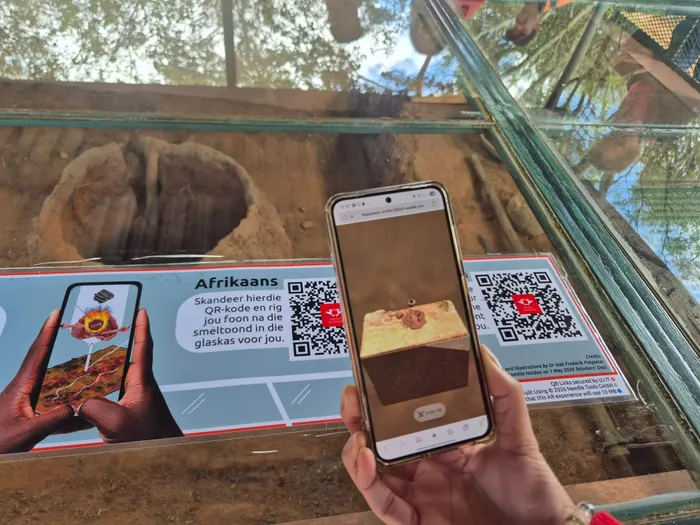
The AR project allows visitors to use their smartphones to see a historically grounded, 3D reconstruction of the ancient smelter digitally overlaid directly onto the existing remains using QR codes.
Image: Supplied
Professor Kammila Naidoo, Dean of UJ’s Faculty of Humanities, spoke at the launch about the significance of the project. “Melville Koppies has long stood as a place of deep historical and cultural significance. For many of the present generation, these histories can feel distant, and this project steps in as not just a technological achievement, but an intellectual and cultural bridge. Through augmented reality, we can reconstruct, reanimate, and re-experience a vital aspect of our shared history.”
The technology is designed to be accessible, even for users with basic smartphones, enabling them to scan a QR code and experience the site’s rich history through animation and storytelling.
Dr Potgieter, who spearheaded the project, emphasized the importance of connecting people with history. “The site offers a rare opportunity to represent pre-colonial African technological knowledge in-situ. By animating the past, we enable visitors to engage with history in a way that is immediate, accessible, and deeply meaningful,” he said.
The AR experience will be available not only at the Melville Koppies site but also in UJ libraries to encourage student engagement with this historically significant location.
Jenny Grice, from the Melville Koppies Management Committee, noted that the project would complement existing activities at the site, helping to attract visitors from all walks of life. “It’s a great addition to what’s already happening here and will undoubtedly draw even more visitors, both young and old.”
By combining archaeological and ethnographic evidence, UJ hopes to set a new standard for digital storytelling, preserving cultural memory while safeguarding protected conservation areas.
In a panel discussion at the launch, Dr Potgieter highlighted the value of community partnerships in heritage preservation. “Through this project, the University of Johannesburg and its partners aim to establish a precedent for immersive heritage interpretation in South Africa. Digital technologies can deepen public understanding, enhance heritage conservation, and foster meaningful engagement between communities, scholars, and visitors,” he said.
The Melville Koppies AR experience not only preserves and celebrates the legacy of the Batswana settlement but also sets the stage for future projects that integrate cultural heritage, research, and innovative digital storytelling.