
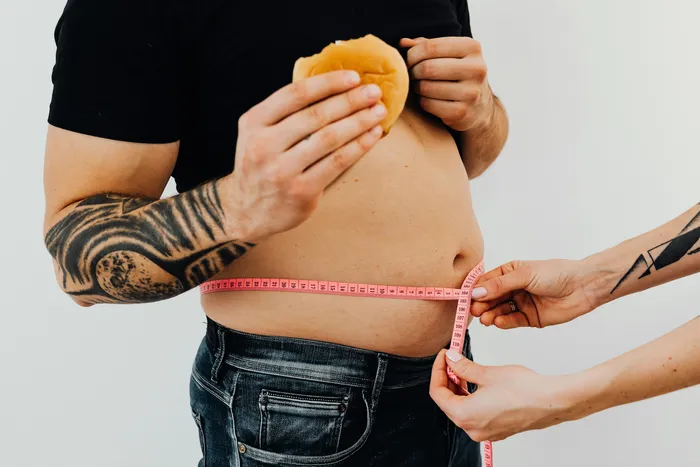
What experts say about body fat percentage
Image: Pexels
Body fat percentage — the percentage of your total body mass that is made up of fat — has long been a core tenet of the gym bro lexicon. Ultimately, and as we’ll explain in more detail below, your body fat percentage is the variable that determines whether or not you get to see the results of your abs workout in the mirror. If you have your sights set on a summer six-pack, it’s a crucial number to keep track of.
But a rippling midsection is far from the only reason why this metric matters. For one, "body fat is a pretty strong predictor of healthspan and lifespan” says Paul Kriegler, RD, CPT, registered dietitian, personal trainer, and director of nutritional product development at Life Time. “Your level of body fat carries over into how the body functions over time, how the body handles disease and other challenges, how resilient it is, and how it manages inflammation. It’s a key factor.”
That said, obsessing over a low body fat percentage can be just as unhealthy as ignoring it altogether, and experts warn against putting too much stock in this number. "A healthy way to frame body fat is just like abdominal waist circumference or lab results — yet another metric to measure your overall metabolic health and how your metabolism is running,” says Kevin Gendreau, MD, board-certified obesity medicine physician.
Whether you’re looking to burn belly fat in order to reveal a submerged six-pack or just get yourself into a healthy range, here’s everything you need to know about your body fat percentage, according to the experts.
There’s an old saying that abs are made in the kitchen. You could do core workouts all day and night to build the world’s sickest six-pack, and not see a trace of it in the mirror — that is, until you reduce your body fat enough to reveal it. “Body fat is basically what determines if your work gets shown or not,” says Kriegler.
“That's something that happens quite often, when a person’s focus is more in the gym and less in the kitchen, and they’ve either moved away from nutrition or they're looking at nutrition as just a way to fuel the gym,” says Dr. Gendreau. Piling on the calories might be helpful to build muscle and ensure you have enough energy to power through your workouts, but fine-tuning your abs requires a more measured approach — specifically, maintaining an overall caloric deficit while still making sure to consume enough protein to build muscle.
The general advice among trainers is that abs start to surface once body fat dips below around 15 percent. “It kind of depends on how you're carrying your weight,” Kriegler says. “If you want to look good with your shirt off, you're going to want to try to get your body fat down towards the lower end of that healthy range — probably 10 to 15 percent. But even then, some guys don't see their abs until they're at or even slightly under 10 percent.”
“For most guys, that cover-model abdominal definition typically kicks in between 10 to 15 percent, however there isn't a universal magic number,” says Dr. Gendreau. “Genetics, where your body likes to naturally store fat, and how much muscle mass you're actually packing underneath your adipose tissue — all of these factors play a major role. Some men look shredded at 14 percent body fat, others won't see a six-pack until they hit sub-10.”
At the end of the day, the visibility of your six-pack really doesn’t correlate to your overall state of wellbeing. As Dr. Gendreau says, "abs do not equal health.” However, body fat isn’t just aesthetic, and hanging onto too much of it can pose some serious health risks.
“Body fat isn’t just inert storage of energy,” says Kriegler. “It produces inflammatory signals. It produces hormones that can be disruptive. The more body fat you have, and the longer it sticks around, the more potential negative consequences there are, especially if it's fat stored in the abdomen and in and amongst the visceral organs, which tends to have the strongest association with negative health outcomes from an inflammatory, metabolic, and cardiovascular risk standpoint.”
And the more fat you allow to accumulate, the easier it becomes to pack on. “Excess visceral body fat — the deep fat that is tucked around your vital organs — is a massive driver for insulin resistance,” says Dr. Gendreau.
As for a healthy body fat percentage to aim for, “there are different figures if you look at different health authorities, but, generally, 10 to 20 percent is what's considered the healthiest range for men,” Kriegler says. “That is typically what's associated with the best health outcomes over time.”
“You can break it down by age as well,” says Dr. Gendreau. “A range for the age group of 20–39 would be something like 10 or 12 percent, up to 20 percent. For 40 to 59, we will often use 12 percent as the lower end, up to 22 percent. And then for 60-plus, 14 percent is the bottom and it goes up to about 24 percent. So, basically, the range is something like 18 to 24 percent.”
When it comes to wellness, things often tend to get classified as good or bad — like carbs, or cholesterol — when really there’s nothing inherently and absolutely positive or negative about them. “We've spent decades demonizing body fat, but fat is a vital endocrine organ,” says Dr. Gendreau. “It has a role in hormone production, including testosterone, as well as energy storage, temperature regulation, and more.”
While excessive body fat can undoubtedly pose a risk to your health, and even a healthy level of body fat can obscure your abs, experts advise against fit, healthy people becoming overly fixated on a low body fat percentage. “When people's body fat percentage drops too low for too long, things start to malfunction,” Dr. Gendreau says.
“Everything that is needed to be done to get there and stay that low puts a lot of extra stress on the body,” says Kriegler. "It can strain your neurotransmitter production, your mental health, your mood, your focus, your memory, your cognitive function, your hormone production. Those can start to shift in a negative direction. If you're surfing too fine of a line to stay lean, something is going to give.”
Especially in the age of GLP-1s and other weight-loss peptides, where extreme weight loss is potentially just a few jabs away, it’s especially important to be aware of these risks. “When you're using those tools too aggressively, there are trade-offs and risks, and I don't think we're fully aware of all the risks, particularly in healthy or lean people,” says Kriegler. “People start to lose bone too early in life. They lose muscle mass. If they're already very lean, they can start losing the very fat tissue that insulates their nervous system. It's a slippery slope.”
“I always tell my patients that chasing single-digit body fat is a full-time job often reserved for Olympic athletes,” says Dr. Gendreau. “It's not a sustainable or necessary goal for a healthy life.”
Via GQ India