
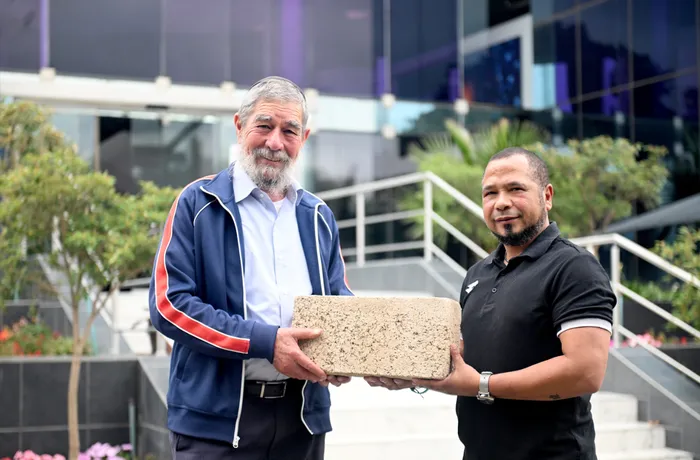
Professor Michael Rudolph and Brenton Abrahams showcase the hemp brick that could redefine South African housing.
Image: Supplied
South Africa’s housing crisis is no longer just about numbers. It is about dignity, climate resilience and the urgent need to build smarter, especially in rural communities where infrastructure backlogs, energy poverty and rising construction costs collide.
Researchers at the University of Johannesburg (UJ) are driving a breakthrough that could shift the national housing conversation. By transforming locally grown hemp into a high-performance construction material, UJ has partnered with Canna-B-Africa which has developed a hemp-based brick designed specifically for energy efficient, climate responsive and sustainable housing with measurable societal impact.
The hemp brick is the product of years of advanced research within UJ’s Civil Engineering Technology Department, where scholars and hemp industry experts are pioneering the transformation of hemp into hempcrete as a sustainable alternative to traditional cement.
This work forms part of a broader national drive, in partnership with the Department of Science, Technology and Innovation, to explore advanced materials and innovative building technologies, including UJ’s 3D printed housing systems aimed at accelerating housing delivery.
At the centre of this breakthrough is the Hemp Brick prototype, a lightweight, breathable and carbon-negative building material designed to redefine how South Africa builds.
Developed through a collaboration between Canna-B-Africa, the Centre for Ecological Intelligence (CEI) and its subdivision, the Hemp Research and Technical Station (HERTS) and the Sustainable Materials and Construction Technology Research Centre in UJ’s Faculty of Engineering and the Built Environment, the brick represents a science-driven, locally engineered response to the country’s housing crisis.
“Housing is a major problem in both urban and rural areas. The current informal dwellings are dangerous and unsustainable. Many families are still living in poorly insulated homes, exposed to extreme temperatures and unreliable electricity, while the cost of conventional building materials keeps rising,” says Professor Michael Rudolph, Director of the CEI.
“Rural communities carry the heaviest burden of the housing backlog, which is why we are not simply developing another brick. We are developing a solution that can accelerate housing delivery in a way that is affordable, energy-efficient and environmentally responsible. For rural South Africa, building smarter and more sustainably is not optional, it is essential.”
Hemp is a rapidly renewable crop that requires minimal pesticides and absorbs significant carbon dioxide during growth. When used in construction, that carbon is locked into the walls of homes, lowering the overall carbon footprint and supporting South Africa’s transition to greener infrastructure.
“Its benefits go well beyond sustainability,” says Brenton Abrahams, founder of Canna-B-Africa, UJ’s Senior Research Associate and Advisor to HERTS.
“The brick offers excellent thermal efficiency, with a porous structure that naturally regulates temperature and humidity, reducing the need for artificial heating and cooling. For rural households with limited or costly energy access, this passive climate control can lower monthly expenses and improve living conditions. It also delivers strong fire resistance and is naturally resistant to mould and pests, enhancing safety and durability without chemical treatments. Acoustic performance adds further value by minimising noise transfer and creating healthier indoor environments.”
The hemp brick is manufactured using the woody core of the hemp plant combined with a natural lime-based binder. Beyond its technical performance, the innovation carries broader societal impact. Expanded hemp cultivation could stimulate rural agricultural value chains, create new green economy jobs and support local enterprise development linked to sustainable construction.
The hemp brick can also be used for energy storage and bioremediation both innovative technologies which are currently being researched at UJ.
“UJ scholars have been actively exploring how hemp can be transformed into hempcrete as a sustainable alternative to traditional cement, forming part of broader research into innovative construction technologies, including 3D printed housing systems,” says Prof Jeffrey Mahachi, Director of Sustainable Materials and Construction Technology at UJ.
He emphasises the importance of rigorous validation. “The second-generation prototype is undergoing full testing, validation and certification. Our objective is to bring a credible, certified product to market that meets national building requirements while delivering on its sustainability promise.”
Brendan Wood, technical hemp expert at HERTS, emphasised the national significance of the innovation, which was highlighted at the 2026 Innovative Building Technologies Summit, where the UJ Hemp Brick prototype drew strong interest from policymakers, industry leaders and President Cyril Ramaphosa.
During his engagement with the UJ team, the President acknowledged the brick’s potential to advance sustainable infrastructure development while unlocking economic opportunities within emerging green industries.
Prof Mahachi concludes, “As South Africa confronts the interconnected challenges of housing delivery, climate resilience and rural development, the hemp brick represents more than a new building material. It is a locally-developed, science-driven solution aligned with national priorities and designed for real-world impact. If adopted at scale, it has the potential to accelerate housing delivery, stimulate rural economies, reduce carbon emissions and redefine sustainable housing in South Africa. The future of construction can quite literally be grown from the ground up.”