
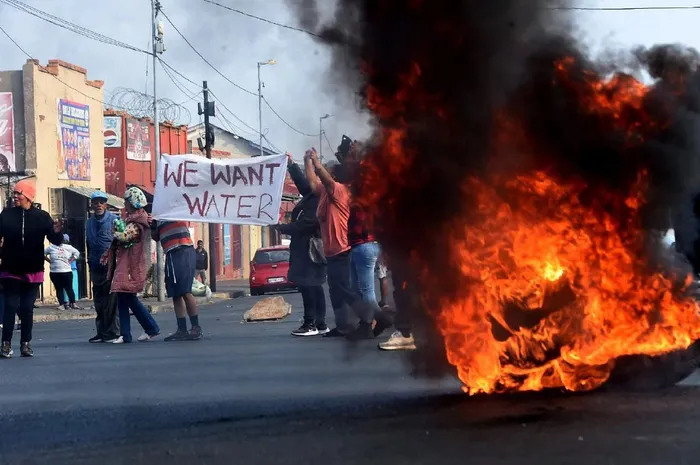
Protesters in Coronationville, Johannesburg, demanding a consistent water supply. Quality service delivery will be at the centre of Johannesburg’s highly contested mayoral battle in the upcoming local government elections.
Image: Itumeleng English / Independent Newspapers
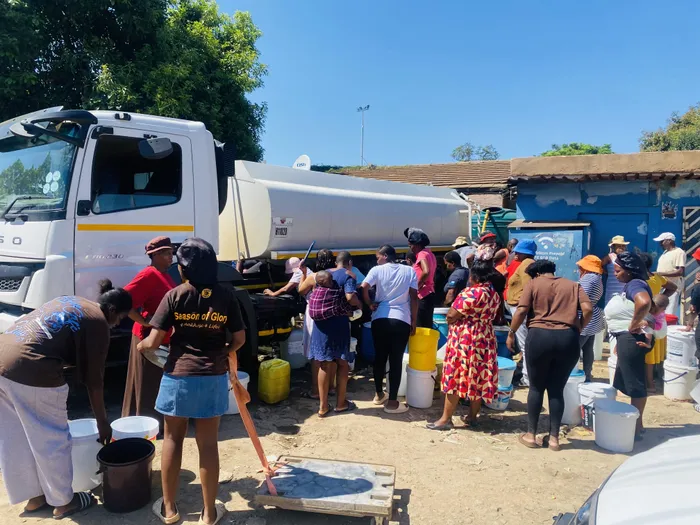
For many Gauteng residents, the water crisis is no longer just a headline, it’s a daily struggle. From dry taps and low pressure to disrupted schools, clinics and businesses, uncertainty about water has become part of everyday life.
Image: Simon Majadibodu/IOL
In a country confronting deep water and sanitation challenges, any international working visit must answer a simple question: does it make a real difference in the daily lives of South Africans?
For residents of Gauteng and other parts of the country who have experienced water interruptions, low pressure and ongoing uncertainty, that question is not abstract. It is deeply personal. It is about whether a household can function with dignity, whether a clinic can operate safely, whether a school can remain open, and whether businesses can plan with confidence. Water security is not simply a technical matter; it is the social and economic foundation upon which communities depend.
It was with this understanding that I led a delegation of highly skilled engineers and officials on a recent strategic working visit to Japan. At its core, this visit was aimed at strengthening bilateral cooperation between South Africa and Japan in the critical area of water and sanitation. It was about deepening institutional ties, aligning technical expertise and building a long-term partnership that advances mutual interests while directly supporting South Africa’s reform agenda. This was not ceremonial diplomacy; it was purposeful engagement designed to translate cooperation into practical outcomes.
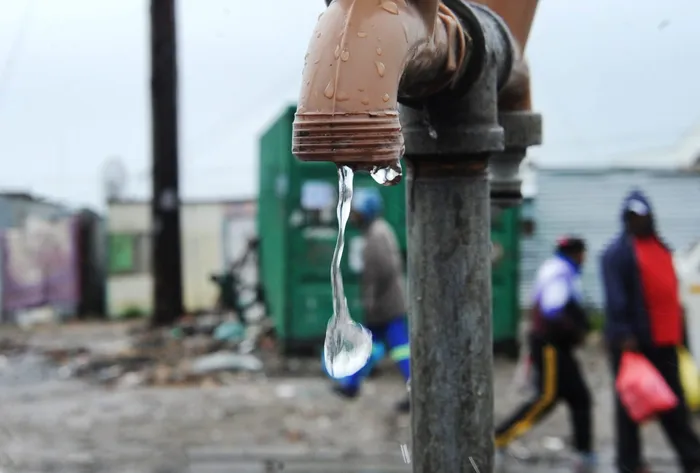
Government says fixing failing infrastructure and reducing massive water losses is now an urgent national priority.
Image: Cindy Waxa / Independent Newspapers Archives
South Africa and Japan share a long-standing relationship built on mutual respect and a shared commitment to sustainable development. Through structured engagements with Japanese institutions, technical agencies and sector leaders, we sought to consolidate a framework of cooperation that supports skills transfer, technology exchange, research collaboration and policy alignment. Strengthening bilateral cooperation in this sector is not symbolic; it is a strategic decision to leverage global expertise in support of national reform.
Let me also reassure South Africans that our country is not running out of water. At a bulk supply level, our dams, transfer schemes and long-term augmentation strategies remain strong and carefully managed. The water resource base is secure. The challenges we face lie primarily within distribution systems, ageing municipal infrastructure, governance weaknesses and financial sustainability at local level. Addressing these challenges requires structural reform, modernisation and partnerships that enhance capacity.
South Africa continues to lose billions of rands annually through Non-Revenue Water, water that is produced and treated but never paid for because of leaks, infrastructure failure, illegal connections and billing inefficiencies. In some municipalities, these losses undermine financial viability and service reliability. For communities, this translates into frustration and uncertainty. For government, it reinforces the urgency of systemic reform rather than short-term fixes.
Our engagements in Japan also reinforced the importance of a diversified water mix. In smaller towns and rural schemes, groundwater presents a significant and underutilised opportunity. Our experience in Nakai Town, where 100% of tap water is supplied from groundwater sources, demonstrated how well-managed groundwater systems can provide stable and resilient supply when integrated into a broader water mix policy. Groundwater, when properly regulated and monitored, can strengthen local water security, reduce pressure on surface water systems and build resilience against drought. It is a potential we must fully explore as part of a balanced national strategy.
Japan’s water and sanitation systems provide valuable lessons. Its utility model, often structured as a local public enterprise, has created long-term sustainability and a high level of assurance of supply while protecting the most vulnerable’s right to water and other socio-economic rights. These utilities combine financial discipline, professional management and strong public oversight. They demonstrate that efficiency and equity are not mutually exclusive; they can and must coexist. That balance is central to our own reform path.
A key focus of the engagement was structured knowledge exchange and institutional collaboration, including cooperation with the Japan International Cooperation Agency. The objective is to move beyond isolated projects and instead build sustained bilateral cooperation that strengthens South Africa’s institutional capacity over the long term.
There is growing urgency in building water-sensitive and climate-resilient communities across South Africa. Water-sensitive planning integrates stormwater management, groundwater protection, wastewater reuse and sustainable urban design into broader development strategies. Resilient communities are those that can withstand droughts, floods and infrastructure shocks without social or economic collapse. As climate variability intensifies, proactive planning becomes essential to protect livelihoods, infrastructure investments and vulnerable communities.
One example that left a lasting impression was the Tsurumi River Multipurpose Retarding Basin in Yokohama, an infrastructure solution designed to mitigate flood risk while preserving urban functionality. During extreme rainfall, excess water is diverted into an underground storage facility that protects downstream communities. Once conditions stabilise, the water is gradually released back into the system. Above ground, the space serves as a recreational area, demonstrating how infrastructure can protect lives while enhancing community value. It is a model of forward-looking planning that speaks directly to our own climate resilience priorities.
Equally critical is deepening partnerships with universities and research institutions. Lasting reform requires continuous innovation, rigorous research and the development of a highly skilled pipeline of engineers, scientists and water managers. Universities are central to advancing water science, governance research, technological adaptation and climate modelling. By strengthening cooperation between government, academia and international partners, we ensure that our policies are informed by evidence and that our future leaders are equipped to sustain a modernised sector.
We also intend to expand structured cooperation and embed a professionalisation framework within our training programmes. The Training of Trainers model will ensure that expertise gained through bilateral engagement is institutionalised across provinces and municipalities. Our long-term objective is to build self-sufficient, financially viable utilities capable of delivering reliable services without recurring crisis intervention.
This work is aligned with the National Water Crisis Committee chaired by Cyril Ramaphosa, ensuring coordinated oversight at the highest level of government. Political leadership, institutional reform and strengthened bilateral cooperation are being integrated into a unified national response.
Government is approaching this challenge with urgency and seriousness. We are strengthening regulatory oversight, accelerating infrastructure maintenance, investing in skills development and deepening strategic partnerships. We understand the frustrations experienced by communities when services falter, and we are committed to restoring stability and confidence.
Yet water security is a shared responsibility. I call on residents, businesses and community leaders to work with us by reporting leaks promptly, protecting infrastructure from vandalism and illegal connections, using water responsibly and paying for services where financially able to do so. When government and citizens uphold their responsibilities together, accountability becomes mutual and reform becomes sustainable.
The path ahead will require discipline, transparency and at times difficult decisions. But inaction would carry far greater social and economic costs. Modernising our water and sanitation systems is not optional; it is fundamental to growth, public health and national resilience.
This working visit to Japan was, above all, about strengthening bilateral cooperation in water and sanitation in a way that delivers tangible benefits for South Africa. It was about building relationships that endure beyond a single visit and translate into practical reform.
Our bulk water resources remain secure and our reform programme is advancing. By embracing a diversified water mix that includes groundwater, learning from sustainable local public enterprise models, strengthening universities and deepening bilateral cooperation with Japan, South Africa can secure its water future with confidence, resilience and shared determination.
Deputy Minister of Water and Sanitation, David Mahlobo