
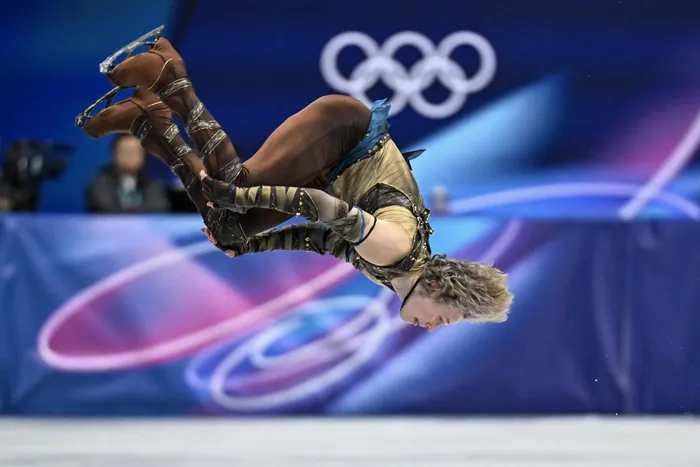
USA's Ilia Malinin performs a backflip in the men's singles short program during the Winter Olympics in Milan this week.
Image: Gabriel BOUYS / AFP)
Robert Samuels
After decades of debate, discussion and disinformation, these Olympic Games are featuring cartwheels, handstands and - yes - the backflip in figure skating, reversing one of the sport’s most controversial rules.
“It is the slam dunk of figure skating,” said Troy Goldstein, an American technical specialist for the International Skating Union. “A slam dunk is not more valuable than a layup, but crowds love it.”
The change - to a rule known in skating parlance as Rule 610 - was the ISU’s attempt to inject energy into a sport it fears is becoming staid.
The organization approved the change with a caveat: Unlike jumps and spins, judges will consider the backflip a flourish - with no assigned point value when it is executed. But the excitement the backflip brings could factor into a skater’s grade of execution or component score, which evaluates how an athlete presents and packages what they do on the ice.
The last time a skater backflipped during an Olympic competition was in 1998, when French skater and five-time European champion Surya Bonaly illegally performed the move - landing on one foot, no less - during the women’s final. The act was deemed a rebellious end to a controversial career, and the lore of Bonaly’s acrobatics thrives online today.
Bonaly was a pioneer, but the history of the backflip is deeper. The head-over-heels journey spans almost a century, pushing the boundaries of propriety, race, economics and the interconnectedness of an insular sport.
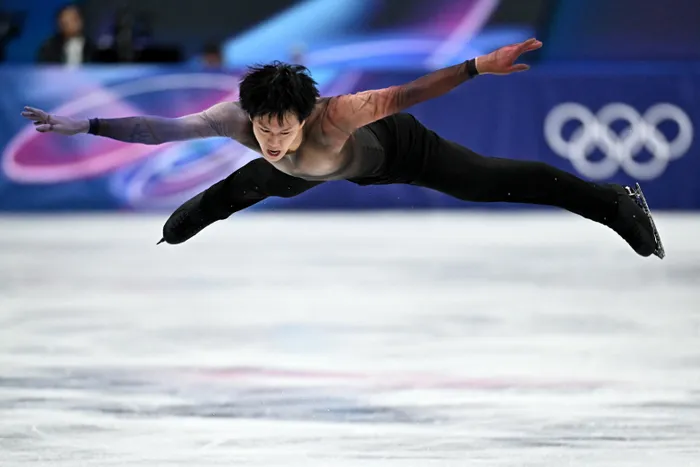
France's Adam Siao Him Fa competes in men's singles short program in Milan this week. It was Fa's inclusion of the backflip in last year's world championships that saw to the unbanning of the manouvre in skating.
Image: GABRIEL BOUYS / AFP
The godfather of the move is Skippy Baxter, a skater from the 1940s. Back then, athletes were primarily scored on their ability to cleanly retrace shapes and figures on the ice. A backflip was not a particularly helpful skill, so there was no incentive to attempt it.
But there was also a vivacious world of touring performances for retired skaters. Baxter was a main attraction in the Ice Follies. The crowd would roar when he did a backflip, and it became a mainstay for skaters looking to draw the adoration of audiences, not judges.
Those who knew Baxter, who died in 2012, often recalled that he described attempting the move simply: Skate backward really fast, dig into the ice, and the momentum will cause you to flip over.
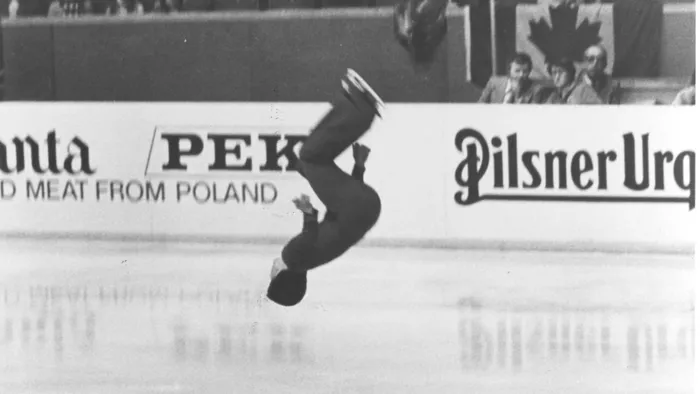
Skater Terry Kubicka performs the backflip in the 1976 Olympics in which he won a bronze medal, the only legal backflip in the Games until the move was allowed again this year. It was banned shortly afterwards on the grounds that it made the sport a circus.
Image: File
In the 1970s, Terry Kubicka learned that backflipping was not so simple. But he had a larger purpose when he revived the technique. At the time, judges gave preference to men who offered something different from Kubicka’s portfolio of triple jumps. John Curry of Great Britain enchanted them with his balletic posture and turned-out toes; Canadian Toller Cranston performed with the avant-garde flair of a modern dancer.
Kubicka’s coach, Evy Scotvold, had an idea to upend the aesthetic: How about you learn the backflip?
So Scotvold wrapped a beach towel around Kubicka’s waist and began training him to go head-over-heels on ice. By the 1976 Olympics, tension filled the rink as the crowd and the judges wondered if he was going to perform the move.
Kubicka proceeded through his programme methodically and then, with seconds left, dug into the ice and flipped around. The crowd erupted.
The judges did not know how to score the maneuver. Kubicka finished seventh. According to Kubicka, bronze medalist Cranston complained that “Terry Kubicka is trying to make the sport into a circus.”
The ISU intervened. Sonia Bianchetti, an Italian representative on the ISU’s technical committee, led the call to ban the backflip. She succeeded.
“I was disappointed because I wasn’t in 100 percent agreement with where the sport was going,” Kubicka recalled in a recent interview. “I thought skating was a sport, where other people saw skating as an art.”
But officials also noted more serious reasons to question the backflip’s legality. Unlike other jumps, the backflip was not being landed on one foot. Some felt the risks were too dangerous.
Kubicka said he was never injured performing the backflip, but months after he learned the move, the dangers became clear: His coach revealed to him that he had cracked his own cranium attempting one - and had a metal plate in his head.
Because figure skating is a judged sport, athletes tend to accept judges’ whims. The backflip returned to its showbiz origins.
And then came Scott Hamilton. After winning the 1984 Olympics, Hamilton wanted to give his performances extra pizzazz in a popular skating tour, the Ice Capades. As an amateur, Hamilton was proficient in using the blades to execute speedy steps across the ice and high, straight jumps.
Learning the backflip required him to retrain his instinct to turn when taking off, as in a typical skating jump. Doing so could lead to serious injury.
He debuted his backflip in 1985. He recalled being so nervous that he would hurt himself that he gave specific instructions to the crew member responsible for lighting.
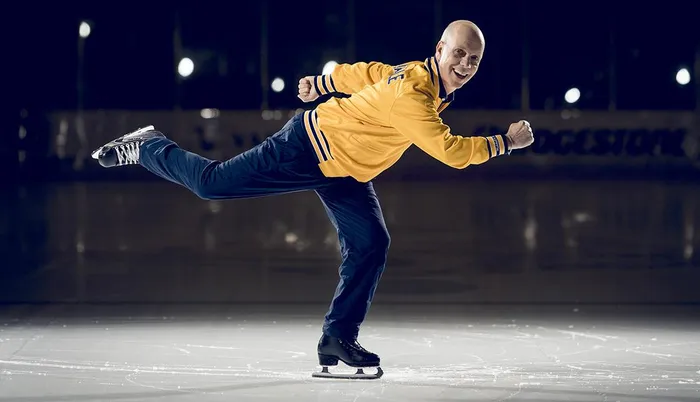
Scott Hamilton today. The former Olympian made the backflip his hallmark in exhibition events in the 80s. He once instructed the lighting team "If I fall on my head cut to black. I don't want to frigten the kids with blood on the ice."
Image: File
“I’m going to backflip tonight,” Hamilton recalled telling him. “If it doesn’t go over, and I land on my head, go to black. I don’t want little kids to live with the memory of me shattering my skull on the ice.”
Hamilton still remembers the audience going wild when he did the backflip. “I remember thinking, I am never leaving the house again without this thing.”
As ice shows and made-for-TV competitions became ubiquitous in the ’90s, it was Hamilton who became “Mr. Backflip.”
Hamilton said he tried to push the envelope. At a conference with then-ISU head Ottavio Cinquanta in the mid-’90s, Hamilton recalled raising his hand and asking, “Why is the backflip still illegal?”
According to Hamilton, Cinquanta made a face.
“Next question,” he huffed.
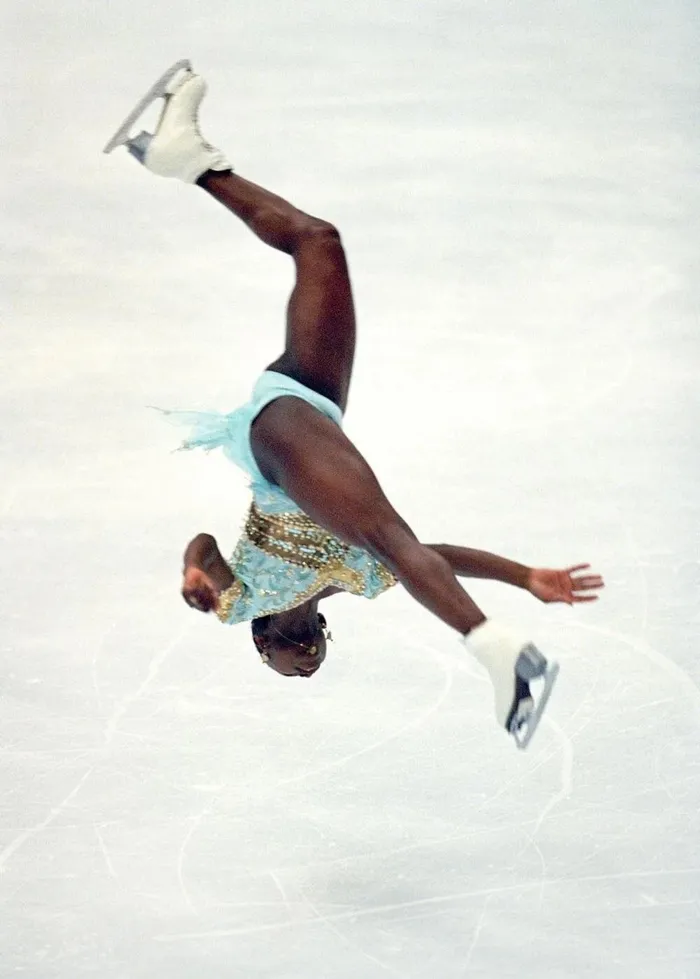
French skate sensation Surya Bonaly performs an illegal backflip in protest at the 1996 Olympics. She is the first woman skater credited with completing the move.
Image: File
The legal backflip might have helped Bonaly, the French skater impressing audiences with her triple-triple combinations. She had grown up admiring German skater Norbert Schramm, a former Olympian who backflipped on tours throughout Europe.
Bonaly had been a champion tumbler in France, so her parents and coach thought she could easily learn the skill.
Learning was scary, Bonaly recalled. A few days before she tried it, Schramm had fallen on a backflip and fractured his jaw.

Surya Bonaly today teaches skating in Minnesota in the US.
Image: File
But her mother and coach held each of her hands and helped her practice on the ice. The Guinness Book of World Records documented Bonaly as the youngest person to perform a backflip on figure skates. She was 12 - and, as far as most can tell, the first female skater to do so.
“I was always looking to do something different, so it was perfect for me,” Bonaly said. “It was a backflip, but also original because you never saw someone do it besides a guy.”
Bonaly said she was fine doing backflips only in shows because “maybe I would make more money and it would be more entertaining.”
In competition, judges criticized Bonaly for not having complicated movements between her solid jumps and flexible spins. They consistently lowered her artistic mark, the second of two scores evaluating a skater’s performance.
Her low artistic marks raised debates over whether Bonaly’s skating was truly flawed, or whether the style and look of a muscular Black woman were too unconventional for a predominantly White sport.
She finished second at three consecutive world championships between 1993 and 1995 to a different skater each time. When officials handed her the silver medal at the 1994 world championships, she pulled it off her neck and stepped off the podium in protest.
She told The Post that she was struggling with a pulled groin during the 1998 Olympics, where she found herself out of medal contention after the short programme.
“I was really handicapped, and it’s too late to ask another skater from France to come and replace me,” said Bonaly, who now coaches skating outside Minneapolis. “I didn’t want to just step on the ice and say, ‘I have to withdraw, thank you very much, bye-bye.’ No. So I asked myself: What could I do?”
She backflipped. But she didn’t simply backflip; she split her legs as she did, creating a shadow like the propeller of a fan. Then she landed on one foot. The crowd erupted, and when she finished her routine, she faced the audience and turned her back on the judges.
“I wanted it to one day be legal,” Bonaly said. “Or to at least have them write everywhere that ‘Surya did it,’ because I was a pioneer.”
The deductions were brutal. Her placement dropped from sixth to 10th.
Bonaly insisted her decision was not political. But those around the world, and in her country, saw something more. Her backflip consistently loops in nostalgic posts on social media. It’s a GIF that can be called up on your cellphone.
“If you ask any French person to name a figure skater, the first person they will name is Surya Bonaly,” said Djamel Cheikh, the technical director of the French Ice Sports Federation. “She is seen as someone who stands for justice.”
The backflip issue had been settled for 25 years. But in 2023, Adam Siao Him Fa performed the maneuver even though it was against the rules. Like Bonaly, Fa is a French skater from a minority background - his parents are Mauritians of Chinese and Vietnamese descent.
Fa considered his renegade maneuver a form of “positive rebellion,” something defiantly French. The sport’s scoring system had changed significantly since the days of Bonaly and Kubicka, and performing an illegal move was considerably less costly.
He performed the illegal backflip at the 2024 European championships, which he won, and then again at the world championships, where he placed third.
His defiance at the 2024 worlds actually delighted the technical specialist who had to administer the deduction: Kubicka, the first and last skater to have legally performed the backflip.
“I wanted to help the improvement of my sport, so I think it was important to be the one to help make the backflip legal again,” Fa told The Post. “I think every skater should be allowed to do any trick they want as long as they know how to do it.”
Fabio Bianchetti, then the head of the ISU’s technical committee, supported the change to Rule 610. It was overwhelmingly approved. In 2024, backflips became legal.
In doing so, Fabio Bianchetti canceled the actions of Sonia Bianchetti, his mother.
“When [Fa] started to do it again and we saw the audience’s reaction, we thought it was nonsense to penalize a skater for a highlight in his programme from the audience point of view,” Fabio Bianchetti wrote. His mother understood.
The ruling is why fans will see handstands, headstands, cartwheels and backflips during this year’s Games. These tricks will be most seen in the men’s event, in which many skaters plan cartwheels and other acrobatic elements when performing fancy footwork or exiting a spin.
Bonaly is not sure how she feels about it.
“The backflip is fine because it was original,” Bonaly said. “But if 500 skaters are now going to be doing the backflip, what’s the point?”
The fascination with the backflip has already become apparent to Ilia Malinin, the gold medal favorite in the men’s competition. During Sunday’s team final, in which he secured the gold medal for the United States, he heard the roar of the crowd after performing his backflip. When he looked into the crowd, he saw a man with his mouth agape, holding his hands over his head with disbelief. It was Novak Djokovic, the tennis great.
“It was wild,” Malinin said.
He began incorporating the move as soon as it was legal.
“I did gymnastics when I was younger, so I learned to get over the fear of going upside down,” Malinin said. “On the ice it’s a completely different story.”
As the sport’s most accomplished technician, Malinin said he has found all sorts of ways to make the backflip harder once he mastered it. Right before the Olympics, he finally accomplished a skill he had been working on all year: He started landing his backflips on one leg, much like Bonaly.