
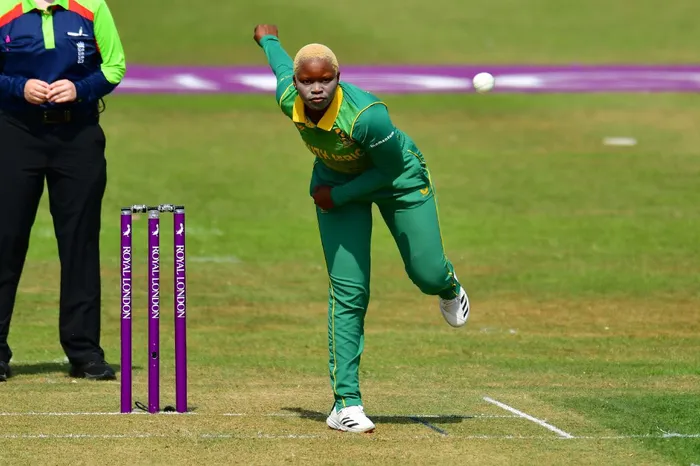
Proteas spinner Nonkululeko Mlaba.
Image: BackpagePix
It is not often that Proteas Women’s spinner Nonkululeko Mlaba goes through an entire series having picked up just one wicket.
But that was the current SA Women’s Cricketer of the Year’s negligible return during the recent three-match New Zealand series.
The White Ferns had solid gameplans against Mlaba, with particularly Kiwi captain Amelia Kerr taking the challenge to the left-armer, as the home side prospered during the middle overs.
It certainly was an eye-opener for the 25-year-old, who has been the Proteas’ Women’s team premier wicket-taking threat the past three seasons.
The conditions certainly played its part with the surfaces, especially at Wellington’s Basin Reserve for the second and third matches, being heavily grassed and not in favour of the spin bowlers.
Head coach Mandla Mashimbyi believes not too much should be read into Mlaba’s numbers in New Zealand, and is confident his No 1 spin bowler will be back amongst the wickets in the upcoming T20I series against India, starting on Friday at Kingsmead.
“I think it's easy to look at her numbers and think that, you know, she actually had a bad tournament,” Mashimbyi said.
“I think there was a game that she bowled her 10 overs for, I think, 37 runs within the 50-overs stuff.
“But I think they're not taking as many risks against her. And like you said, you know, so they actually kind of just want to see her out. And obviously that makes her not to take wickets.”
In truth, the entire Proteas bowling unit struggled in New Zealand, with the tourists conceding in excess of 300 in both matches in Wellington. It was only veteran seamer Ayabonga Khaka who returned with her reputation enhanced after picking up nine wickets, including a career-best six-for, in the first two matches.
Mashimbyi feels that it's the responsibility of the entire bowling unit to improve, and in so doing will help Mlaba get back to her best.
“I think when you're a bowling unit, if pressure is coming from all sides, it makes our spinners very dangerous. And unfortunately, it wasn't the case because you've got to look at the game holistically and try and understand why our spinners were not as effective as they should have been,” he said.
“I think one of the main things was the fact that we didn't create enough pressure from both sides and we were not hunting in packs as a bowling unit.
“That's why it made it easy for New Zealand to actually play our spinners. And if that pressure was coming from our seamers and then our spinners coming to the full, I think the numbers would have been different.”