
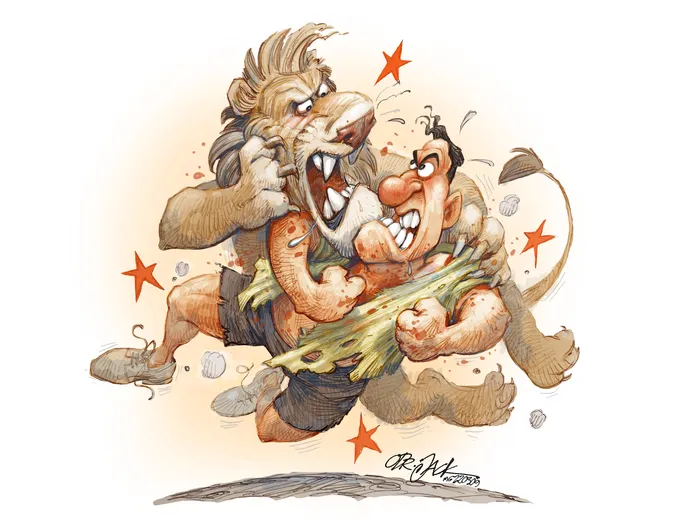
The Springbok prop who killed a lion with his bare hands
Image: Dr Jack
The talk of Wilco Louw being arguably the strongest prop to play for the Springboks got me thinking about the forgotten Bok who choked a lion to death.
Indeed, Andy MacDonald is an African bushveld legend. A tough farmer, he could manhandle livestock, shift tractors and on weekends he hunted monster crocodiles for fun.
MacDonald, the Springbok tighthead prop in 1965, was freakishly strong, even in an amateur era where there were no gym programmes or nutritional supplements. He would be a heavyweight even by modern standards — his physical dimensions were similar to those of Os du Randt.
So how come he is not a household name? He would have played substantially more than his five Tests had he not been Rhodesian and had he played Currie Cup rugby south of Beit Bridge (Rhodesia was part of the Currie Cup until it became Zimbabwe in 1980 and their players qualified for the Springboks).
In those days, if Natal was the Last Outpost of the British Empire as far as the Bok selectors were concerned, then Rhodesia was their last resort.
In fact, if it had not been for All Black captain Wilson Whineray, MacDonald might not have been capped by the Boks at all.
Loosehead prop Whineray led New Zealand on their 1960 tour of Southern Africa. He commented that while his Springbok adversary Piet “Spiere” du Toit (the grandfather of Pieter-Steph du Toit) was powerful, there was a beast of a player in Rhodesia.
Whineray said MacDonald was the strongest prop in world rugby and that he could not understand why he had not played for the Springboks.
Ian McIntosh, the former Springbok, Sharks and Rhodesia coach, was a close friend of MacDonald, and has told the story of the famous leonine encounter.
Andy had been losing livestock to a lion and he decided to hunt and destroy it. He and a helper tracked down the lion and Andy shot and wounded it. They were following the bloody spoor when suddenly the lion ambushed them from behind a thorn tree. The helper fled for his life (and then to get help) while Andy fought for his, the lion having singled him out.
The lion bit off part of his ear and severely lacerated his legs and abdomen with its claws, but when it went for Andy’s head for the coup de grace, the farmer shoved his arm down its throat, losing a few fingers in the process.
The story is that Andy had years before read in a book about the bush that the most effective way to disarm a wild animal is to shove an arm down its throat. In his moment of need, those words rushed back to him.
The lion backed off as it choked on its tongue while Andy “played dead”. The lion retreated, but regathered its strength and returned. Again Andy fought it off.
This cat-and-mouse game continued until the lion eventually staggered away, lay down and died.
Andy’s assistant had meanwhile alerted the farmhouse and Andy’s brother went out in his Land Rover searching for him.
When they saw him staggering down the road, they at first thought he was a local tramp because, from head to toe, he was a mess of congealed blood and dust. They drove past him and continued to search for some time before backtracking and discovering the tramp was MacDonald.
MacDonald was taken to Livingstone Hospital where he had two fingers amputated and 400 stitches to his wounds in a six-hour operation. Before he went under the anaesthetic, Andy had one wish: “Make sure I get the lion skin.”
The attack had occurred 10 days before Christmas in 1966. He made a full recovery and was released on Christmas morning.
Another account by a farmer friend of his illustrates MacDonald’s uncanny strength and innovative methods of enhancing it in those pre-gym days.
“Andy devised a regimen of dragging a 2½ ton Massey-Ferguson tractor 100m with its plough embedded in the ground. He would then release the plough and apply the brakes before dragging it another 50m. I watched him do this several times.”
MacDonald indeed had the physical strength to match his immense courage, a formidable combination for a rugby forward.
MacDonald’s thighs were so muscular that regulation rugby shorts did not fit him. He contracted an Indian tailor in Lusaka (the capital of Northern Rhodesia) to custom-make his shorts.
By the time the Springboks were due to tour Australia and New Zealand in 1965, the selectors had heeded Whineray’s advice.
But there was a major problem. Northern Rhodesia had become independent (it was now Zambia) and the new president, Kenneth Kaunda, warned Andy that if he toured with the Boks, he would confiscate his farm.
Apparently, an old dear in the Eastern Cape offered to deed her farm to him as compensation and reward for playing for the Boks.
In any event, he did tour, playing in all five Tests and in a losing cause — the Boks lost twice to the Wallabies and lost two out of three to the All Blacks.
As Whineray had predicted, MacDonald made a big impact in the tight exchanges. Another All Black legend, Colin Meads, experienced his strength first hand.
Meads said in his autobiography: “The Springbok Andy MacDonald was probably the most imposing physical specimen we have lined up against, a very good player and one of the greatest of gentlemen.”
And in a telling tribute, Meads added: “Andy was badly mauled by a lion when he went home after the 1965 tour. It would be a toss-up as to whose side I’d rather have been on.”
Kaunda did not carry out his threat to confiscate Andy’s farm, but it is where he and his wife met a tragic end. In 1987, when he was 58, they were accosted on their farm by dissident thugs who mercilessly gunned them down in a hail of AK 47 bullets.
Just like that.
This column is based on an extract from Mike Greenaway’s best-selling book, The Fireside Springbok.