
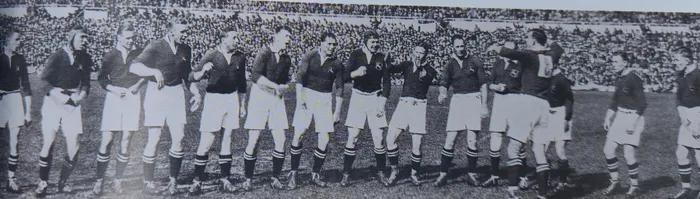
Boks attempted the Haka in 1928 at Kingsmead in Durban, before the first-ever Test match between the Springboks and the All Blacks on South African soil.
Image: Supplied
The rugby world is about four months away from the ‘Rugby’s Greatest Rivalry’ tour. The hype is going to be off the scale, and the Boks need to keep their nerve.
Rassie Erasmus needs to “keep the main thing the main thing,” as he often says, and that includes not trying to find an off-field advantage that probably is not there. The temptation has been there before for some of Rassie’s predecessors…
In 2007, Jake White believed he had a cracking idea to give the Boks an edge at the World Cup that year; but perhaps thankfully, his South African version of the haka literally never got off the ground. Jake had put it to the team that a blood-revving dance, along the lines of the New Zealand war cry, could be an added psychological tool.
But it probably would have left the Boks looking red-faced and the crowd in stitches, as it did when the Boks did the very same thing in 1928 at Kingsmead in Durban, before the first-ever Test match between the Springboks and the All Blacks on South African soil.
Bennie Osler, the Springbok fly-half that day, tells the story of the unconvincing war cry:
“I was so nervous that in the dressing room I felt the pangs of the damned. Finally, Phil Mostert led us out to the waiting All Blacks. We stood in single file as the All Blacks danced their haka, and then we replied with our own war cry — a mixture of bad Zulu and gibberish.”
If you look at the photograph of the confused faces of the players, you can understand why the crowd was more amused than inspired! Consequently, the Boks’ Zulu dance was dropped. Maybe that clumsy effort confused the All Blacks, too; they lost 17–0 and the hero, Osler, scored 14 points.
The resounding win was all the more impressive because the Boks played with 14 men after centre Bernie Duffy was concussed early on. In that era of no substitutes, many a stricken player tried to continue, but Duffy was wandering around senseless and his teammates mercifully steered him off.
Osler, who would become a Springbok great, was also one of the most nervous. He often vomited before games, but his worst case of nerves was before his Test debut against Great Britain in 1924, when he lost the power of speech on the morning of the game and could only communicate by croaking.
Interestingly, Osler did grant this about the Zulu dance at Kingsmead: “It allowed me to blow off steam, and my nerves settled.” Osler’s butterflies would have stirred early that day because of the Test-match fever that had gripped Durban.
The rivalry between the teams was already fierce because the first-ever series between the countries — the Boks' 1921 tour of New Zealand — had finished all-square. Durbanites queued from 6:30 am to get into Kingsmead, and the capacity of 10,000 was soon reached. It was the biggest crowd that had ever gathered for a sporting event in Durban.
But back to Jake and his idea of reviving Osler's old remedy for nerves. He said: “New Zealand have their haka and I would like to use our version as a challenge to them. We have done it in our team room, but it hasn't taken off yet...”
Well, history shows that Jake’s war dance was not required by the magnificent Boks at that World Cup, nor did it make it out of the team room — and thank heavens for that!