
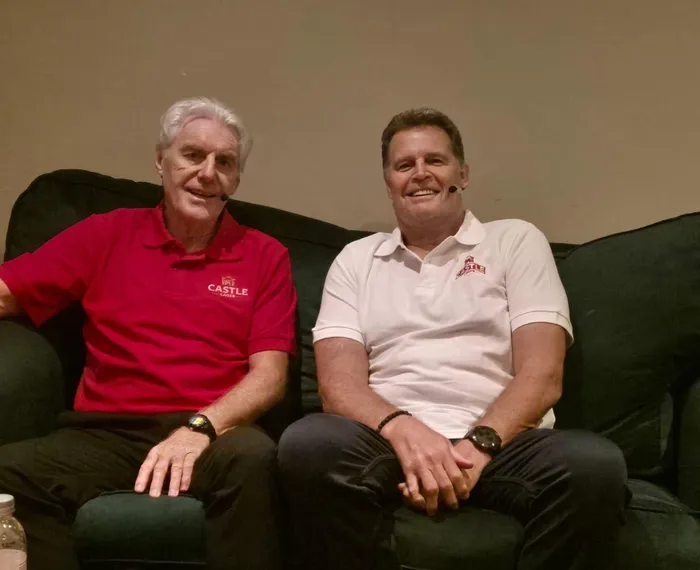
Broos to pick Rassie's brain Springboks head coach Rassie Erasmus with his Bafana Bafana counterpart Hugo Broos,are probably the two longest serving South African national men's team coaches ever.
Image: Rassie Erasmus on X
A book on the rise and fall of Springbok coaches, The Poisoned Chalice, reveals the psychological pressure that Springbok coaches endure in one of the toughest jobs in sport.
The author, Gavin Rich, lightheartedly suggested that when the coaches sip from the chalice, they incur not mad cow’s disease but mad coaches’ disease (MCD).
MCD has been around since the first post-isolation coaches — think the thousand-yard stare of Ian McIntosh — right up to the madcap antics of Rassie Erasmus on social media.
It was Rassie’s colourful series of homemade videos — some featuring his bulldog, some of him dancing —that reminded me of how bizarrely Bok coaches have behaved over the last three decades.
An important part to remember is that the coaches believe what they are doing is in the best interests of the Springboks. They should not be judged harshly, and it is with tongue in cheek that we define MCD.
Mad Coaches Disease (noun): At some point, as Springbok coach, the incumbent will display one or all of the following symptoms: a. foot-in-mouth syndrome; b. selection doubts; c. incomprehensible strategies; d. contradictory behavior, resulting in: 1. dismissal; 2. resignation; 3. temporary insanity.
It was Jake White who confessed he thought he was losing his marbles when he met a host of post-isolation coaches for a think tank on the Boks in 2006.
Jake’s Boks had lost five matches in a row, and SA Rugby was under pressure to either fire him a year before the World Cup or provide constructive assistance. President Regan Hoskins wisely chose the latter and invited an array of former Bok coaches to a meeting with Jake.
Nick Mallett told Hoskins that Jake was simply going through a bad patch that is inevitable for all Bok coaches and that he should be left to get on with his job. Hoskins listened, and a year later the Boks were world champions.
But Jake made a telling comment: “Listening to these guys who had been there made me feel better. They had also felt the blow torch, and I was reassured that I wasn’t going mad.”
However, winning the Webb Ellis Cup did not keep Jake in the job. His contract was not renewed, and it was not the first time that a Bok coach’s success on the pitch could not save him from his enemies in the boardroom.
Mallett had coached the Springboks to a record-equaling 17 consecutive wins in 1997/1998 and to a bronze medal in the 1999 World Cup, only to be persona non grata in 2000 just days after beating the All Blacks in a 46-40 thriller.
The next week, the Boks moved to Durban to play the Wallabies. On the eve of the match, Mallett was walking through a hotel when a woman asked him what he thought of the (exorbitant) cost of tickets.
Mallett was unaware that the lady was a reporter and said they were too high. The next day, The Independent on Saturday led its front page with the headline “Mallett slams ticket prices”, and the Blazers at Saru could not believe their luck.
They had their excuse to sack a coach they regarded as too outspoken.
Mallett had initially wanted to fight Saru in court but chose to walk away. An interesting postscript is that All Blacks coach Laurie Mains had this to say when Mallett left the Saru building: “Have they (Saru) gone mad?”
Insurance tycoon Harry Viljoen replaced Mallett and hoped that the introduction of modern business principles would take the Boks to a new level. But Harry could not handle criticism even when it was warranted.
For example, in his very first match, against Argentina, he forbade flyhalf Percy Montgomery to kick — in the first half, Percy did not kick once. But as losses and the pressure on Viljoen mounted, the Boks ended up with a flyhalf who did nothing but kick (Louis Koen).
Harry quit, and in came Rudolf Straeuli. In the build-up to the 2003 World Cup, the Boks took some fearful hammerings, and the distraught coach’s last “ace” up his sleeve was Kamp Staaldraad.
This was hardcore army commando training in the bush. It included the players being forced to fight each other in boxing matches and having to tread water in a freezing dam while singing the national anthem.
I was at the 2003 World Cup final between England and Australia in Sydney. On the day of the match, the newspapers were brought into the media room at the stadium. On the front page of one paper was a photo of naked Boks trudging forlornly through the bushveld…
Peter de Villiers succeeded Jake, and his relationship with his employers was difficult from the outset when Hoskins suggested that De Villiers had been appointed for reasons other than rugby.
If Hoskins doubted he had the right man, imagine how he cringed when De Villiers lit up the drab world of press conferences with a litany of outlandish comments.
Heyneke Meyer coached the Boks in 48 Tests from 2012 to 2015. Television cameras loved to pan to Meyer during matches. His passion was second to none as he belted out Nkosi Sikelele’ Afrika with his hand on his heart.
As the pressure mounted on Meyer — there were historic losses to Argentina and Japan — he grew increasingly conservative in his selections, relying heavily on his former charges at the Bulls.
But Meyer ended his tenure with a bronze medal at the 2015 World Cup. He recovered from the loss to Japan to come within three points of making the final — the Boks lost 20-18 to the All Blacks in a memorable semi-final at Twickenham.
Allister Coetzee succeeded Meyer in 2016, and he immediately had a mountain to climb. Many of the Bok squad who came so close to winning that semi-final retired. “Toetie,” as he was nicknamed, not only had to rebuild the Boks but also speed up transformation.
And he had to do it without being allowed to pick overseas-based players (this changed when Rassie took over).
It makes you think that maybe De Villiers was speaking for all the coaches driven dilly by the job when he said: “Why don’t we go to the nearest ballet shop, get some tutus, and get a dancing show going?”
This story is an extract from Mike Greenaway’s best-selling book The Fireside Springbok.