
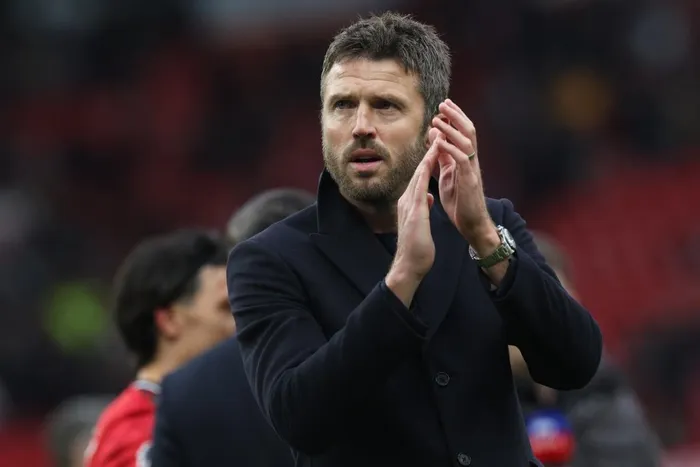
Manchester United's interim manager opens up about his managing and playing for Manchester United and Sir Alex Ferguson's influence on his career.
Image: AFP
As Michael Carrick prepares to lead Manchester United into a titanic clash against Arsenal following an emphatic debut victory, United’s new man at the helm reveals the elite mentality and Sir Alex Ferguson's influence driving his interim head coach reign in an in-depth interview.
On his previous stints as a manager:
You were initially asked to take charge of Manchester United for three games. What was it like being the Manchester United manager?
It was a real privilege and a huge responsibility. On the other side, I was so close to Ole that the fact it hadn't worked out really hurt me. When Ed Woodward asked me to take over on that Sunday morning, my first thought was that I needed to speak to Ole. Ole told me, 'I know they're going to ask you, and I've told them you're the best one for it. You have to do it'.
Once he said that, I clicked into gear. I had to produce a team for Tuesday. I really enjoyed it; I didn't feel it as a pressure. I knew the club, every member of staff, and the players off by heart. It seems a monster from the outside, but I’d been in it for 15 years. It just felt like my day-to-day job.
And then you went out on your own at Middlesbrough. Did that give you more of a taste of the manager life?
I really enjoyed working with the players and the development side of it—helping them thrive in their careers. That probably came from Sir Alex; he was ruthless but he always cared about the players.
Being away from family was a challenge, but I'm proud of the work we did. To answer your question — yeah, I enjoyed it. It’s something I’d like to carry on with at some point, but right now I’m not chasing it. I’m content to see what comes next.
On being a player at Manchester United:
You wore the number 16, Roy Keane's number. Was that just something you went, "Yeah, bring it on"?
It didn't massively bother me. The boss asked what number I wanted and said 16 was available. Part of me was like, "Yeah, no problem." The other part of me was thinking, "Well, I’m not going to say no to Sir Alex on my first day!"
never saw myself as a replacement for Roy anyway. We were totally different players and characters. He is one of the greatest to ever play for the club, but I never tried to be him. Shirt numbers never really bothered me. It probably seemed bigger for people watching me lift the shirt than it did for me at the time.
Did you thrive on the fact that a draw was a disaster and you had to win?
Yeah. My first start was Watford away; we won 2-1 in a horrible game. I came back to the changing room thinking, "We won, away from home, I'll take that."
But the Gaffer went mad. I thought, "Wow, this is a level of intensity and standards I’ve never come across." That was my "welcome to Manchester United" moment. There was something inside me that really liked it because we were different from everyone else.
What did it feel like to be part of the team that delivered the Premier League back? They say the first one is just that little bit more special.
The first one was special. I was fortunate to step into a group with lads who had won it multiple times. My biggest skill was accepting what I didn't know and just copying them. We felt like we were going to win it. But actually, every one after that meant almost more to me because you get greedy. You get selfish within the group and think, "No, this is not enough."
What was that mentality like? I know Sir Alex would say, "Lie on a beach, take it all in, but as soon as we're back, that's gone. You have to win it again."
The biggest lesson I ever had was losing the FA Cup final to Chelsea at Wembley the week after winning my first league. Didier Drogba scored in the 120th minute. I thought I'd be celebrating the league all summer, but losing that game hurt so much that the league title almost didn't matter.
I learned from the older lads how they dealt with it — we needed to win it again next year. The year after, when we won the league and had Chelsea again in the Champions League final, I was as focused and determined as I've ever been. Luckily, we went on to win the bigger one in Moscow.
Moscow is a standout day. Were you nervous taking that penalty?
It was a horrible feeling. Going into extra time, I knew I needed to take one for myself, just to know I’d put myself forward. The manager asked who wanted one, and I said I'd go second or third. It was a disgusting feeling walking up.
What was the walk like?
I ran. I thought the longer I have to think about this, the more negative things will pop into my head. I’d been preparing myself during the last five minutes of extra time. I’d taken a couple against Petr Cech previously, so I was trying to out-bluff him.
When I got to the spot, I just tried to cut everything off and tell myself, "It's just training. Just do what you do." Luckily, he dived the wrong way and the relief was immense.
In 2016 you won the FA Cup. Sir Alex had gone by that stage — what was the transition like as a seasoned member of that dressing room?
It was tough because of the responsibility. I’d seen the players before me take it on, and we felt we had to carry that. Change can be good, but we were so desperate to make it work that when it didn't, it hurt more than ever.
You felt like you were letting the club down. We went on to win FA Cups and tried to keep the culture, but it felt like it was falling through our fingertips. It was frustrating and bitterly disappointing.
From Player to Manager:
When you stopped playing, was there a moment where you thought, "I can't do this anymore at this level?"
I played in a Carabao Cup game at Old Trafford and my heart ... I didn't realise it at the time, but I started going dizzy. I felt like life was coming out of me. I thought I was going to faint. I told the doctor and he put the tests on my chest and told me I had to go to the hospital. It was atrial fibrillation — a bit of a nuisance, really. I had a small operation to "zap" it, which put me out for four months. I came back for an FA Cup game at Huddersfield.
I remember getting through the game and the lads were saying 'well done', but I knew I was miles off. I was thinking, 'Lads, you’re having to do extra work to cover me'. At that moment, I knew I was done. I sat down with Jose Mourinho and he suggested staying on as a coach. It just naturally happened.
And then, of course, Ole Gunnar Solskjaer returns and asks you and Kieran McKenna to stay on. When you look back, do you think of "what if" moments?
I don't sit down and think about it much, but I do think we were close. We finished third, then second, and had a record run of 29 away games unbeaten. We lost the Europa League final on penalties, which was close.
I’m quite sad because I think the club was in a decent place at that stage, but we didn't have a good start to the following season and then it was gone.