
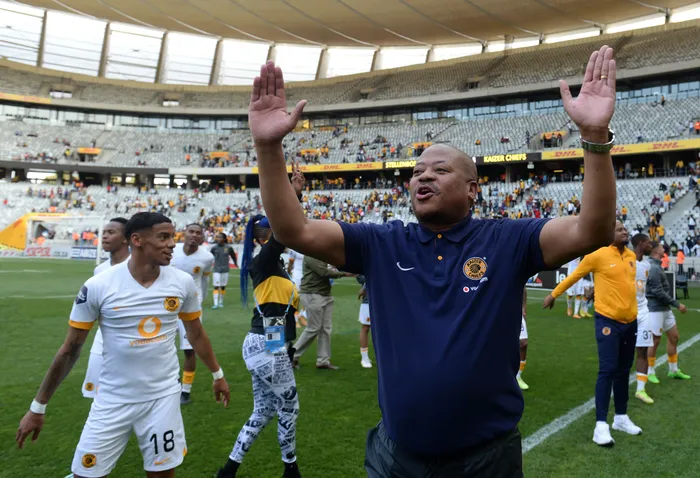
Bobby Motaung has deemed Chiefs’ Nedbank Cup date with Orlando Pirates as the ‘right’ fixture. KAIZER Chiefs football manager Bobby Motaung speaks about how growing up in the 'Kaizer Chiefs family' shaped his upbringing as he was born in the same as the famous football club.
Image: BackpagePix
There are men who join football clubs, and then there are men who are born into them. Bobby Motaung belongs firmly in the latter category.
He arrived into the world in 1970—the same year Kaizer Chiefs Football Club was formed. That coincidence has since hardened into something closer to destiny: a life so deeply entwined with the gold-and-black institution that separating the man from the club feels almost unnatural.
“I was born the same year as Chiefs,” he says matter-of-factly, as though stating a simple truth rather than a defining biographical marker. Yet, nothing about growing up a Motaung was ordinary. Chiefs was not just a football club his father ran; it was the environment that raised, shaped, and disciplined him, ultimately defining his purpose.
Long before Naturena became the fortress it is today, Chiefs was a traveling, living organism. The team camped at the family home, sharing meals and blending sport with community. Bobby remembers his grandmother cooking for the players, washing the kit, and watching over them as if they were her own. Footballers slept in rooms once reserved for family; meals were communal and privacy was an unknown luxury.
“We were never taught privacy,” he recalls. “Everything was shared.”
That sharing extended beyond food and space—it was a philosophy. Chiefs was never meant to belong to the Motaungs alone, despite what detractors would later suggest. From its inception, it was a collective: players, administrators, and supporters united by belief.
“When we say the ‘Chiefs family,’” Bobby explains, “we don’t mean only the Motaungs. It is bigger than that. It is the founders, the supporters, the administrators, the elderly gogos, the former players—everyone who loves this brand.”
As a boy, he did not fully understand the magnitude of what he was witnessing. He only knew that football was everywhere, that it brought people together, and that it gave communities something to believe in during a time when such hope was scarce. What stands out most in his memories is not the trophies, but the unity.
“There was a spirit,” he says. “There was love. Society was different; communities were together.”
It is from this soil that Bobby Motaung’s worldview grew — one rooted in service rather than entitlement. Ironically, despite growing up around elite athletes, Bobby did not pursue a professional playing career. This wasn't due to a lack of ability—he played in the development structures under coach Abie Matseng—but rather because circumstances and temperament pushed him elsewhere.
While an injury curtailed his progress, his interests were already drifting toward administration. While other boys dreamed of scoring goals, Bobby was selling tickets at the gate, organizing logistics, and observing how matches were run.
“I realized my passion was different,” he admits. “If you’re a player, your passion must be to play and enjoy. Mine was on the administration side.”
There was also the unavoidable pressure of being Kaizer Motaung’s son. “My old man was a superstar,” he says. “A great left-footer. I didn’t want to be him. I wanted to be me.” Choosing administration was both an act of self-definition and self-preservation; it allowed him to honor the legacy without being crushed by it.
Perhaps no relationship illustrates Bobby’s quiet influence better than his bond with Doctor Khumalo. Their fathers were friends and their families were close. Bobby and Doctor grew up and played together. But when rival clubs circled, eager to lure Khumalo away, Bobby intervened.
“I made sure he didn’t get stolen,” he says without bravado.
He remembers sharing a room with Doctor during a tournament in Brits and overhearing an Orlando Pirates official discussing how they must sign his talented “brother” from the Chiefs ranks. Bobby decided then to put a stop to it. It wasn’t a calculated executive decision, but the instinctive action of a brother protecting a brother.
“I had an eye for talent,” Bobby says. “I knew what I was seeing.”
As Chiefs professionalised, so did Bobby’s role. He effectively pioneered the Team Manager position at the club, creating a department focused solely on logistics and player welfare — a concept that didn't exist in South African football at the time.
With visibility, however, came scrutiny. Bobby became one of the most recognizable — and controversial — figures in the game. He became the lightning rod. When Chiefs signed players, praise followed; when results dipped, fingers pointed his way.
“I understood my role,” he says. “As a leader, not everyone will smile.”
There were moments when the criticism became deeply personal, touching his family and children. At times, he reacted — human responses that were often used to caricature him as volatile. “With time, I learned,” he says quietly. “That’s part of the job.”
Today, Bobby speaks with the calm of someone who has been tested and tempered. His joy, he says, has never been personal glory, but collective happiness. Now, as the Motaung siblings work together, the focus has shifted toward stewardship. Each brings a different skill — Kemiso (Digital), Jessica (Marketing), Kaizer Jr. (Technical), and Bobby (Administrative) — all aligned to preserve their father’s legacy.
“We are custodians,” Bobby says. “We are serving.”
Succession, he insists, is not a race or a title. It is a process shaped by contribution and time. Kaizer Motaung Snr. remains firmly at the helm, guiding the next generation with wisdom rather than force.
As Chiefs chase a return to their glory days, Bobby Motaung remains what he has always been: a man born into the gold and black, still serving the institution that raised him.