
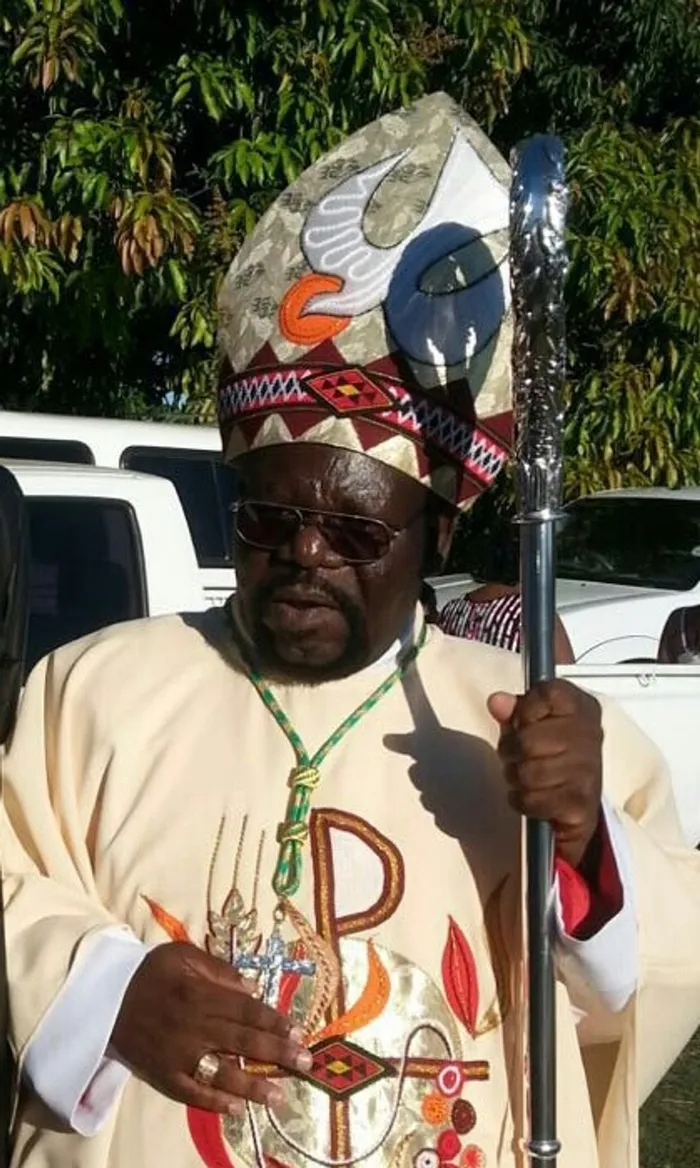
ARCHBISHOP Siegfried Mandla Jwara of the Durban Archdiocese has clarified the Catholic Church's stance on syncretism stemming from a pastoral letter signed by other eight bishops in KwaZulu-Natal which caused a stir among members of the church.
Image: File
The KwaZulu-Natal Catholic archbishop, who was one of the authors of the letter that condemned the blending of Catholicism and traditional practices, has broken his silence on the story that was broken by the Sunday Tribune last week.
The decision by the KZN bishops received heavy criticism from some of the black members of the church.
Archbishop of Durban, Siegfried Mandla Jwara, who was in eSwatini for an Interregional Meeting of the Bishops of Southern Africa (Imbisa) last week when this newspaper reached out to him to no avail, has weighed in on the matter to clarify the church's stance.
Jwara said media reports misrepresented their 16 September joint statement on syncretism (the blending of Christianity and traditional practices) issued by eight other bishops of various dioceses around KZN.
Jwara expressed disappointment at what he described as misleading headlines that “created the false impression” that the Church was condemning the belief in ancestors.
He clarified that the bishops’ statement was instead directed at priests who mix traditional healing practices, particularly ubungoma (divinity), with Catholic liturgy.
“Africans do not worship ancestors but may seek from those esteemed members of their family, now passed from this world, guidance and support in times of need,” Jwara said.
“Our concern was not about cultural identity but about maintaining the integrity of our faith practices.”
The Archbishop emphasised that a priest, as a representative of Christ, “cannot serve two masters.”
He said those who perform ancestral rituals while conducting church duties risk causing confusion among the faithful and diminishing the Gospel’s message.
“His very life must be a witness and testament to the person and message of Christ,” Jwara said, adding that any blending of spiritual roles could “lead to scandal among the faithful.”
Jwara also stressed that the Church does not seek to condemn African culture but rather to purify it through prayer.
He acknowledged that African cultures are “dynamic and alive,” with both beneficial and harmful elements, and said the Church’s role is to guide the faithful toward practices consistent with Christian belief.
“Whatever ancestral rituals are practised privately in families should not be brought into liturgical celebrations,” he said.
“Just as the vine is pruned by the vinedresser, our cultures may be pruned by Christ of any practice incompatible with our faith.”
The Archbishop dismissed rumours that the Church had prohibited traditional rites such as funerals, tombstone unveilings, or traditional marriage ceremonies, calling such reports “absolutely untrue.”
As the Church prepares to enter the month of November, traditionally dedicated to remembering the departed, Jwara called on Catholics to continue praying for their ancestors and loved ones who have passed.
“Let us entrust them to the love and mercy of God, as is our most ancient and noble tradition,” he said.
The church's clarification comes after it came under fire from many prominent Catholics like Dr Velaphi Mkhize, an academic and former radio personality who now consults and mentors traditional healers.
Mkhize had challenged the church and the archbishop to clarify whether their joint decision by KZN bishops was endorsed by Pope Louis XIV.
Mkhize further challenged the bishop to fight for the appointment of a black pope instead of policing traditional practices of the Catholics. He also spoke against the pastoral letter on the country's biggest radio station, Ukhozi FM, this week, where he has a segment with radio hostess, Dudu "Lady D" Khoza.
However, many Catholics supported the bishops' letter and said some Christians had made a mockery of the church by dabbling in divinity.
The archbishop's clarification seems to be an about-turn, as the 16 September pastoral letter was explicit in condemning the faithful from:
- consulting traditional healers, tarot card and palm readers.
- the slaughter of chickens and goats.
- the use of coloured water known as (isiwasho).
- the use of coloured candles.
- anti-liturgical wild dancing, which many interpreted as the banning of traditional Zulu dancing (ukusina).
SUNDAY TRIBUNE