
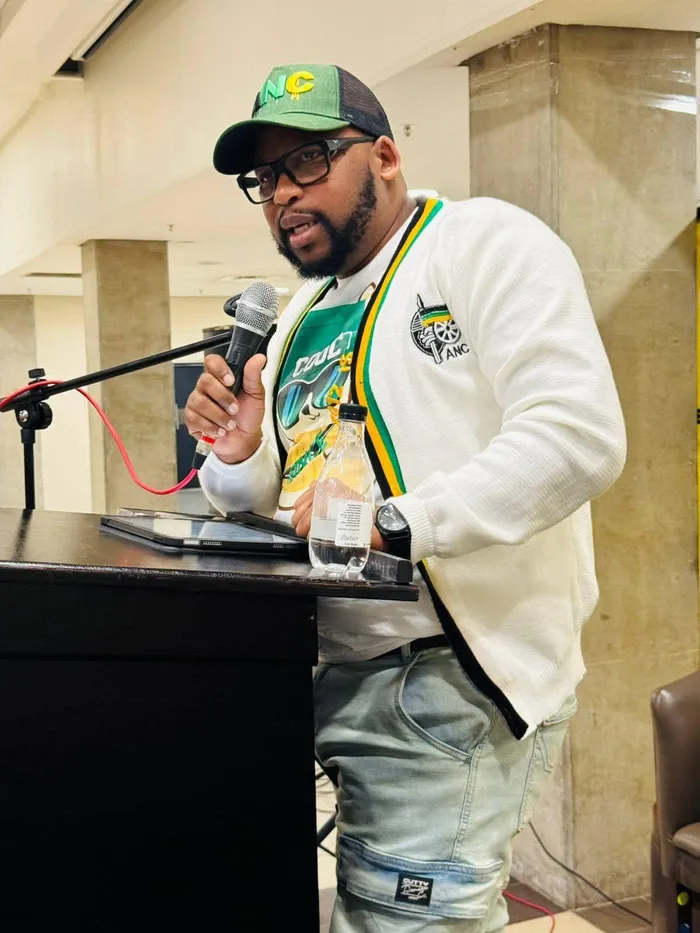
AFTER last year's poor showing at the polls, the ANC's largest region in KwaZulu-Natal is implementing a grassroots 'Asiye Ekhaya' (let's go home) campaign to reconnect with its base. EThekwini Region Task Team Regional Secretary Simiso Mkhize acknowledges the shortcomings but is optimistic of the outcomes of their interaction with their branches.
Image: Supplied
The ANC’s largest KwaZulu-Natal region, eThekwini, is preparing for the party’s 5th National General Council (NGC) next month as it intensifies efforts to rebuild following its bruising defeat in last year’s national and provincial elections, which forced it into coalitions at all three spheres of government.
The poor showing in KwaZulu-Natal and Gauteng prompted the ANC’s national working committee to reconfigure the provinces’ elected leadership structures and replace them with provincial task teams.
In KwaZulu-Natal, this decision saw the return of party veterans Mike Mabuyakhulu and Jeff Radebe as coordinator and convenor, respectively, while provincial secretary Bheki Mtolo, a farmer, was put out to pasture.
This year’s NGC is being held under the theme “The Year of Renewal: Making the ANC a More Effective Instrument of the People to Achieve the Vision of the Freedom Charter.”
Despite its electoral slump in KZN, the ANC managed to out-manoeuvre the uMkhonto weSizwe Party (MKP), which emerged as the single largest vote-winner, by forming a government of provincial unity with the IFP, DA and NFP, relegating the MKP to the opposition benches.
Against this backdrop, eThekwini Regional Task Team (RTT) secretary Simiso Mkhize says the party has humbled itself and returned to the grassroots on a fact-finding mission to understand where it went wrong with voters.
In an interview with the Sunday Tribune, the former banker was measured in his assessment, acknowledging the party’s shortcomings while insisting that the answers lie within the branches.
“'Amandla asemasebeni' (the power lies with the branches) is an ANC slogan. For this reason, we are embarking on a campaign to listen to our people. Our programme of action requires us to be with the people and to support our councillors and branches through consultation and communication,” said Mkhize.
With an estimated membership of 100 000 with 111 wards, eThekwini is an influential region regarded as a deal-maker for the ANC in KZN. As secretary, Mkhize could boast about the massive size of the region, but the wounds of May 2024 are still fresh. Despite the drubbing by the MK Party, within the party, the region remains key in elective conferences.
He spoke enthusiastically about the party’s Asiye Ekhaya (“Let’s go home”) campaign, launched in March this year, which appeals to disgruntled members to return to the organisation. The campaign is designed to serve as the ANC’s grassroots engine to reconnect it with its core constituency.
Through this initiative, Mkhize and members of the eThekwini RTT have been crisscrossing the vast region, engaging learners, faith-based organisations, traditional leaders, professionals, artists and communities through public meetings and door-to-door campaigns and other stakeholders.
“We also run study groups for the ANC caucus. I sit in all caucus meetings to ensure that we deliberate on matters that are a priority for the ANC and that those matters reflect the organisation’s mandate,” he said.
Mkhize believes that equipping councillors and leaders with access to current research and statistics will strengthen their ability to respond effectively to service-delivery challenges.
“We intervene in situations where councillors are at loggerheads with ward members and assist in resolving those disputes,” he added.
He acknowledged the sensitivities around the ANC’s partnership with the IFP in the provincial government of unity, particularly among supporters still scarred by decades of internecine political violence between the two parties.
“It is not easy. I am also among those who lost family members during that violence,” Mkhize said.
He believes healing and partnership are essential elements in the broader journey of reconciling the past with present political realities.
The task ahead remains daunting, he conceded, particularly in communities that feel betrayed by former leaders who defected to other parties.
“Some constituencies were betrayed by people they trusted the most,” he said.
As the region prepares to send its delegation to the NGC, Mkhize said all regions have been instructed to ensure strict 50/50 gender representation among delegates. With only two women out of six in the current RTT structure, he offered a wry smile as he conceded that one of the male members is likely to be sacrificed to meet the requirement.
The NGC, which is regarded as the party's de facto political school, will be held in Gauteng between December 8 and 11, and the registration for the council closes on Tuesday. It's an important mid-term review of the party's progress, challenges, and policy development and is a platform for capacity building for its members.
With next year's local elections around the corner, the task ahead is massive for the party, which last enjoyed a two-thirds majority twenty-one years ago.