
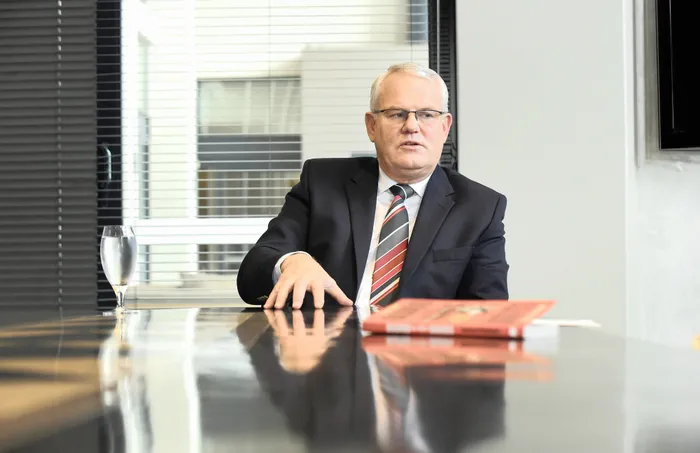
Former KwaZulu-Natal Hawks head Johan Booysen.
Image: Nokuthula Mbatha/African News Agency
National Director of Public Prosecutions (NDPP) Advocate Shamila Batohi recently testified at the Nkabinde Inquiry, revealing that she did not personally review the case docket implicating former KZN Hawks head Major General Johan Booysen and members of the Cato Manor Unit.
This admission has sparked significant debate regarding her decision to withdraw the racketeering charges against Booysen.
Batohi explained that she withdrew the charges due to insufficient evidence to support the prosecution, also confirming that the murder charge against Booysen was dropped for the same reason.
The inquiry is currently examining the fitness of Deputy Director of Public Prosecutions (DPP) Advocate Andrew Chauke to hold office, focusing on two controversial cases: the racketeering prosecution of Booysen and the Cato Manor Organized Crime Unit, as well as the discontinuation of murder charges against former police crime intelligence head Lieutenant General Richard Mdluli.
During her testimony, Batohi stated, “I didn’t study the dockets,” emphasizing that her decision to initiate a disciplinary case against Advocate Chauke was based on a memorandum prepared by Advocate Rodney de Kock, rather than a personal examination of the 23 related case dockets.
“My answer now also relies on the evidence of a report of the DPP KZN,” she added.
Advocate Tembeka Ngcukaitobi, representing Chauke, challenged Batohi's stance, questioning how she could assert there was no case against Major General Booysen without having read the docket.
“Can I suggest that that is an astonishing proposition coming from the head of our prosecution service? I am going to tell the panel that, at the end, your evidence must be rejected as incredible because it is irresponsible to make such a claim without having read the docket,” Ngcukaitobi argued.
In her defense, Batohi maintained that it is not unreasonable for a national director to rely on reports and presentations from a prosecutorial team instead of reviewing every piece of evidence personally.
“There is case law that national directors are not expected to read every single bit of evidence and every docket in cases,” she explained.
“It is perfectly acceptable for a national director to rely on reports, to rely on presentations, to request aspects of evidence, and to take decisions on that basis. It is what is expected of a responsible national director.”
Ngcukaitobi pressed further, pointing out that the docket against Booysen was relatively small, consisting of just seven charges, contrary to the extensive volumes Batohi had referenced. In response, Batohi clarified that her earlier comment regarding dockets filling a room was merely to illustrate that national directors are not expected to read every single piece of evidence.
The inquiry also addressed allegations that Chauke had improperly sought to have the Acting DPP of KwaZulu-Natal sign case dockets.
“It’s not our case that Advocate Chauke needed or asked the DPP to sign any case dockets. So this is clearly incorrect.” She acknowledged that while Chauke supported a decision to prosecute without evidence, the claims regarding improper attempts to have dockets signed were inaccurate.
Throughout her testimony, Batohi consistently emphasized that her reliance on reports rather than direct review of dockets was in line with her responsibilities as NDPP.
“It is permissible for a national director to consider evidence presented by a team and presentations and to ask for specific aspects of evidence if required,” she asserted.
“But it is certainly not expected that a national director should read every single docket in any context.”
Ngcukaitobi countered, stating that Batohi's conclusion about the lack of a case against Booysen, without having read the docket, was “a grossly irresponsible thing.”