
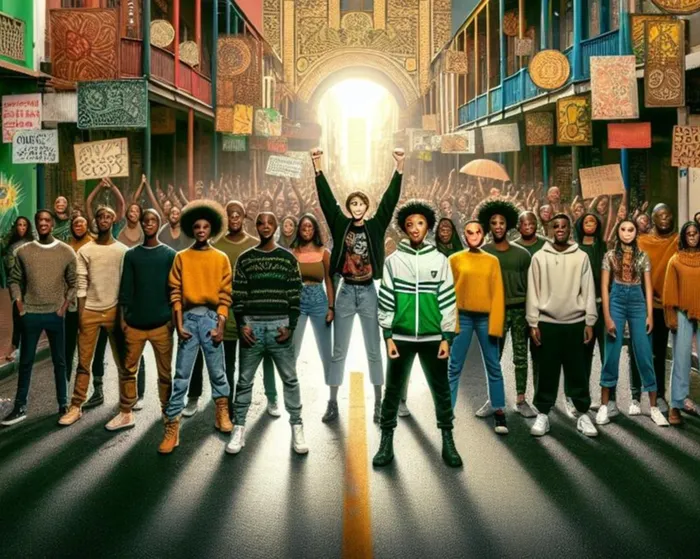
More than 60% of South Africa’s population is under the age of 35. These are the people who were told that freedom in 1994 would unlock opportunity, that hard work and education would be rewarded, and that democracy meant accountability and progress. For many, those promises have not just been broken — they have been shattered.
Image: RON AI
A dangerous silence is brewing in the streets of many South African towns and cities – the kind that precedes an explosion. You can see it in the tired eyes of the young man selling sweets at the taxi rank, or in the frustration of the university graduate standing at traffic lights with a handwritten sign begging for work.
South Africa’s youth are hungry – for food, for opportunities, for dignity – and yet those in power seem oblivious to the ticking time bomb beneath their feet. The recently formed Government of National Unity (GNU) — a political experiment born out of compromise, backroom deals, and elite negotiations — has inherited a fragile nation. But more critically, it has inherited a restless generation with nothing to lose. And that is perhaps the most dangerous inheritance of all. More than 60% of South Africa’s population is under the age of 35.
These are the people who were told that freedom in 1994 would unlock opportunity, that hard work and education would be rewarded, and that democracy meant accountability and progress. For many, those promises have not just been broken — they have been shattered. Youth unemployment sits at over 45%, according to recent Stats SA figures. That number doesn’t simply represent people without jobs. It represents households without income, futures without hope, and communities where crime and addiction thrive because there are no alternatives. It represents the young woman with a degree who can't afford transport to job interviews. It represents the teenage boy lured into gangsterism because the street offered him something the state could not — a sense of power and belonging.
The GNU, led by President Cyril Ramaphosa and composed of parties that just months ago were bitter rivals, claims it is working to stabilise the economy, restore governance, and build national consensus. However, consensus among politicians does not necessarily equate to consensus among the people. And while the elite play chess in Cape Town and Pretoria, ordinary young South Africans are playing a different game — one of survival. It is not enough for the GNU to celebrate its creation as a triumph of democracy. If it does not urgently address the crisis of youth marginalisation, it will find itself presiding over a nation whose foundations are already cracking.
The July 2021 unrest — sparked ostensibly by the jailing of Jacob Zuma, but fuelled by years of poverty, inequality, and state neglect — should have been a warning. It wasn’t a protest; it was an explosion. And it could happen again, only this time with even more devastating consequences. Political will is not a slogan — it is action. It is an urgent investment in youth employment, not just press releases and strategy documents. It involves creating safe community spaces, providing proper funding for TVET colleges, and offering support for small and informal businesses. It is land and housing for young families, not only for the politically connected. And it is a government that listens, really listens, to the voices of the young, not just during campaign season. The time for empty promises is over. The time for ceremonial youth summits and ribbon-cuttings is over. What young people are demanding is not charity — it is justice. Economic justice.
Educational justice. Social justice. The GNU must understand that no amount of public relations spin can mask the anger of a hungry generation. Social media has given voice to the voiceless — and they are speaking. The youth do not trust traditional politics, and for good reason. They’ve seen what it produces: corruption scandals, collapsed municipalities, and endless infighting while their lives remain stagnant. South Africa’s young people are not apathetic. They are disillusioned. But disillusionment can turn into mobilisation.
And mobilisation, in a country with such a deep history of struggle, is always powerful. The youth are watching. They are organising. And unless something changes — fundamentally and urgently — the GNU may find that the most dangerous opposition is not in Parliament, but in the townships and streets, where hunger meets rage. It’s not too late. But the clock is ticking.
Mayalo is an independent writer. The views expressed are not necessarily the views of IOL or Independent Media