
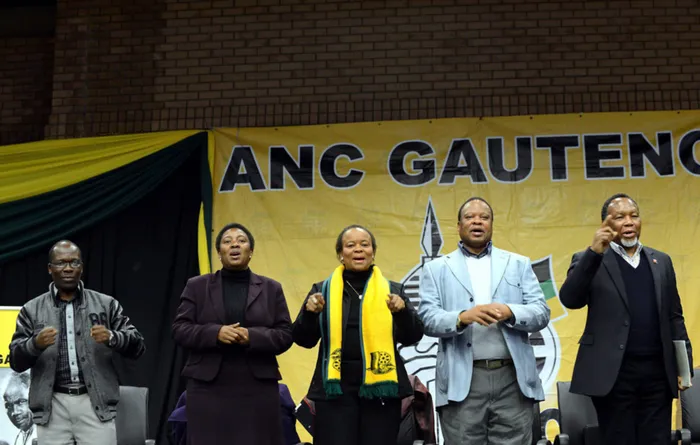
New strategies: ANC leaders, from left to right, Humphrey Mmemezi, Ntombi Mekgwe, Gwen Ramokgopa, Rapu Molekane and Kgalema Motlanthe at the party's political school graduation ceremony. The political school counts among the major successes of the ANC in Gauteng. Picture: Bongiwe Mchunu New strategies: ANC leaders, from left to right, Humphrey Mmemezi, Ntombi Mekgwe, Gwen Ramokgopa, Rapu Molekane and Kgalema Motlanthe at the party's political school graduation ceremony. The political school counts among the major successes of the ANC in Gauteng. Picture: Bongiwe Mchunu
Once one of the smallest of the party’s provincial wings, the ANC in Gauteng has grown significantly in recent years, in clout as much as in numbers. The current 134 000-strong register is nine times what it was in 1995 and almost double the figure that was captured at the last provincial meeting in 2010.
Though the aggressive numbers game that is playing out here, as elsewhere in the country, is grounded by some solid structures and initiatives put in place in the past decade, all is not entirely well in Gauteng.
The province oscillates around two opposing factions; one led by the premier, Nomvula Mokonyane, who is at political odds with her party chairman, Paul Mashatile.
She is openly canvassing for President Jacob Zuma to be returned for a second term in December, while he has not been shy in calling for change at the helm.
And while she contends that her base is as big, if not bigger, than Mashatile’s, the truth is that he trounces her in Gauteng.
However, ANC politics being what it is, she can still emerge triumphant in December should Zuma be returned for a second term, though this race is still too tight to call.
All that is certain where Gauteng is concerned is that regardless of who wins in Mangaung, there will be a significant number of losers in this province and more is the pity, because for all its faults, it is easily one of the most innovative and potentially promising of all of the nine provinces.
After a rough patch in the 1990s when the provincial government was plagued with corruption and the party’s ranks were eroded by factionalism, the Provincial Executive Committee was eventually disbanded in 2000.
But a year after that the province entered an era of growth and significant transformation. In 2001, and on foot of a decision taken at the Mafikeng national conference four years earlier, it began to align its branch network with the new electoral ward system that was introduced with the first local government elections in 2000 and Gauteng, like all other provinces, began to sprout new branches.
In the township of Katlehong on the East Rand, for example, the single 20 000-strong branch was restructured into 12 separate branches. The same in Alexandra, where membership in one branch had tipped 18 000 before it was realigned with the township’s wards.
Membership was only a fraction then of what it had been in 1994.
While the euphoria of the early 1990s had helped swell the ranks of the would-be ruling party, membership dropped drastically immediately after the first democratic elections. In Gauteng it had gone from 215 000 in the year of liberation to 14 792 a year later.
However, by the time the Gauteng provincial team began the ward alignment in 2001, the figure was just looking healthier at just shy of 49 000.
But who were they? SA was changing and there was massive migration into the urban areas as well as away from the townships and into the suburbs.
The identities of the members were blurring and to understand them better, the provincial team embarked on an extraordinary exercise that year and conducted what can only best be described as a mini-census.
Branch members from townships and informal settlements were trained to carry out participatory research among fellow members, seeking information on income, education, political attitudes, lifestyle, the kind of homes they occupied, and so on, to help establish a profile of the average member, their needs and, by default, the social requirements of the ward, vis-à-vis the ANC branch.
“It’s what we would call a sociological profile of the ward,” which helped the ANC develop programmes suitable for that area, says David Makhura, who oversaw the research.
“And we came out of that exercise much stronger.
“It helped us be more relevant as an organisation.”
A follow-up survey was carried out in 2006 and a third one is under way and due to be released next year, though Makhura is the first to admit that the initiative has lost the core place it once had in the provincial branch.
The Gauteng leadership team then turned its focus to auditing membership and developed a system that has since been replicated by party headquarters.
Shortly afterwards it began to scale up the Walter Sisulu Leadership Academy, the school of political education that was started by the province in 1998 and enhanced in 2000.
It has grown significantly since then with an annual intake of 600 students for the past five years, men and women who attend classes once or twice a month on weekends.
Every bit the big feather in Gauteng’s cap, the academy is now located at the University of Johannesburg, on its city and Soweto campuses, with outreach structures scattered across the province.
Gauteng has also started a provincial monitoring and evaluation unit, headed by Makhura, a structure that is intended to keep public office bearers on their toes, though with the two centres of power at play, it is possible to see it as more of a means to weigh in on Mokonyane’s authority than it is a method of general oversight and accountability.
Another recent innovation is the establishment of the ANC Gauteng integrity committee, headed by veteran Baba Alexander Mbatha, and described “as one of many instruments we need to help us try to restore sanity in the ranks as we struggle to deal with runaway corruption”.
And yet corruption has been one of Gauteng’s greatest weaknesses. From the Jessie Duarte scandal in the late 1990s, that cost her a provincial cabinet post, to a number of other allegations and later claims of a so-called Alex mafia that refuse to subside, it will be interesting to see how the integrity committee unfolds. But it won’t be for want of trying, not least on Makhura’s part.