
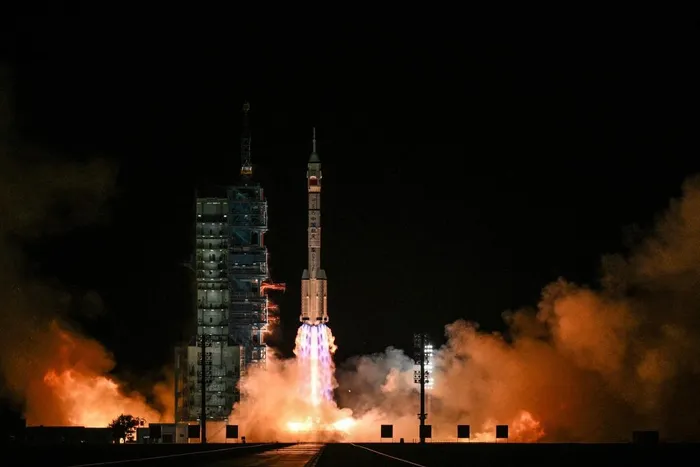
A Long March-2F carrier rocket, carrying the Shenzhou-21 spacecraft and a crew of three astronauts, lifts off from the Jiuquan Satellite Launch Centre in the Gobi desert, in northwest China on October 31, 2025. A new crew took off for China's Tiangong space station on October 31, including the country's youngest ever astronaut and four lab mice.
Image: Hector Retamal / AFP
US defunding of science has had a particularly damaging effect on climate and health research, but other countries – and the private sector – are pushing ahead with new advances.
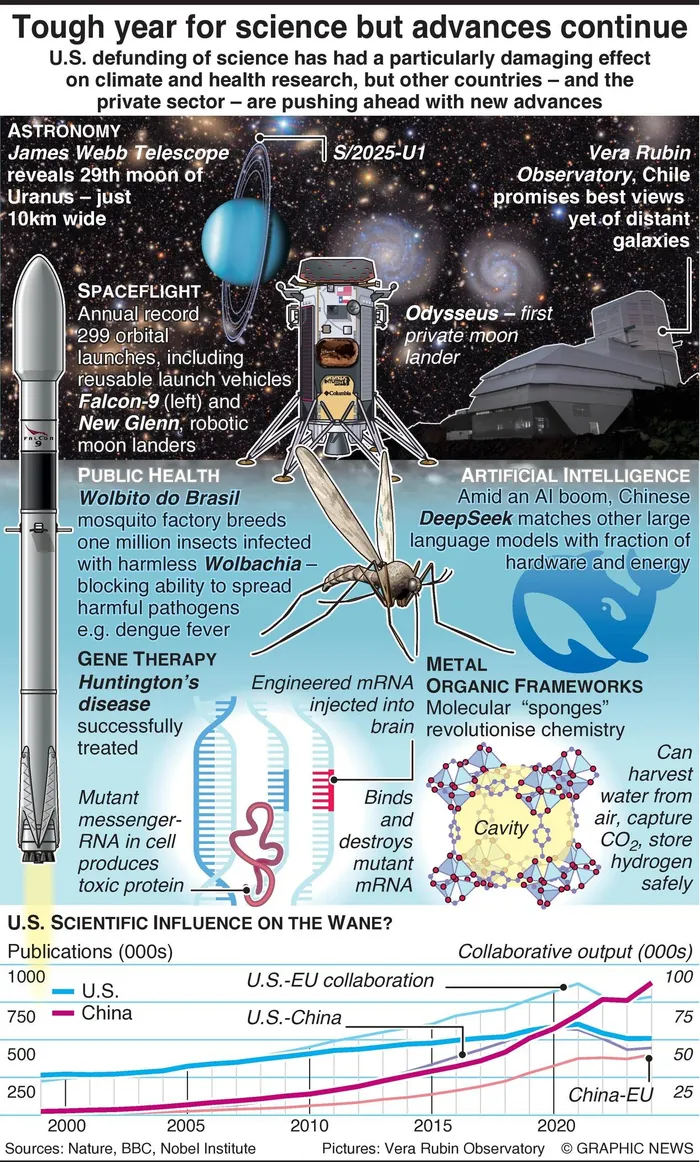
Graphic looks at the scientific achievements and anti-scientific regression in 2025.
Image: Graphic News
Despite the withdrawal of US funding, established projects like the James Webb Telescope and Vera Rubin Observatory continue to reveal new secrets to the universe.
Spaceflight has entered a new era with a record 299 orbital launches in 2025, many by private sector, including the first private moon landing. In the middle of an AI bubble, which shows little sign of abating, Chinese financier Liang Wenfeng released the DeepSeek large language model which matched other AI models with a fraction of the associated hardware and energy costs.
CRISPR gene therapy offers new cures for genetic diseases such as Huntington’s. Susumu Kitagawa, Richard Robson and Omar Yaghi are awarded the Nobel Prize for their work on Metal Organic Frameworks, molecular “crystal sponges” which look set to revolutionise chemistry with their ability to harvest water from desert air, remove “forever chemicals” from water, capture carbon dioxide, safely store hydrogen or drive chemical reactions.
The Trump administration has already cut $1 billion from the National Science Foundation – 56.9% of its budget – and $625m of all NOAA funding for climate research, on which the whole world relies. Another $299m has been cut from the US Geological Survey’s budget for ecosystems research and $300m from US Forest Service research.
NASA has seen a 24.3% cut including 47.3% of its science research budget while the NIH faces cuts of $4.5 billion. The US Centers for Disease Control and Prevention has been gutted and is now promoting vaccine policies unsupported by science.
Proposals are being considered to shut down NASA and NOAA satellites that researchers and governments around the world rely on for forecasting weather and natural disasters.
According to the number of published papers US scientific influence appears to be on the wane, with China-EU collaborative output rising strongly while US collaborations are facing a marked decline.
Graphic News