
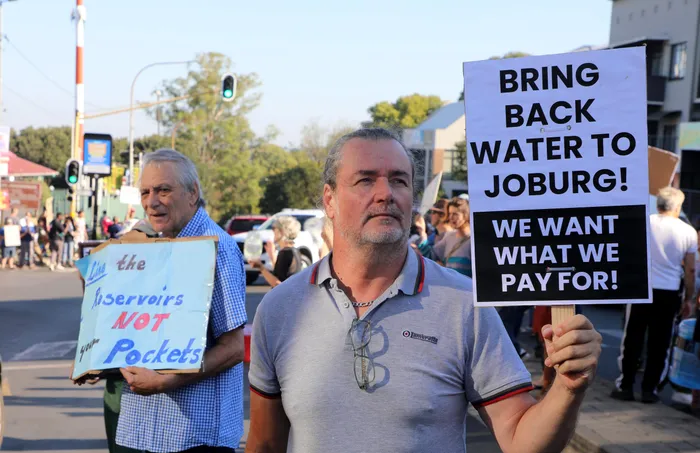
Joburg residents took to the streets recently to protest over continued water challenges.
Image: Timothy Bernard/Independent Newspapers
When Panyaza Lesufi said he had to go to a hotel to get water, it wasn't a scandal. It was a revelation. It revealed how power separates itself from collapse. The issue was never that a premier needed water.
The issue was that his solution exposed a country living in two separate realities. In one, water failure is an inconvenience solved with a booking and credit card. In the other, it's a daily sentence with no appeal.
For millions of South Africans, there is no hotel option. There are buckets, neighbors, tankers that may or may not arrive, and taps that have taught people not to hope.
According to the Department of Water and Sanitation's own reporting, over 60% of municipalities are in water distress, with infrastructure operating beyond its design life.
Water scarcity has been normalised so deeply that planning your life around it no longer feels like a crisis. It feels like survival. That's why the statement struck a nerve. Not because it was offensive, but because it was honest in the wrong way. It confirmed what many already suspect: when systems fail, leaders have exits. Citizens have endurance.
Hotels don't have water by accident. They maintain infrastructure. They plan for risk. They treat water as non-negotiable. Municipalities, meanwhile, have treated water as background noise.
Pipes burst and are patched. Treatment plants limp along decades beyond their intended lifespan. Qualified engineers leave or are sidelined while water losses through leaks reach 40% in some metros. Maintenance budgets are sacrificed for visible projects and political optics. The Blue Drop certification system, once a rigorous standard for water quality, has been quietly abandoned.
Of the country's 144 water treatment plants assessed in recent years, fewer than a third meet acceptable standards. This didn't happen overnight. The water crisis wasn't a sudden disaster. It was invited by years of systematic neglect. So, when leaders speak casually about improvising through failure, people hear something else. They hear that collapse has been accepted as normal and that governance has shifted from prevention to personal contingency planning.
This is where voters begin asking harder questions. Should the African National Congress be held accountable for this moment? If this were only about one sentence, then no. But if that sentence captures a pattern in a culture, a long-standing unwillingness to confront decay honestly, then voters aren't being emotional. They're being rational. Water is the most basic promise of the democratic state. Before housing. Before economic growth plans. Before speeches. When water fails, legitimacy fails with it.
Children cannot attend school safely without sanitation. Clinics cannot sterilize equipment or maintain hygiene protocols. Small businesses collapse quietly; hair salons, restaurants, and laundromats are killed not by competition but by infrastructure failure.
Women and girls lose hours each day to fetching, storing, and rationing water. This isn't an inconvenience. It's structural violence delivered through neglect. Yes, South Africa inherited an infrastructure system deliberately designed to exclude Black communities. Yes, climate change has intensified water stress. Yes, municipalities face fiscal constraints. But these realities explain the challenge; they don't excuse three decades of insufficient response.
Other middle-income countries facing similar conditions have treated water infrastructure as existential. South Africa has treated it as negotiable.
Beyond statements and damage control, six things must change:
First, declare water a permanent national priority, not a seasonal talking point. Ring-fence water infrastructure budgets and protect them from political interference with independent oversight. Make maintenance legally non-negotiable, with quarterly public reporting on infrastructure condition and spending.
Second, restore technical capacity immediately. Appoint qualified engineers, water managers, and technicians on merit. Offer competitive salaries to retain expertise. Political loyalty cannot fix pipes. Only expertise can. Where skills don't exist, create fast-track training programmes funded as crisis interventions.
Third, replace reassurance with radical transparency. Publish real-time data on water losses, infrastructure conditions, repair timelines, and budgets in accessible formats. Communities can endure hardship when they understand the truth. What they cannot endure is being misled while taps run dry.
Fourth, make consequences visible. Where investigations prove corruption, negligence, or deliberate underinvestment, prosecute swiftly and publicly. Without accountability, collapse becomes policy by default.
Fifth, democratise water alternatives. Boreholes, greywater systems, rainwater harvesting, and emergency storage cannot remain privileges of hotels, estates, and private institutions. If alternatives exist, deploy them in townships and informal settlements first, not last. Budget for it. Make it an infrastructure rights issue.
Sixth, change the language of leadership. Speak from the lived reality of citizens, not from behind buffers that soften failure. When leaders improvise personal solutions to public crises, it tells people they're on their own. Words signal seriousness.
And seriousness is what people are desperate to see.
The hotel comment will be explained away. Context will be added. Advisers will insist it was misunderstood. But moments like this matter because they cut through performance. They reveal who the system protects when things break.
If voters choose to change governments, it won't be because a premier went to a hotel. It will be because too many people still wake up without water, without answers, and without confidence that anyone is building towards solutions rather than simply managing their own comfort through the crisis. Water infrastructure can be rebuilt.
Trust can be rebuilt, too. But only if leadership stops improvising around collapse and starts treating public systems with the same urgency that hotels treat their own.
Until then, every dry tap will keep asking the same question: Who is this government really working for? And every election will be a chance to answer.
Qwesha is a trade finance consultant with expertise in global commerce and risk management and regularly contributes to a number of publications