
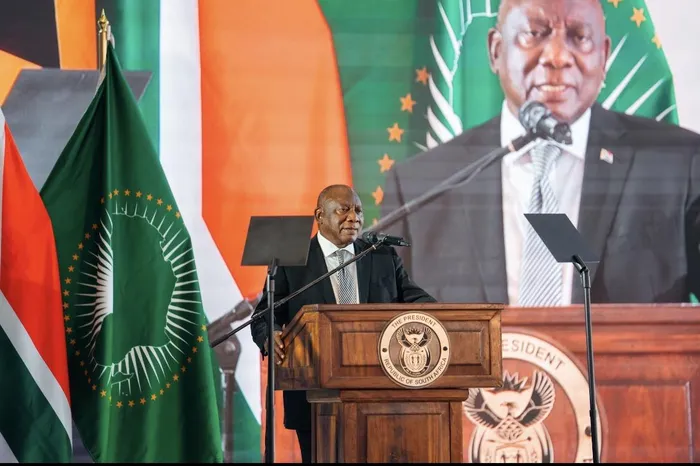
President Cyril Ramaphosa delivering his keynote address at Africa's Travel Indaba 2026.
Image: Supplied
At the opening of Africa’s Travel Indaba 2026, President Cyril Ramaphosa positioned tourism as one of Africa’s most powerful tools for economic growth, job creation and development.
Addressing delegates at the Durban ICC during Africa Month celebrations, Ramaphosa said tourism had become “a major economic driver” capable of transforming economies across the continent.
“For many African countries, tourism is not merely a leisure industry. It is a developmental instrument through which we can grow our economies,” said the president.
Ramaphosa highlighted tourism’s contribution to employment, infrastructure development and foreign investment, noting that before the Covid-19 pandemic, tourism accounted for about 7% of Africa’s GDP and supported tens of millions of jobs.
Countries including Egypt, Kenya, Tanzania, Mauritius, Rwanda and South Africa have demonstrated how tourism can become “a real pillar of national growth”, he said.
The president noted that South Africa welcomed 10.5 million tourists, underlining the sector’s importance to the country’s economy.
“When tourists travel, they do not travel empty-handed,” he said. “They come with foreign exchange, create tax revenues and encourage investment inflows.”
Ramaphosa said tourism also offers African countries an opportunity to diversify economies traditionally dependent on commodities such as mining and oil.
“Tourism distributes economic activity across communities,” he said. “It opens opportunities for everyone and has mass employment potential because most tourism subsectors are labour-intensive.”
He added that tourism creates opportunities for young people, women-owned businesses, informal traders and people living with disabilities.
The president used Durban and KwaZulu-Natal as an example of how tourism can stimulate investment and urban renewal.
He praised the collaboration between government and business through the Presidential eThekwini Working Group, which was formed to help restore confidence in the metro.
“We started seeing Durban beginning to see great development,” Ramaphosa said. “Hotels are springing up because we are creating a conducive climate.”
He described Durban as “the true Mecca of tourism in South Africa”, adding that tourism supports a wide ecosystem of businesses and industries, from tour operators and transport providers to farmers, cultural performers and digital marketers.
Ramaphosa also emphasised tourism’s role in rural development and heritage preservation. He pointed to destinations such as Vilakazi Street in Soweto, the Battle of Isandlwana in KwaZulu-Natal and cultural heritage sites across the continent as examples of how tourism can reshape local economies.
“Tourism has the unique ability to bring economic activity into rural and underdeveloped areas,” he said.
The president further linked tourism to conservation and environmental protection, saying wildlife and eco-tourism initiatives create sustainable livelihoods while protecting Africa’s natural resources.
He referenced conservation organisation African Parks for its work in restoring protected areas and involving local communities in conservation efforts.
Ramaphosa also called on African nations to use tourism to reshape global perceptions of the continent.
“Tourism shapes the way the world looks at our continent,” he said. “Too often, global narratives focus on wars, poverty and instability. Tourism is the instrument we can use to showcase Africa’s beauty, culture, heritage and people.”
The president stressed that improving infrastructure, connectivity and safety would be critical to unlocking the continent’s tourism potential.
He called for improved airports, roads, visa-free travel and lower airfares to encourage intra-African tourism.
“We need to market Africa not as isolated countries, but as one continental destination ecosystem,” he said.
Ramaphosa concluded by urging African governments and the private sector to work together to position the continent as a leading global tourism hub.
“Tourism has unlimited growth possibilities,” he said. “Visitors will come back to their original home, which is the continent of Africa.”