
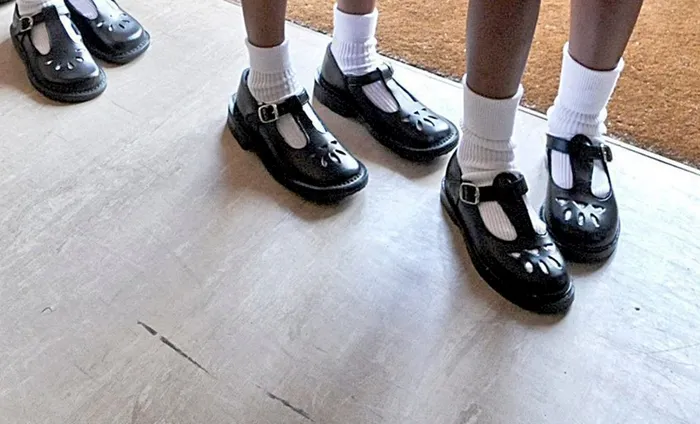
Girls school shoes South African schools officially open next week
Image: Adrian de Kock
The Western Cape Education Department (WCED) said it's fully prepared for the start of the 2026 school year, with educators returning to schools on Monday, 12 January, and learners set to enter classrooms on Wednesday, 14 January.
As the new academic year begins, the department has emphasised the importance of readiness for both schools and families, noting that the start of school marks a critical step in a child’s journey towards independence and economic inclusion. Parents are encouraged to ensure their children are fully prepared, as this lays the foundation for long-term learning success.
The WCED has urged parents to carefully read all communication from schools, which typically includes essential information such as stationery requirements, uniform expectations and administrative arrangements. With the school year just days away, the department says the final weekend before reopening is a crucial opportunity for families to complete any outstanding preparations.
Extensive planning and procurement completed
The department said preparations for the 2026 school year involved extensive planning and coordination to ensure teaching and learning can begin immediately. Essential resources were procured and delivered well ahead of time.
Schools were able to order top-up textbooks between 12 and 23 May 2025, with all deliveries completed by October 2025 at a cost of R58.7 million. In addition, stationery for non-section 21 schools valued at R25.3 million was delivered by November 2025, with a further R31.6 million worth of goods delivered by December.
The WCED said it also remains ready to respond to new or unexpected requirements that may arise as a result of late applications or increased demand.
Clarifying no-fee school contributions
The department also addressed recurring concerns around requests for stationery and other contributions at no-fee schools. These schools receive norms and standards funding to provide stationery for learners, and any additional contributions requested from parents must be voluntary.
Parents who are uncertain or concerned about such requests are encouraged to discuss the matter directly with the school or contact their education district office. The WCED said that in most cases raised, issues stem from misunderstandings or miscommunication regarding voluntary contributions.
As the 2026 school year gets underway, the WCED has reiterated its commitment to ensuring that schools are resourced, learners are placed, and teaching and learning can begin with minimal disruption.
Late applications continue to strain the system
Despite extensive public communication encouraging parents to apply on time, late applications continue to pose significant challenges. As of 7 January 2026, the WCED had successfully placed 180 960 learners representing 96% of applications received for Grades R, 1 and 8.
However, placement is still outstanding for 7 540 learners in these grades, largely due to the high volume of late applications received since the official application window closed.
Since 1 November 2025, the department has received 10 666 late applications, including 5 873 in November, 4 035 in December, and 758 extremely late applications received in the first week of January.
The WCED has warned that late applications disrupt planning for learner placement, staffing and resource allocation. The situation is compounded by the fact that schools are closed during the holiday period, meaning placement discussions can only resume once schools reopen, further delaying the process.
The department reiterated that the responsibility to apply on time rests with parents, noting that late applications affect not only individual learners but place additional strain on the entire education system.
Steps to secure outstanding placements
With school-based staff returning on Monday, the WCED says it will intensify engagement with principals and school management teams to identify additional placement opportunities. Further movement within the system is expected as schools finalise promotion, progression and enrolment lists, which often result in additional capacity.
The department will also conduct its annual 10-day snap survey once schools have been open for ten days. This survey provides accurate data on learner numbers across grades and is used to determine where additional resources such as furniture and equipment are required and where further placement opportunities may exist.
Infrastructure expansion is also contributing to increased capacity. The WCED has built 175 new classrooms through the construction of new schools and the expansion of existing ones, which will assist in accommodating more learners.
Acknowledging the anxiety faced by parents still awaiting placement, the WCED has appealed for patience and cooperation as it works to place learners as quickly as possible. Parents who have not yet applied for the 2026 school year are urged to do so immediately at their nearest education district office.
tracy-lynn.ruiters@inl.co.za