
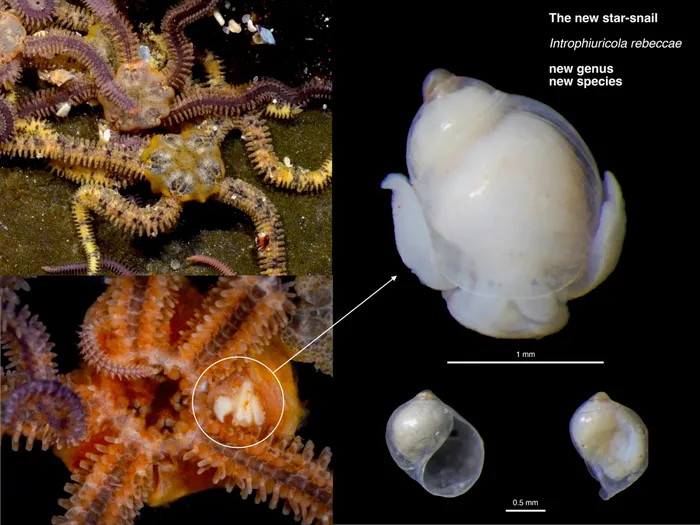
A parasitic sea snail discovered by a team of scientists.
Image: Supplied
In a groundbreaking achievement for marine science, a team of researchers has unveiled a new genus and species of parasitic sea snail, the result of nearly a decade of rigorous study. The discovery, reported in the Journal of Molluscan Studies, is the culmination of collaborative efforts involving scientists from the University of Cape Town (UCT), Sea Change Project, Stellenbosch University, and the University of Tokyo.
The journey began in 2015 when Dr Jannes Landschoff from the Sea Change Project, along with Rebecca MacKinnon, then an honours student, stumbled upon this unique snail while researching the biology of the Equitailed brittle star, Amphiura capensis. Unlike their starfish relatives that glide effortlessly through the water using tube feet, brittle stars manoeuvre across the seafloor by whipping their flexible arms, a behaviour that led to this remarkable discovery.
Dr Landschoff, heavily invested in studying brittle stars and their reproductive behaviours, first launched this project at the beginning of his research career, which later became the foundation for MacKinnon’s thesis. Their ongoing research yielded an unexpected find: small, white globules discovered in the brood chambers of brittle stars. After extensive investigation, these were identified as parasitic snails from the family Eulimidae, a group that had previously remained largely unknown to the researchers.
Identifying the unique snails required expert guidance, leading them to Associate Professor Yasunori Kano and Dr Tsuyoshi Takano at Tokyo University. They shipped their specimens to Japan, sparking a meticulous taxonomic study to determine their classification—a process that would unfold over nearly 10 years.
The eventual outcome confirmed the discovery of Introphiuricola rebeccae n. gen. n. sp., named in honour of MacKinnon, marking a significant addition to Molluscan science. Its parasitic lifestyle living as an internal resident of brittle stars is entirely unprecedented, representing a new wave of knowledge in the field.
Emeritus Professor Charles L Griffiths expressed his excitement about the discovery, noting that while the finding is unusual in brittle stars, several parasitic species are documented in related marine organisms such as starfish and sea urchins. "Finding new species in marine environments in South Africa is fairly routine," Griffiths remarked, reflecting on his more than 50 years of experience during which he has participated in over 100 species discoveries.
This research holds considerable importance for the 1001 Seaforest Species project, an initiative aimed at documenting the diverse life forms inhabiting the Great African Seaforest. As a vital part of the Sea Change Project and the Save Our Seas Foundation partnership, this work points to the ongoing need for collaboration among scientists to explore and understand our planet's rich marine biodiversity.