
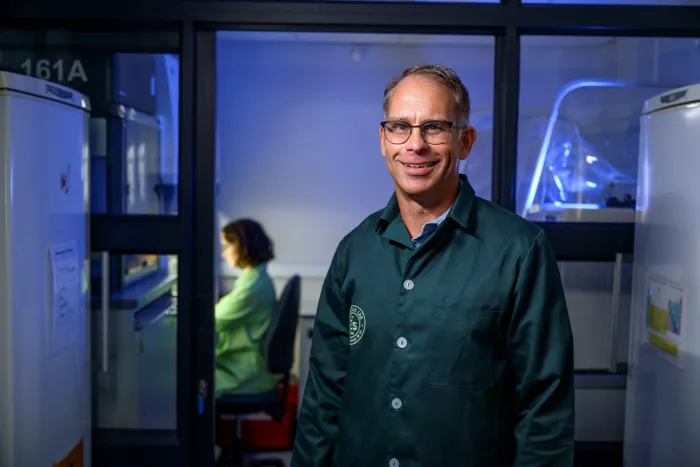
Prof Erick Strauss in his laboratory in the Department of Biochemistry at Stellenbosch University. He is leading one of two African project teams selected to participate in a global consortium to transform antibiotic discovery to counter the growing antimicrobial resistance (AMR) crisis.
Image: Stefan Els
In a significant stride towards combating the escalating crisis of antimicrobial resistance (AMR), Prof Erick Strauss from Stellenbosch University’s (SU) Department of Biochemistry is steering one of just two research teams from Africa selected for a global consortium aimed at revolutionising antibiotic discovery.
Announced by the Gates Foundation, the Novo Nordisk Foundation, and Wellcome, an ambitious $60 million in grant funding will bolster the efforts of 18 diverse research teams across 17 countries over the next three years.
This collaborative initiative—dubbed the Gram-Negative Antibiotic Discovery Innovator (Gr-ADI)—aims to counter the menace posed by Gram-negative bacteria, particularly Klebsiella pneumoniae, a notorious contributor to AMR-related mortality. As antimicrobial resistance presents an escalating threat, effective antibiotics have become increasingly elusive, marking an urgent need for innovative approaches in antibiotic research.
Prof Strauss, a prominent chemical biologist and head of SU’s Department of Biochemistry, is optimistic about the collaborative potential that Gr-ADI presents. His team, which includes esteemed co-investigators Prof Andrew Whitelaw from SU’s Department of Medical Microbiology, Prof Adrienne Edkins of Rhodes University, as well as partners from the Ersilia Open-Source Initiative in Spain, is poised to contribute significantly to this global endeavour.
“Traditional antibiotics disrupt critical processes necessary for bacterial growth and survival,” explained Strauss. “However, with the rising resistance against these drugs, we urgently need new strategies that can tackle Gram-negative bacteria differently.”
The innovative approach his team is exploring involves harnessing mechanisms from cancer therapy, specifically targeted protein degradation. This method employs specially designed bifunctional molecules known as PROTACs (proteolysis targeting chimeras) to redirect a cell’s native degradation machinery, effectively leading to the destruction of target proteins within the pathogens.
While the utilisation of PROTACs in cancer treatment has been well-documented, their application in combatting bacterial pathogens has only recently begun to gain traction. The concept of bacterial PROTACs, or BacPROTACs, was only introduced in 2022 as a potential treatment against multi-drug-resistant Mycobacterial infections, including tuberculosis.
Following a successful funding bid last year from the Gates Foundation and LifeArc, Strauss and his team are now excited to pivot their focus toward developing BacPROTACs against Gram-negative bacterial infections. “What is especially promising about this method is that the drug can be reused,” says Strauss, explaining the analogy of utilizing a fishing rod with a baited hook. “This suggests that lower doses may be required, potentially extending the drug's efficacy.”
Initiating a BacPROTAC development workflow centred on Klebsiella pneumoniae, Strauss's team aims to identify compounds that encourage the breakdown of vital drug targets within the bacteria, paving the way for innovative therapeutic options to emerge.
“We are thrilled to be part of the Gr-ADI consortium and contribute to addressing health challenges that disproportionately affect Africa. This is a crucial investment in our capacity to develop new therapies for infectious diseases," he concluded, reiterating the team's enthusiasm for their pioneering work in the fight against AMR.