
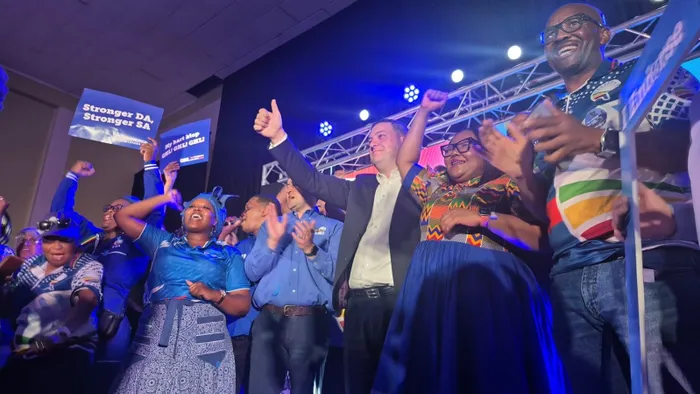
Cape Town mayor and now DA leader candidate in triumph mood at the Elsies River Civic Centre with Education minister Siviwe Gwarube sharing his announcement.
Image: Tracy-Lynn Ruiters
The sounds of “GHL!, GHL!” echoed throughout Halt Road as Cape Town Mayor Geordin Hill-Lewis took to the stage to make his “big announcement” that he has thrown his hat into the ring to become the next leader of the Democratic Alliance.
If elected at the party’s upcoming congress in April, he would become the youngest federal leader in the DA’s history, a factor his backers say signals generational renewal within the party.
Hill-Lewis's candidacy follows the decision by current DA leader John Steenhuisen not to stand for re-election. Hill-Lewis thanked Steenhuisen for stabilising and strengthening the party, saying the DA was in a better position because of his leadership. At the same time, he said the moment called for growth and a deeper connection with voters across the country.
“If we are going to build a stronger South Africa,” he told supporters, “we must have a stronger Democratic Alliance.” The launch event at Elsies River Civic Hall was marked by enthusiasm from those in attendance.
Reacting to the news political analyst, Nkosikhulule Nyembezi, said: "This candidature has been creating waves for a while, even among many who are not party members. I see Hill-Lewis’s stepping into the howling void Steenhuisen has vacated."
Nyembezi said Hill-Lewis may be exactly what the party needed. "In Hill-Lewis, they have a brilliant candidate, a competent public representative in the local government sphere with first-hand experience of the cracks and leaks in our social fabric and bright ideas for fixing them. In Cape Town and in many other constituencies nationally, the DA now appears to be one of the most plausible parties nominating individuals with a proven record of success in good governance to party leadership positions," he said.
Throughout the public debate on the party leadership contest, opinion makers have judged the DA candidates as the best bet. "So if, as the DA claims, the key aim is to stop the ANC, EFF, and MKP from gaining power, it is doing well in fielding candidates for party leadership and local government positions," Nyembezi added.
ANC provincial spokesperson Sifiso Mtsweni said while they would not be drawn on the DA's internal processes, the party was in a "freefall downward spiral at a very fast pace". "They are hemorrhaging votes in the bi-elections, they are deeply divided everywhere and society has now opened its eyes on the farce it is and the dummy it sold our people as a party of clean and effective governance, if anything it’s a direct opposite of everything it professes to stand for," he said.
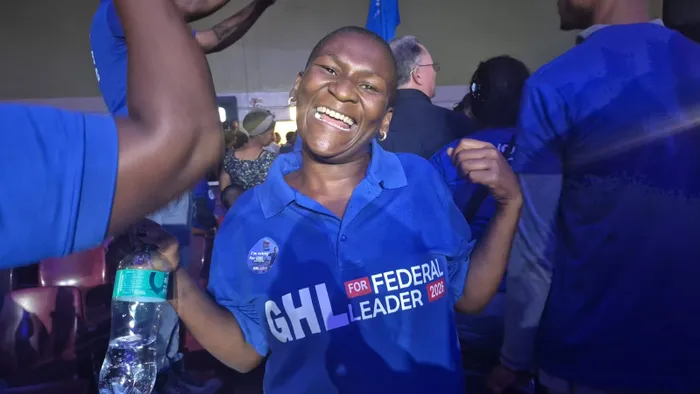
Clara Witbooi, happy about Geordin Hill-Lewis as DA Leader candidate.
Image: Tracy-Lynn Ruiters
In his speech, Hill-Lewis centered his campaign on restoring belief that South Africa can work. He criticised what he described as divisive politics that focus on blame and fragmentation, arguing instead for leadership rooted in constitutional values, tolerance and service. He said South Africans across communities share common aspirations such as safety, reliable basic services, job opportunities and hope for their children’s futures.
Drawing on his experience in Cape Town, he argued that decline is not inevitable and that competent governance can reverse failure. He pointed to investments in infrastructure and the delivery of basic services in the city, as well as economic growth and job creation, as evidence that effective leadership makes a tangible difference.
“When cities work, people work,” he said, suggesting that local success can serve as a blueprint for national progress. Hill-Lewis outlined a four point plan that he said would strengthen the DA over the next three years.
First, the party must continue to demonstrate that it governs effectively wherever it holds office, managing budgets responsibly, appointing competent officials and delivering services consistently. He stressed that the DA must govern for all residents, not only its supporters.
Second, he said the party must close the gap between itself and millions of South Africans who have never voted for it. While many recognise the DA’s governance record, he acknowledged perceptions that the party can appear distant.
He said trust must be earned through sustained engagement and listening to communities. Thirdly, Hill-Lewis defended the DA’s participation in the Government of National Unity, saying joining was the correct decision and the best opportunity in decades to reverse national decline.
However, he warned that the party must actively shape policy within the coalition and not drift quietly without influence. He said the DA must be principled and prepared to draw firm lines when necessary.
Finally, he said the party must lead with belief in South Africa’s future. Rejecting narratives that the country is beyond repair, he called for action driven hope focused on fixing what is broken and expanding the DA’s electoral footprint in upcoming elections.
Delegates will elect the party’s next federal leader at congress on 11 April in what is expected to be a closely watched contest. For Hill-Lewis, the race is about renewing the party and positioning it as a credible national alternative.
His campaign slogan, “Stronger DA. Stronger SA.”, now frames a leadership battle that could shape the direction of the Democratic Alliance for years to come.