
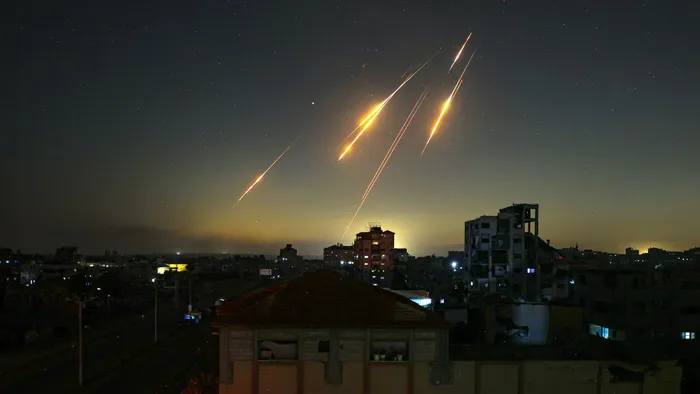
Missiles light up the night skies.
Image: Ayad Baba / AFP
South Africans living in the United Arab Emirates have described nerve-wracking nights as missiles and drones were intercepted over the region, while a Capetonian couple narrowly escaped danger while on pilgrimage in Saudi Arabia. For families back home in South Africa, the anxiety of watching loved ones in the midst of such chaos has been profound.
The recent surge of missile and drone attacks targeting the UAE and other Gulf countries began on 28 February 2026, following a major retaliatory operation by Iran. Earlier that day, a joint U.S. and Israeli military strike hit multiple locations inside Iran.
The attacks came amid months of escalating regional tensions and were reportedly linked to the reported death of Iran’s Supreme Leader, Ayatollah Ali Khamenei, an event that Tehran pledged to avenge.
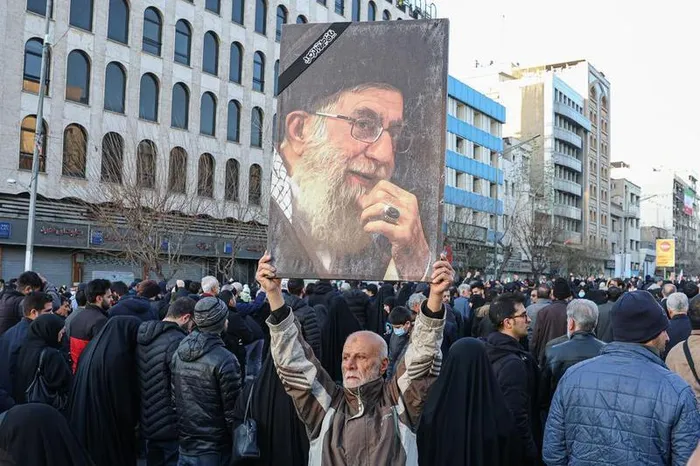
People gather to mourn the death of Iran's Supreme Leader Ayatollah Ali Khamenei in Tehran, Iran.
Image: Mehr News Agency/Handout via Xinhua
Cedric and Annelize Abrahams, parents based in South Africa, recounted the terrifying moments when they tried to reach their son, who was in Abu Dhabi with his spouse.
On Saturday, 28 February, the couple was attending a high school reunion when Annelize’s sister alerted her to check their family chat group.
“My son had been trying to get hold of us: ‘Where are my parents that they’re not answering their phones?’” Annelize said.
When they opened the chat, messages from family members were full of shock and fear, emojis highlighting the panic. Their son quickly gave them a summary of what had been happening, ending with: “But no danger here, we are fine.”
“Our hearts were gripped with shock and disbelief,” Cedric said. “‘No… it can’t be. Is this a joke?’ But his earlier words carried definite panic. In that moment, we knew we had to be firm, rooted, and strong for them.”
The couple called shortly after 22h00. On the video call, their son and spouse showed fragments of debris lighting up the night sky.
Stay calm
"At that stage, we could hardly see what they were showing us because we had only one thing on our minds as parents: We need to be calm for their sake, even though my heart was pounding somewhere in my throat,” Annelize said.
With steady voices, they reassured their family that they were safe and protected, even amid the chaos. News coverage confirmed how close debris had fallen, and the sounds described matched what was being broadcast live.
“The next morning, we called again. While we were on the call, they showed us how one of the ports at Jebel Ali was still smoking from debris of an intercepted projectile. Palm Jumeirah, visible from their apartment, had also been affected. Smoke rose into the sky when another missile was deflected,” Cedric explained.
Annelize described the anxiety of being far away from their family. “As a mother, my mind ran through every corner of their home. My prayers were for God to calm them and, above all, to shelter them from the chaos erupting around them.” Cedric, meanwhile, stayed quietly reflective, drawing strength through prayer.
They found ways to lighten the tension. “He made a joke. I added one too, suggesting they make a bed in the bathtub for the night since the bathroom is in the center of the apartment, away from the windows. They laughed, and we could feel the tension easing,” Annelize said.
Later, they realised they were already late for church. “Only then did we realise we were 90 minutes late for the service. We went anyway, arriving just in time to hear the sermon about Jesus walking on water Matthew 14:22–33, a reminder to stay focused and keep our eyes fixed on Him, who is in control of everything around us.”
After church, a call brought a moment of relief. “They were jolly, showing what food they prepared for lunch. They showed us outside the area where they stay, Jumeirah Beach Residence, usually a hub of tourists, deserted, no soul in sight,” Cedric said.
Missile interceptions
Meanwhile, other South Africans living in Abu Dhabi and Dubai shared their experiences of watching missile interceptions in real time. One expat described seeing bright flashes in the sky followed by loud booms that echoed across the city.
“You can actually see them being shot down,” she said. “There’s a flash in the sky and then a loud bang that follows. Sometimes it’s just a single burst of light. Other times there are multiple interceptions in quick succession.”
Despite the fear, she stressed that the UAE government’s swift response brought reassurance.
“Social media seems to be pushing the narrative that it’s very dangerous here, but for the most part, we’re staying indoors and following the safety protocols that have been put in place. At the moment, we can hear the bangs, but it’s really not that bad.”
Another expat noted, “I am relatively fine, but there are some that are anxious, which is understandable because you can literally hear and even see the missiles.”
Adding another layer, a Capetonian couple on pilgrimage in Saudi Arabia shared how they managed to leave just in time amid airline closures and airspace restrictions.
“My husband and I made it out just in time,” they said. “We were one of a few people who made it onto the Turkish Airlines flight and got through the gates. Istanbul to Cape Town was packed. We made it out in the nick of time.”
For many South Africans, the past days have been a mix of fear, faith, and gratitude whether witnessing missile interceptions in the UAE or anxiously following loved ones from afar.
“The reality is terrifying, but through faith and staying connected, we found moments of calm and reassurance,” Annelize said. “You pray, you watch, and you hope for another quiet night.”
Deep concern
President Cyril Ramaphosa and the Government of the Republic of South Africa have expressed deep concern regarding the escalation of tensions in the Middle East.
“These developments pose a serious threat to regional and international peace and security, with far-reaching humanitarian, diplomatic and economic consequences,” the statement said.
Ramaphosa called on all parties to exercise maximum restraint and to act in a manner consistent with international law, international humanitarian law, and the principles of the United Nations Charter.
“Article 51 of the UN Charter provides for self-defence only when a state has been subjected to an armed invasion. Anticipatory self-defence is not permitted under international law, and self-defence cannot be based on assumption or anticipation,” the statement continued.
“Experience has repeatedly demonstrated that there can be no military solution to fundamentally political problems that can and should be resolved diplomatically. Military confrontation has never delivered sustainable peace, nor has it addressed the legitimate grievances that underlie conflict. Long-term peace and stability can only be achieved through inclusive dialogue and a genuine commitment to justice and coexistence.”
In addition, the International Relations and Cooperation Department (DIRCO) has issued a Security Advisory and Travel Readiness Guidance for South African citizens in the State of Israel.
Key instructions include:
Operating hours for border crossings:
Allenby/King Hussein Bridge: 08:00 – 14:30 (Jerusalem, Ramallah, Jericho)
Northern Crossing (Beit She’an/Sheikh Hussein): 08:30 – 14:30 (Haifa, Nazareth, Galilee)
Southern Crossing (Yitzhak Rabin/Wadi Araba): 08:00 – 20:00
Menachem Begin Crossing/Taba Terminal: 24 hours (Southern border with Egypt, near Eilat)
Emergency contacts:
Israeli Emergency Services: 101 (Medical), 100 (Police), 102 (Fire)
South African Embassy in Israel: +972 50-520-8100 / +972 54-588-0698
South African Embassy, Amman, Jordan: +962 6-461-5167
South African Emergency Line (DIRCO): +27 12 351 1000 (Consular Services)
Jordan Border Inquiry: +962 5 393 3031
Emails: ngwanyaa@dirco.gov.za / segevl@dirco.gov.za
DIRCO emphasises that all decisions must prioritise safety, and citizens should prepare as though evacuation may be required.
tracy-lynn.ruiters@inl.co.za