
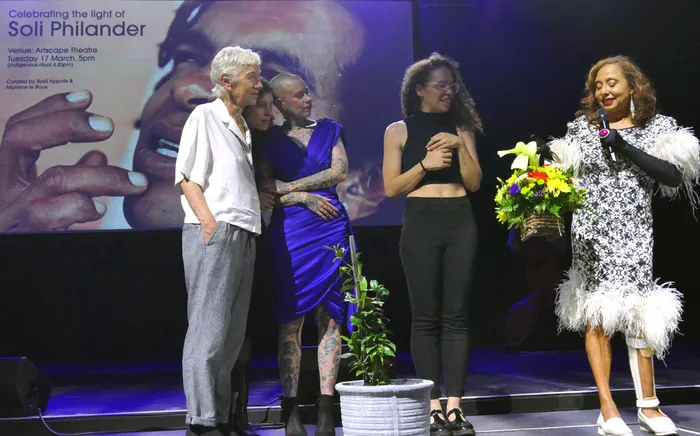
Marlene Le Roux (far right) hands over a bouquet of flowers to Soli's family
Image: Ian Landsberg
The stage lights at Artscape Theatre Centre burned a little softer on Tuesday evening as artists, friends, family and admirers gathered to honour the life and legacy of South African arts legend Soli Philander.
Titled Celebrating the Light of Soli Philander, the tribute brought together some of the country’s most recognisable voices in entertainment, all united in remembrance of a performer whose impact stretched far beyond the stage.
Among those in attendance were comedian Marc Lottering, singer Robin Pieters, Natalia da Rocha, Richard Juries, Celeste Williams, Didi Moses, and legendary drag performers Manila Von Teez, Kat Gilardi and Jayde Kay Johnson reflecting the diversity of a community Philander championed throughout their (non-binary) life.
In a remarkable show of dedication, the tribute was conceptualised and brought together in just seven hours by Artscape CEO Marlene le Roux and director Basil Appollis, highlighting both the urgency and the deep love felt across the arts community to honour Philander’s life.
The evening began on the Piazza outside the theatre with a deeply moving and spiritual moment, as members of the Khoi-San community led patrons in a cultural ritual acknowledging Silamour (Soli's birth name) a reflection of Philander’s ancestral heritage.
The ceremony set a powerful tone for the night, grounding the tribute in history, identity and remembrance.
The evening was both a celebration and a farewell, marked by music, storytelling and deeply personal reflections.
Delivering the keynote tribute, Le Roux opened with a message of both grief and gratitude.
“Welcome to Celebrating the Light of Soli Philander. Tonight, we gather with heavy hearts, but also with deep gratitude, to honour a life that gave this country so much,” she said.
Le Roux extended a heartfelt welcome to Philander’s loved ones, including Tony whom she described in Philander’s own words as “the love of their life” as well as their children and mother, acknowledging the deep personal loss behind the public mourning.
“To the entire Philander family, to Soli’s friends, loved ones, and chosen family, we hold you especially close this evening,” she said.
She also recognised the broader community present, from artists performing in Philander’s honour to audiences attending in person and online.
“Thank you for being here. Thank you for showing up in love.”
Le Roux described Philander as far more than an entertainer, highlighting a life defined by courage, truth and advocacy.
“Soli was not only a remarkable performer… Soli was also a truth-teller. A cultural worker. An activist. A person who stood in the fullness of who they were and, in doing so, made space for others to do the same,” she said.
She noted that while Philander’s humour brought laughter to many, it was their ability to affirm and reflect communities that left a lasting mark.
“Soli made people laugh, yes. But Soli also made people feel seen.”
In her address, Le Roux reflected on the deeper role of art in Philander’s life and work.
“They carried the stories of our communities with honesty, wit, tenderness and courage… Soli reminded us that art is not only performance. Art is memory. Art is resistance. Art is healing. Art is belonging.”
For many in attendance, the venue itself carried special meaning. Artscape was one of Philander’s artistic homes and, as Le Roux noted, the last stage on which they performed.
“This theatre was one of Soli’s homes… and it is profoundly moving, and painful, that this was the last home in which they performed,” she said.
“So tonight, Artscape does not simply host this gathering. Tonight, we welcome Soli home.”
Her words resonated through the auditorium as she invoked a sense of return of voice, spirit and memory.
“We welcome home their voice. We welcome home their spirit. We welcome home the memory of their laughter… and the truth they told so bravely.”
Beyond the tributes, the evening also served as a reminder of Philander’s expansive career. Born and raised in Elsies River, he carried the stories of his community into every performance, becoming known for blending humour with social commentary.
His work spanned theatre, television and radio, earning him recognition both locally and internationally, with performances in countries including the United Kingdom, the United States, Sweden, Swaziland and Namibia.
Philander became a household name through television shows such as Liriekeraai and the South African adaptation of Are You Smarter Than a 5th Grader?, while also appearing in productions like Arendsvlei, Dias Santana, Hooten & the Lady and Devil’s Peak, as well as the film The Umbrella Men: Escape from Robben Island.
For many South Africans, one of his most enduring contributions remained his role as Timothy Traddle in the children’s programme Kideo a character that quietly became part of the country’s collective childhood memory.
His voice also reached audiences through radio, most notably as host of Airborne on CapeTalk, where he combined humour with meaningful conversation.
In later years, Philander devoted much of his time to community activism, particularly in District Six, where he lived. He became known not only as an entertainer, but as someone who used his platform to advocate for marginalised communities and to speak openly about social justice issues.
The tribute unfolded as both a communal grieving space and a celebration of a life that shaped South African storytelling across generations. Through music, shared memories and moments of silence, the evening reflected the many dimensions of Philander’s legacy artist, activist and mentor.
Closing her tribute, Le Roux left the audience with a message of continuity rather than finality.
“Soli’s light will not be dimmed by death. It lives on in the work, in the memories, in the people they touched, in the communities they affirmed, and in every life made a little braver by their presence.”
tracy-lynn.ruiters@inl.co.za