
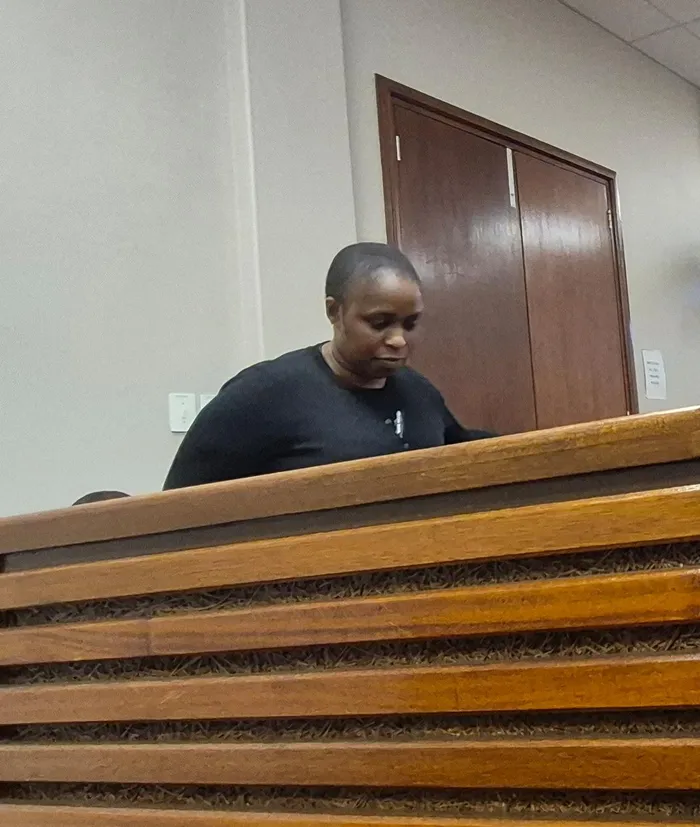
A social worker testified in mitigation of sentence that Noxolo Pearl Ngqono convicted of killing her five-year old son suffered from mental illness.
Image: Tracy-Lynn Ruiters
As the mother convicted of beating her five-year-old son to death awaits sentencing in the Western Cape High Court, the court this week heard emotional testimony from defence witnesses pleading for mercy and arguing that untreated mental health struggles linked to pregnancy may have played a role in the killing.
Noxolo Pearl Ngqono, who was found guilty of murdering her young son with a mop, returned to the Wynberg Regional Court, sitting as the Western Cape High Court, for sentencing proceedings where the defence sought to convince the court to deviate from the prescribed minimum sentence.
The court heard evidence from a social worker who compiled a report after interviewing Ngqono and several family members.
According to the report, the deceased child had been born prematurely, two months before his due date, under traumatic circumstances after Ngqono allegedly gave birth in a toilet.
The social worker testified that the traumatic birth appeared to have deeply affected the accused.
She further told the court that both the earlier assault incident in 2019 and the fatal assault occurred while Ngqono was heavily pregnant.
In her professional opinion, pregnancy-related mental health struggles, including possible postpartum depression or postpartum psychosis, may have contributed to the offences.
“The main thing that stood out were the issues surrounding pregnancy that were identified,” the witness testified.
“It could be tied in with postpartum psychosis and depression.”
However, she stressed that she was not qualified to formally diagnose any mental condition.
The social worker testified that Ngqono had no prior history of impulsive behaviour or hostility and described her as deeply ashamed and emotionally distressed during interviews conducted for the report.
“She felt ashamed of her behaviour and how she dealt with the child,” the witness said.
The court heard that Ngqono struggled to speak about the incident and at one stage allegedly expressed suicidal thoughts, telling the social worker she could not believe what had happened.
“She mentioned that she would kill herself,” the witness testified.
The social worker also criticised the decision to return the child to Ngqono’s care after the earlier 2019 abuse incident.
She noted that Ngqono had attended parenting programmes before the child was reunited with her, but said no psychological assessment or postnatal support appeared to have been provided.
“In my professional opinion, I believe this was definitely an oversight,” she said.
“the decision to return the child should not have been made at that time.”
The witness told the court that multiple stressors appeared to have affected Ngqono, including pregnancy, retrenchment, Covid-19 hardships and possible untreated mental health challenges.
“Mental health played a very big role,” she testified.
“For this reason, I believe long-term imprisonment is not beneficial, even though punishment is necessary.”
Under cross-examination, the State questioned why the social worker had not requested a psychiatric evaluation if she believed underlying mental health conditions may have existed.
The witness responded that the report had to be completed within a limited timeframe.
The State also questioned why the accused’s husband had not been properly consulted about possible symptoms associated with depression, including persistent sadness, lack of sleep and loss of interest.
The social worker replied that the husband had described Ngqono as stressed during discussions.
Acting Judge Amanda van Leeve also raised concerns during questioning, remarking that much of the defence argument appeared to rely on possible diagnoses that were never formally confirmed.
“So everything depends on whether the accused was diagnosed, which she was not,” Van Leeve commented.
The court later heard emotional testimony from Ngqono’s husband, Bandile Ngqono, who pleaded with the judge not to impose a lengthy prison sentence on his wife despite accepting the court’s guilty verdict.
“I have accepted that the court has found my wife guilty, but I have a few requests and I won’t go against the decision of the court,” he told the judge.
“I know when something goes wrong, the person has to be punished.”
Bandile explained that their youngest child was only one year old when Ngqono was separated from the family following her arrest.
“That child has been staying with me ever since,” he said.
“I want to request the court, when punishing my wife, not to throw away the key please. That child does not know his mother anymore. He is seven now.”
The court also heard that the couple’s five-year-old daughter currently lives with him.
“I request the court to consider these factors,” he pleaded.
“Ever since being separated from my wife, I only see her at court and I can see she is broken. She is not the same.”
He asked the court to consider a suspended sentence, adding: “She is not violent.”
Ngqono remains in custody after her bail was revoked following her conviction. She faces a prescribed minimum sentence, including the possibility of life imprisonment, unless the court finds substantial and compelling circumstances to justify a lesser sentence.