

Navy Chief Vice-Admiral Monde Lobese.
Image: SANDF
The head of the SA Navy has warned that repeated budget cuts have left the force buckling under the strain of safeguarding the nation’s maritime borders, especially with South Africa’s waters seeing a 100% surge in ship traffic as the Strait of Hormuz remains closed and piracy attacks off Somalia and Yemen escalate.
Speaking on the sidelines of a recent medal parade held before the tabling of the national defence budget, Chief of the South African Navy, Vice Admiral Monde Lobese, warned that geopolitical tensions and increased shipping activity along South Africa’s coastline had placed the Navy at a critical crossroads.
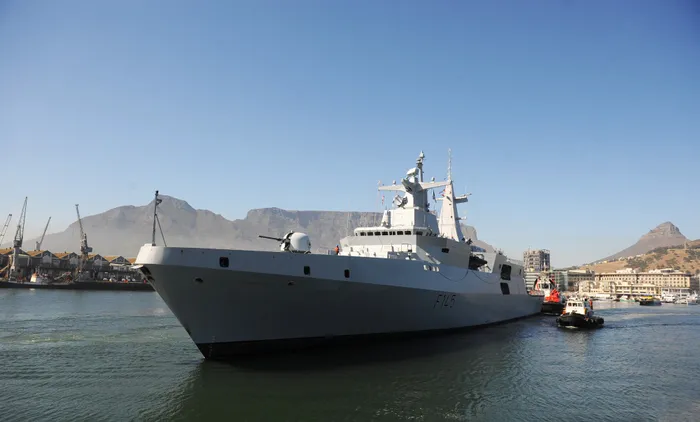
The work of the SAS Amatola (F145) has been praised
Image: Armand Hough / Independent Newspapers
Lobese revealed that maritime traffic in South African waters has more than doubled following instability in the Strait of Hormuz, one of the world’s most critical shipping chokepoints.
“The conflict at the Strait of Hormuz has significantly increased the maritime shipping traffic in our waters,” he said.
He added that before the conflict, South Africa’s Maritime Domain Awareness Centres recorded an average of 16 606 ships in local waters, but that number has since surged to an average of 36 171 vessels.
At the same time, piracy attacks off Somalia and Yemen have escalated sharply, with at least four vessels reportedly hijacked since April 2026. Lobese said the resurgence of piracy, coupled with coastal terrorism and organised maritime criminality in regions such as the Horn of Africa, the Gulf of Guinea and offshore Mozambique, continues to threaten international trade routes.

Defence Minister Angie Motshekga
Image: Supplied
Despite South Africa’s strategic position along one of the busiest maritime corridors in the world, Lobese admitted the Navy lacks the operational capability and resources required to fully safeguard the country’s national interests.
“We are not even equipped as the South African Navy, to sail to the Straits of Hormuz, or anywhere else in volatile waters, in order to protect our national interests from any threat,” he said.
He stressed that more than 80% of South Africa’s trade moves through the oceans, warning that any major disruption at sea could have devastating economic consequences.
Lobese also painted a picture of a Navy battling to maintain morale while operating under severe resource constraints.
“As the chief of the Navy, I'm doing my utmost best within the limited resources that I have at my disposal,” Lobese said, explaining that the Navy often has to “rob one ship to keep the other one at sea” in an effort to maintain operational capability.
He said sailors were becoming increasingly demotivated because vessels were no longer regularly deployed like they were in previous years.
“Our sailors can only be motivated if the ships actually will see them at sea,” he said, recalling how, after 1994, it was common to see multiple naval vessels departing harbour daily.
“Today you cannot actually see that. So our sailors get demotivated by those experiences and end up going to join the private sector.”
Lobese warned that South Africa could not afford to neglect maritime defence at a time when global instability was placing additional strain on shipping routes and regional security.
“We are facing serious challenges as a country,” he said, adding that the increase in maritime traffic passing through South African waters carried risks beyond commercial trade.
“There’s a lot of human trafficking that’s actually taking place through the seas. So the presence of the South African Navy at sea always helps to be a deterrent.”
He pointed to a recent operation in which the Navy, working alongside other state departments, intercepted a vessel arriving from South America that was suspected of carrying drugs.
“I would say that the presence of the South African Navy in collaboration with other state departments is something that this country cannot afford not to have,” he said.
A week later, the concerns raised by Lobese were thrust into sharper focus during the tabling of the national defence budget. The Department of Defence received a total allocation of R57.6 billion, with the South African Navy allocated R1.9 billion. An additional R607 million was earmarked specifically for the repair and maintenance of naval platforms, while R80 million was allocated for military uniforms.
The budget also outlined several operational and structural interventions aimed at strengthening the SANDF amid growing internal and external pressures.
Government also acknowledged the growing importance of maritime security in its budget presentation, noting that increasing maritime traffic along the Cape Sea Route heightens both security and economic risks and underscores the need for a comprehensive national maritime security strategy. The budget presentation further described the Navy as a “strategic necessity of our time”, warning that neglecting South Africa’s maritime capability could result in “strategic self-harm and global irrelevance”.
However, Dr Clive Coetzee of the Department of Economics and Defence Organisation and Resource Management at the School of Military Science at Stellenbosch University, believes the challenges facing the South African National Defence Force, and particularly the Navy, cannot be attributed solely to declining budgets.
“Is the root cause simply the budget? Or do we fully understand the underlying causes of the challenges? I am not convinced it’s always only about the money,” Coetzee said.
He noted that the defence budget has steadily declined over the past two decades and said he does not expect major increases under the current fiscal environment.
“The budget has been shrinking for the last 20 years. Given current fiscal realities and broader socio-economic pressures, I do not foresee significant increases in defence expenditure in the near future,” he said.
Coetzee questioned whether South Africa currently faces a threat environment substantial enough to justify a major expansion in defence spending.
“In my view, South Africa currently faces relatively limited conventional military threats, which makes it difficult to justify a significant increase in defence expenditure,” he said.
Coetzee also cautioned against viewing budget constraints as the sole explanation for operational difficulties within the SANDF.
“While budget constraints are clearly significant, they may not fully explain all of the operational and maintenance challenges facing the defence force,” he said.
He argued that procurement systems, institutional efficiency, innovation and long-term planning should also form part of the discussion.
“An important question is what institutional reforms, innovations, or operational adjustments are being explored internally to address these challenges,” he said.
“To what extent is the current system able to innovate and adapt to evolving fiscal and operational realities?”
Coetzee further suggested that alternative sustainability and revenue-supporting mechanisms could also be explored.
Chris Hattingh, the DA Portfolio Committee on Defence and Military Veterans spokesperson, said the current budget does little to halt what he described as the SANDF’s continuing decline.
“The Defence Review 2015 recognised more than a decade ago that the SANDF was already in critical decline. The first milestone of the Review was not to expand capability, but simply to arrest the decline and prevent further capability losses,” Hattingh said.
“That milestone was never funded and never implemented. The current budget does not reverse the decline. It does not restore naval capability. It does not even stop the ongoing loss of capability.”
Hattingh warned that South Africa’s maritime responsibilities were growing while the Navy’s ability to meet those responsibilities continued to erode.
tracy-lynn.ruiters@inl.co.za