
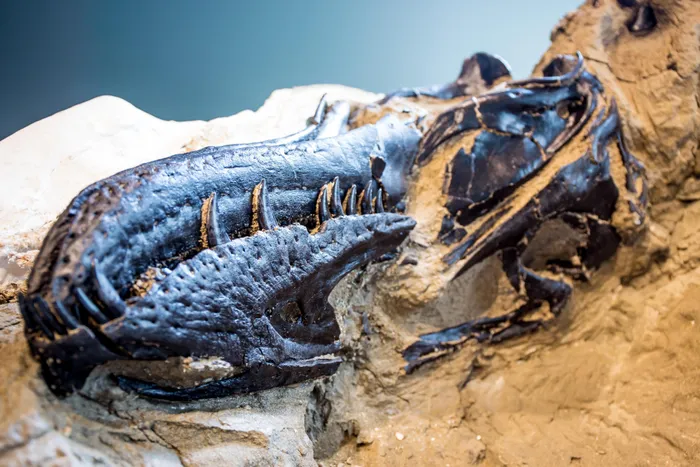
In a new paper, researchers say differences in this fossil skull indicate it is a separate genus from Tyrannosaurus rex.
Image: NC Museum of Natural Sciences/The Washington Post
A remarkably complete tyrannosaur specimen, unearthed in the middle of Montana, USA, may finally settle one of the most contentious debates in paleontology and upend our understanding of Tyrannosaurus rex, one of the most famous extinct animals on Earth.
A paper published in the journal Nature presents strong evidence that the new fossil, along with four others assumed to be teenage T. rex, are actually part of a distinct group called Nanotyrannus. The researchers discovered fine differences in the bones and evidence the new fossil was a mature adult that had stopped growing, revealing that it was not an immature T. rex. The study also fleshes out a more diverse picture of the predators of the late Cretaceous, making the case that there were two species of nanotyrannus.
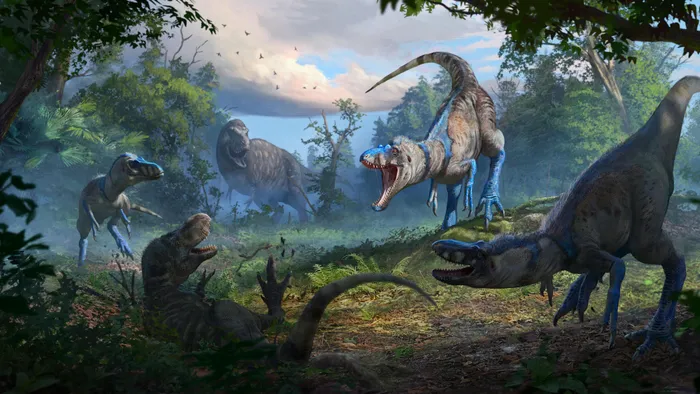
An illustration portrays a Nanotyrannus attack on a juvenile T. rex.
Image: Anthony Hutchings/The Washington post
For several decades, nanotyrannus has been a paleontological third rail. After these small-bodied tyrannosaurs were first identified as a separate species in the mid-1940s, many experts had come to believe they had been misclassified. They were just slender, more lightly built T. rex teenagers, they said.
Upturning that notion leads to new questions: How did these different dinosaur species interact? Did they hunt different prey? What did T. rex adolescence really look like?
“The overarching mic drop of this paper is that Nanotyrannus is real, its own distinct tyrannosaur species, and that necessitates a fundamental reassessment of tyrannosaur classification and evolution,” Steve Brusatte, a paleontologist at the University of Edinburgh not involved in the new study, said in an email. “It’s wonderful when new evidence shows that some of our cherished notions - my cherished notions as a tyrannosaur researcher - are likely to be wrong. That’s science.”
T. rex incites strong opinions and emotions among tyrannosaur experts and the broader dinosaur fandom alike. This apex predator is the yardstick against which all other dinosaurs are frequently measured: How big were they compared to T. rex? How fierce were they compared to T. rex?
And for decades, nanotyrannus proponents had been relegated to the margins by scientific consensus. As word of the new study began to circulate among paleontologists this week, some began to make cryptic anticipatory posts on social media.
“A bunch of us who knew this was coming have been commenting obliquely online about hiding in bunkers. Some people will be angry, others will be, ‘I told you so,’” said Thomas Holtz Jr., a paleontologist at the University of Maryland not involved in the study who said that he had previously been persuaded by the argument that these specimens were T. rex juveniles. “They make a better case for the reality of nanotyrannus than anyone has so far.”
Smithsonian paleontologist Charles Gilmore described a new carnivorous dinosaur from a skull found at the Hell Creek formation in Montana in a paper published in 1946, the year after he died. He described it as a species of Gorgosaurus, another tyrannosaur and slightly smaller cousin of T. rex.
Four decades later, a scientific team reanalyzed the skull and published its interpretation in a paper titled “NANOTYRANNUS, A NEW GENUS OF PYGMY TYRANNOSAUR, FROM THE LATEST CRETACEOUS OF MONTANA.”
Nanotyrannus lancensis was less than half the length of T. rex, from snout to tail. It was a relatively long-limbed animal. Little is definitely known about a species whose existence has been doubted for decades, but scientists have argued it would have been more gracile and cheetah-like, in contrast to the stocky, stomping brute force of T. rex.
Then, paleontologist Thomas Carr of Carthage College offered a compelling rebuttal in 1999. These nanotyrannus specimens, he proposed, had a simpler explanation - they were youthful T. rex.
That explanation took hold in the broader paleontology community. Scientists studying T. rex biology - its feeding habits, its maturation and how it moved about - factored in these smaller specimens.
Paleontologist Nicholas Longrich recalled a scientific meeting a decade ago when a colleague, Peter Larson, came up to him waving around two casts of dinosaur arms. In one hand was the forelimb of a T. rex. In the other was what most people in the tyrannosaur community assumed was a T. rex teenager.
“He comes up to me waving the cast at me, and he’s like: ‘Nanotyrannus is real,’” Longrich recalled. “It’s like a conspiracy theorist telling you a Bigfoot is real. Yeah, sure, Pete. Sure, it’s real.”
Larson, president of the Black Hills Institute of Geological Research in South Dakota, a private company that excavates, buys and sells fossils, has collected a lot of T. rex specimens - so many that he demurs when asked exactly how many. Is it 13 or 14? But all the way back to 2001, when he saw a putative young T. rex called “Jane” - he has been convinced that these smaller-bodied T. rex are not juveniles, but nanotyrannus.
“I was kind of like the lone soul crying in the wilderness,” Larson recalled.
In 2021, the North Carolina Museum of Natural Sciences acquired the “dueling dinosaurs” - 30,000 pounds of bone and rock containing what they thought was a juvenile T. rex and a triceratops, buried together in Montana. The circumstances of the entangled bones lit the imagination - it appeared to be a snapshot of a predator and its prey, a 67-million-year-old battle frozen in time.
Lindsay Zanno, associate research professor at North Carolina State University and head of paleontology at the museum, began to work with James Napoli, now a paleontologist at Stony Brook University, on the fossils.
“We quickly realized it was not at all like a juvenile T. rex, and it started to raise a flag,” said Zanno, who wrote this week’s study with Napoli. The first clue was the forelimb - the arm. The dinosaur’s hand was really big.
“If you compare it to the large-bodied T. rex individuals, these are animals that are 42 feet long. These are enormous fully grown T. rex, and the hand of nanotyrannus is bigger at its small size than the hand of a fully grown T. rex,” Zanno said.
They began a detailed analysis of the fossil and kept finding distinctive oddities - the way the cranial nerves would have threaded through the skull, and the patterns of sinuses in the skull.
Then, they cut into the limb bones. An analysis of the growth rings in the bone showed that at about 20 years old, it was a mature individual that had stopped growing, but at less than half the length of a full-grown T. rex.
They then went back to reexamine 120 existing fossils. They found that one skeleton known as Jane, commonly assumed to be a teenage T. rex, was not only a nanotyrannosaur, but a different species of nanotyrannosaur than the others they were studying. They named it Nanotyrannus lethaeus after the River Lethe, a mythological river in the Greek underworld that souls drank from to forget their past lives.
“We thought that this would be a cool name for an animal that’s been hiding under our noses this whole time,” Zanno said.
Longrich, an early nanotyrannus skeptic, came around after reexamining teenage T. rex fossils and published his own study last year. But the paradigm did not shift until the dazzling new specimen was analyzed in detail this week. He now thinks the field, himself included, had blinders on. Larson was right. He sees the rejection of the nanotyrannus idea as a symptom of scientific groupthink.
“The weight of the evidence was always there, but now it’s an avalanche. Hard to ignore,” Longrich said in an email. “This is one of the most complete examples we have of nanotyrannus, and it’s different from T. rex in almost every bone of its body.”
Even Carr, who propelled the theory that nanotyrannus was adolescent T. rex, said that he was convinced the new “dueling dinosaur” specimen was a small adult tyrannosaur, a different species from T. rex. However, he was unconvinced that Jane was a second species of nanotyrannus. As he ruminated on where these finds left the field, he became philosophical.
“In science, the goal is to arrive at the one true hypothesis of nature - and for a while there, I thought we had a defensible one,” Carr said. “Turns out, it isn’t, and so there’s a lot more to discover. … We’re just learning we don’t know anything about tyrannosaur evolution. So, as a scientist you just have to live with that. You just have to live with your own ignorance. There’s more work to be done. That’s okay, too.”
Why was the idea that nanotyrannus could be a species independent from T. rex so hard to budge?
Some scientists say that the evidence wasn’t quite there before this paper. Others point out that many juvenile T. rex specimens are in the hands of private collectors, not museums, meaning that specimens that could have helped answer this question sooner are missing from the scientific literature. Holtz noted that the politics of paleontology may have played a role. Paleontologists who were connected to the commercial fossil industry in the 1990s and early 2000s - an involvement many academic scientists deeply criticized - were some of the biggest proponents of the nanotyrannus idea.
Taxonomic disputes aside, many paleontologists are excited.
“What gets missed between all this, in all our egos - is nanotyrannus is a cool creature. A beautiful skull. Lanky limbs,” Longrich said. “More options for kids to have a favorite dinosaur.”