
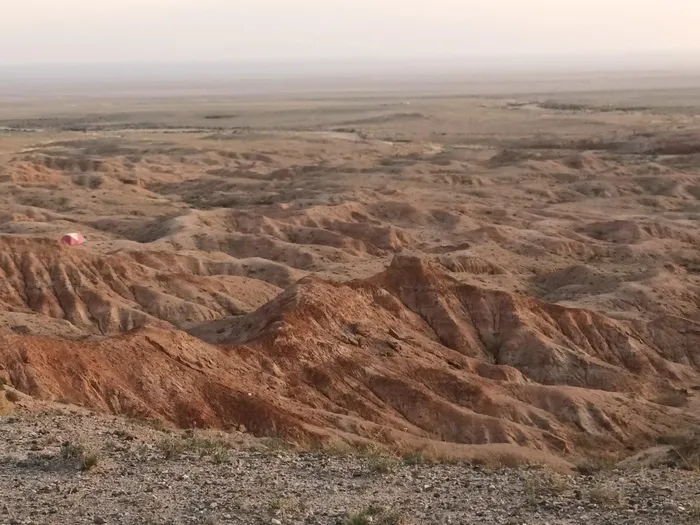
Looking out across the exposed fossil-bearing strata of the fossil locality Teel Ulaan Chaltsai, located in the Sainshand Sub-basin, Eastern Gobi Basin, Mongolia. The team dated eggshell from the Teel Ulaan Chaltsai locality.
Image: Ryan Tucker
An international team of geologists and paleontologists, led by Dr Ryan Tucker from the Department of Earth Sciences at Stellenbosch University, has unveiled a revolutionary approach to dating fossil-bearing rocks by directly examining fossilized dinosaur eggshells. Published in the journal Communications Earth & Environment, this study promises to reshape our understanding of ancient ecosystems and the evolutionary timelines of dinosaurs.
Traditionally, dating fossil sites has posed significant challenges, with many relying on coarsely dated geological formations. Fossils' precise geologic age offers crucial insights for paleontologists attempting to decipher the complex relationships among various species across different periods. The common practice has involved dating minerals such as zircon or apatite associated with fossils; however, these minerals are not always available, and dating methods applied to the fossils themselves have often led to ambiguous results.

Artistic reconstruction of a newly hatched troodontid-like dinosaur resting among fragments of its eggshell (loosely based on Mongolian microtroodontid-type).
Image: EvaUtsukiyouhei(宇津城遥平)2025
Dr Tucker and his research team, including MSc student Kira Venter and Prof Cristiano Lana of the Elemental and Isotope Analysis Laboratory at Stellenbosch University’s Central Analytical Facilities, embarked on a novel approach combining advanced uranium–lead (U–Pb) dating with elemental mapping. This cutting-edge technique allows researchers to measure trace amounts of uranium and lead trapped within the calcite of dinosaur eggshells, functioning as a natural clock to establish when the eggs were buried.
Utilising a Neoma Multi-Collector Inductively Coupled Plasma Mass Spectrometer (MC-ICP-MS), the team demonstrated that the eggshells provided accurate age estimations within five percent when compared to precise volcanic-ash dating methods. Field tests on dinosaur eggs from regions such as Utah (USA) and the Gobi Desert (Mongolia) yielded remarkable successes, including the determination of the first-ever direct age—approximately 75 million years—for a site renowned for its fossilized dinosaur eggs and nests in Mongolia.
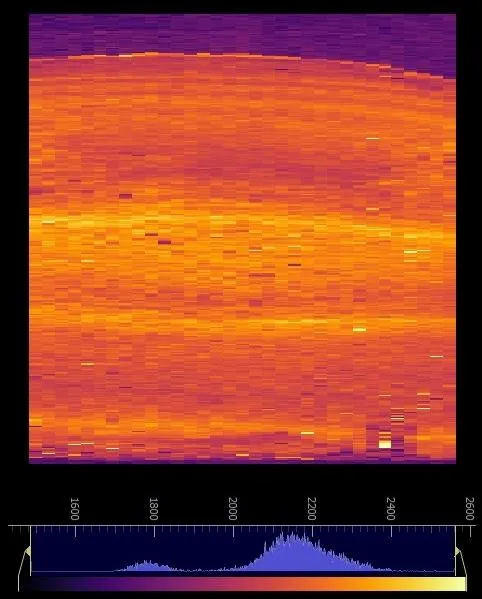
Elemental map of the isotope strontium (Sr) from dinosaur eggshell collected from Teel Ulaan Chaltsai, Eastern Gobi Basin. Elemental maps were used by the researchers to evaluate if the uptake of strontium (Sr) was uniformly distributed across the eggshell. A uniform distribution indicates that uptake of this and other isotopes occurred after burial but prior to fossilization.
Image: Kira Venter and Cristiano Lana
“Eggshell calcite is remarkably versatile,” asserted Dr Tucker. “It gives us a new way to date fossil sites where volcanic layers are missing, a challenge that has limited paleontology for decades.” This ground-breaking technique bridges the gap between biology and Earth sciences, equipping researchers with a robust tool for dating fossil sites worldwide.
The study received contributions from various collaborators, including the North Carolina Museum of Natural Sciences, North Carolina State University, and the Mongolian Academy of Sciences' Institute of Paleontology. Notably, field research in Mongolia was facilitated through the Mongolian Alliance for Dinosaur Exploration (MADEx) and support from the National Geographic Society and the National Science Foundation.
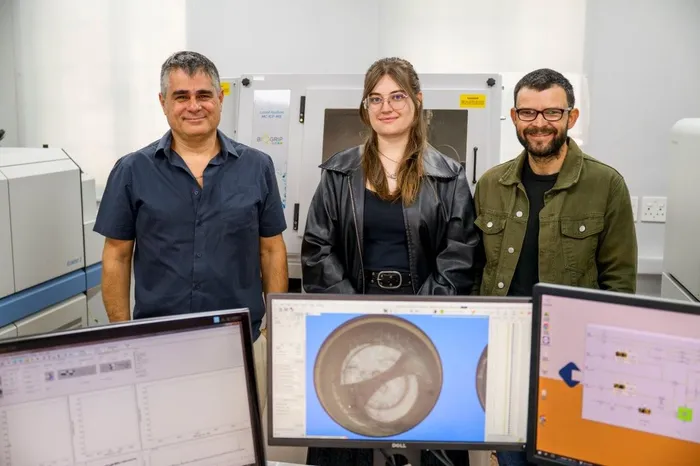
This team from Stellenbosch University (SU) developed a novel method to age-date fossilized dinosaur eggs, using a Neoma Multi-Collector, Inductively Coupled Plasma, Mass Spectrometer (MC-ICP-MS) instrument, hosted in the Elemental and Isotope Analysis Laboratory in SU’s Department of Earth Sciences. They are, from left to right, Prof Cristiano Lana, MSc student Kira Venter, and Dr Ryan Tucker.
Image: Stefan Els
“Direct dating of fossils is a paleontologist’s dream,” remarked co-author Lindsay Zanno, an associate research professor at North Carolina State University and head of paleontology at the North Carolina Museum of Natural Sciences. “Armed with this new technique, we can unravel mysteries about dinosaur evolution that used to be insurmountable.”
This innovative research opens new avenues for paleontological studies, offering a dependable means of accurately dating fossils and enriching our understanding of the dinosaur era. The full details of the study can be found in the article titled “U–Pb calcite age dating of fossil eggshell as an accurate deep time geochronometer,” featured in Communications Earth & Environment.