
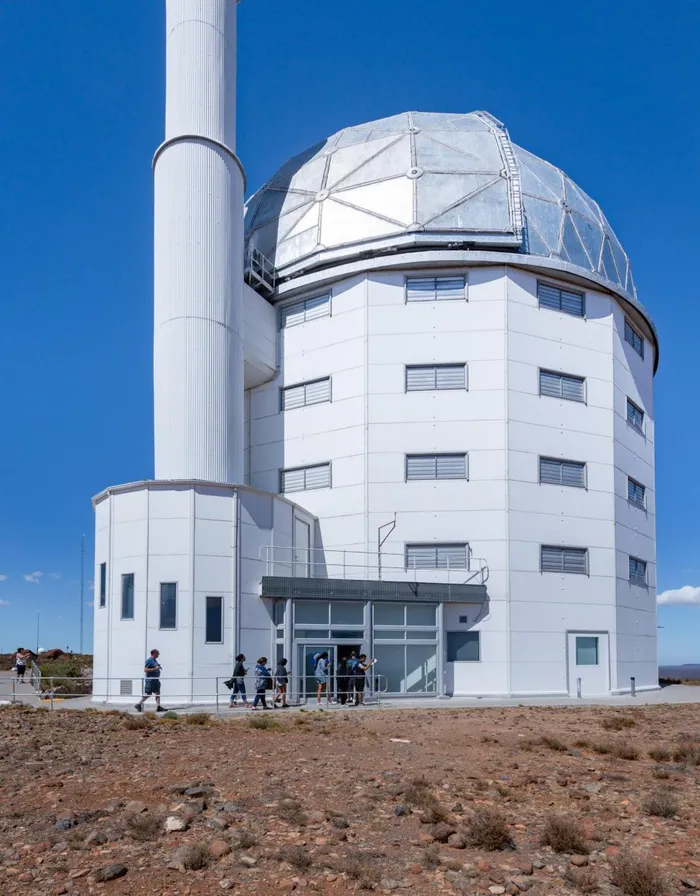
The Southern African Large Telescope (SALT), Africa's largest optical telescope.
Image: Supplied
On 10 November, the Southern African Large Telescope (SALT), Africa's largest optical telescope and one of the world's most potent astronomical instruments, celebrated an impressive 20 years since its official inauguration by then President Thabo Mbeki in 2005. This significant milestone was marked by a grand event hosted in Sutherland, Northern Cape, where SALT continues to unveil the mysteries of the cosmos.
The celebration was a collaborative effort involving SALT, the Department of Science, Technology and Innovation (DSTI), and the South African Astronomical Observatory (NRF-SAAO), bringing together dignitaries, leading astronomers, and representatives from international partners. The gathering offered an opportunity to reflect on SALT's scientific contributions and its legacy within the realm of global astronomy.
In his opening address, Prof Brian Chaboyer, SALT Board Chair, reminisced about the courageous decision made to construct an optical telescope within South Africa. “SALT was the first South African-built optical telescope,” he noted, emphasizing its significance amid a landscape where all previous telescopes were developed abroad. The vision for SALT emerged as part of an ambitious science white paper from the new government aiming to establish the biggest single optical telescope in the Southern Hemisphere.
Deputy Minister of Science, Technology and Innovation, Dr Nomalungelo Gina, delivered the keynote address, reflecting on the democratic government's pivotal decision in 1998 to fund SALT's construction. “This was a defining moment for South African science,” she stated. “SALT was built to serve both science and society, seamlessly linking frontier research with education, technology, and socio-economic development.”
Dr Gina celebrated SALT as a symbol of what is possible when vision, investment, and international collaboration coalesce in pursuit of knowledge. “SALT’s 20-year journey is a story of vision, perseverance, and excellence,” she affirmed, vowing the Department's commitment to maintaining and expanding South Africa’s stature in the field of astronomy. “It shines as a beacon of African science, uniting research, education, and innovation for the benefit of humanity.”
Prof Mosa Moshabela, NRF Board Chair, echoed Dr Gina's sentiments, underscoring that the conception of SALT represented not merely a scientific ambition but a bold governance decision. “South Africa was making a statement that it could build and sustain a world-class research facility,” he asserted. This became reality through the NRF's stewardship, which has been instrumental throughout SALT's two decades of operation, serving as its primary shareholder, funder, and custodian.
Beyond its status as a leading telescope, SALT has become an invaluable laboratory for scientific discovery and a workshop for human development. Over fifty doctoral theses have been produced from data gathered at SALT, with numerous students benefiting from hands-on training at the Observatory. Many have since advanced to prominent positions in research and technology across the globe.
Affectionately termed “Africa's Giant Eye on the Sky,” SALT possesses the remarkable capability to detect light from celestial bodies that are a billion times too faint for the naked eye to perceive. Originally conceptualised in the late 1990s as a key national scientific initiative, SALT received a US$10 million investment from the South African government for its construction, completed in 2005., which was completed in 2005. It commenced full scientific operations in 2011 and has since generated groundbreaking research that continues to deepen our understanding of the universe.
Over the past two decades, SALT has achieved significant astronomical milestones, including:
As SALT gears up for the next decade, its partners and international collaborators are united in their commitment to broadening the telescope’s scientific reach and furthering South Africa’s role as a pivotal player in the realm of cutting-edge astronomy.