
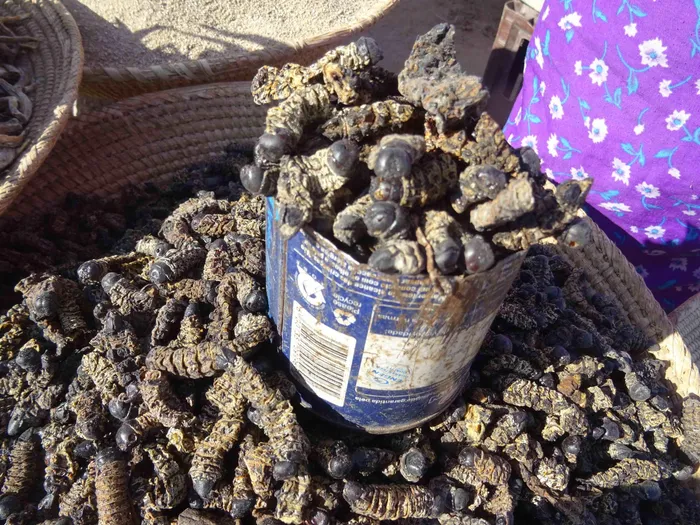
New study on mopani worms warn about their threatened future.
Image: Supplied
Mopane worms, a protein-rich delicacy commonly harvested across Southern Africa, are more than just a sustainable food source—they are crucial to local livelihoods and cultural practices. However, new research is shedding light on the need for conservation efforts amid warnings of rising environmental threats and overharvesting.
Researchers from Stellenbosch University, in collaboration with the South African National Biodiversity Institute and other institutions, recently published a pivotal study in the journal Conservation Genetics, focusing on the genetic diversity and population distribution of mopane worms in Namibia and the Limpopo River Basin, which spans South Africa and Botswana. Their findings reveal alarming trends that could jeopardise the future of this vital species.
Known for containing three times more protein than beef or chicken, as well as rich levels of calcium, iron, and zinc, mopane worms are typically boiled or fried to be enjoyed as a snack or incorporated into meals. While their nutritional value supports local communities, the study underscores an urgent need to understand the genetic health of these populations due to reported overharvesting across Botswana, Namibia, South Africa, and Zimbabwe.
Lead author Dr Barbara van Asch, from the Department of Genetics at Stellenbosch University, explained, “We offer the first look at how mopane worm populations are related and distributed across Namibia and the Limpopo River Basin. Genetic data can help guide wildlife conservation by showing how different populations are related, how big they are, and how they move or connect with one another.”
The researchers analysed the DNA from both adult moths and caterpillars gathered from a variety of trees at different life stages across the three countries. Dr Van Asch notes significant genetic differentiation, with mopane worms in South Africa displaying the highest levels of genetic diversity compared to those found in Namibia and Botswana. In particular, half of the sampling areas exhibited a singular genetic ‘fingerprint’, signifying low diversity in the critical Limpopo River Basin region.
The urgent need for effective conservation strategies becomes even more critical given the impacts of climate change, habitat loss, and increasing cross-border trade valued at millions of dollars. Currently, the lack of formal record-keeping and monitoring of harvesting practices complicates conservation efforts, as a significant portion of ecological activities remains undocumented. Dr Van Asch warns, “This practice may have become unsustainable, rendering the species more vulnerable to extinction, making the species more vulnerable to extinction.”
Looking towards the future, the researchers aim to extend their analyses to mopane worm populations in Zimbabwe and Zambia, emboldening efforts across the region to safeguard this precious ecological resource. The intricate link between mopane worms and human livelihoods plays a significant role in cultural heritage, but without immediate attention to conservation, these vital ecosystems may face irreversible changes.