
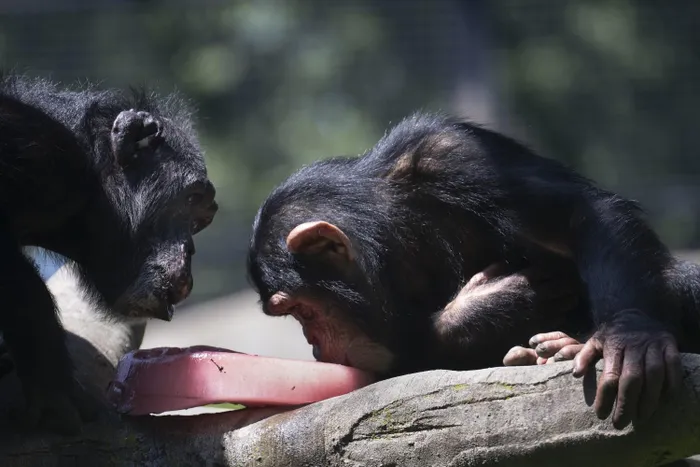
Chimpanzees at the Maryland Zoo in Baltimore on June 24.
Image: Marvin Joseph/The Washington Post
In a world where evolution seems to favour traits that enhance reproductive success, a curious phenomenon has emerged from the study of nonhuman primates: same-sex sexual behaviour. While this behaviour may initially strike observers as non-reproductive and, therefore, evolutionarily questionable, new research reveals that same-gender interactions may serve crucial survival functions in certain species.
A groundbreaking study published in the journal Nature Ecology & Evolution last week offers fresh insights into the complexities of natural selection. Through their analysis of 491 primate species, researchers, led by Vincent Savolainen of Imperial College London, found strong evidence of same-sex behaviour in 59 species, with 23 exhibiting repeated instances of such interactions. The findings indicate that both male and female nonhuman primates engage in same-sex relations, challenging the previous understanding of social behaviours that support individual and species survival.
For decades, the scientific community grappled with what has been labelledthe Darwinian paradox: why do genes associated with same-sex behaviour persist when such interactions do not facilitate direct reproduction? Savolainen’s study posits that these behaviours enhance survival by fostering bonds among individuals within groups. “Young animals might engage in same-sex behaviour to practice having sex,” he noted, “which could ultimately prepare them for mating later in life.” This social structure may also promote trust among group members, enabling more effective cooperation in identifying predators and defending each other.
The complexity of life in nonhuman primate societies has been underscored by the team’s research. In particular, same-sex behaviour appears more prevalent among species enduring harsh climates, social hierarchies, and significant sexual dimorphism—where males and females differ markedly in size and physical traits. According to Savolainen, “Feeding, fighting, looking after your offspring, reproductive sex, and same-sex sexual behaviour are all part of the complex behaviours that ensure these societies operate efficiently.”
Dr. Marlene Zuk, an evolutionary biologist at the University of Minnesota, commented on the significance of the research, linking it to the long-standing nature versus nurture debate surrounding same-sex attraction. “This paper’s systematic approach contributes to a dialogue that’s not new, but incredibly relevant,” she explained. “Understanding same-sex behaviour may require us to consider a multitude of environmental and social factors.”
Recent findings also align with other studies which show that same-sex behaviour isn’t isolated to primates. A separate 2023 study in Nature Communications revealed that same-sex sexual behaviour has been documented in 261 mammalian species—a striking 4 percent of the total. This further emphasises the need for scientists to reassess how we analyse and interpret sexual behaviours across various animal groups.
Julia Monk, an assistant professor at New York University, praised the study’s approach for redefining the narrative around same-sex behaviour. “By focusing on environmental and social conditions, this research moves away from viewing same-sex behaviour as merely a puzzle to solve, encouraging a broader understanding of its role in animal societies.”
Teichroeb, an associate professor at the University of Toronto, echoed this sentiment, suggesting that same-sex interactions might offer critical advantages that go beyond traditional reproductive outcomes. She stated, “The time and energy spent on same-sex relationships could ultimately strengthen alliances and enhance competition for resources or protection.” The notion that these behaviours may yield indirect reproductive benefits marks a significant turning point against the previously accepted Darwinian paradox.
As Savolainen and his colleagues continue to explore their findings, there is hope that this research may pave the way for new revelations about the evolutionary advantages of same-sex interactions. “It would be a complete reversal of this Darwinian paradox,” he concluded, “to show that the more same-sex you engage in, the more offspring you may ultimately produce.”