
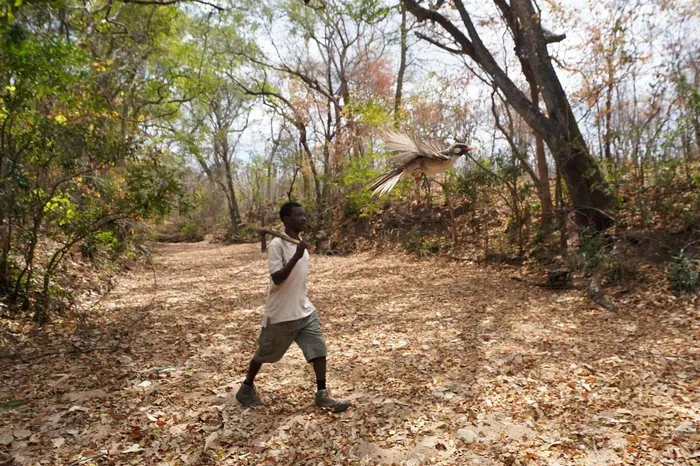
Carvalho Nanguar, Yao honey-hunter from northern Mozambique, with a male greater honeyguide released from the hand after being caught for research purposes.
Image: David Lloyd-Jones and Dominic Cram/UCT
In a remarkable example of interspecies communication, researchers from the University of Cape Town (UCT) have uncovered that honey-hunting communities in northern Mozambique utilise regionally distinct “dialects” when interacting with honeyguide birds. This groundbreaking study, recently published in People and Nature, not only highlights the complexities of human-wildlife interactions but also reveals striking parallels between how human languages diversify across regions.
The study showcases the first documented instance of variable human-to-wildlife communication that mimics the linguistic diversity found among human populations. Each dialect allows local communities to work alongside greater honey-guides (Indicator indicator), wild birds renowned for leading humans to the nests of honeybees. In this mutually beneficial relationship, honey-hunters and honey-guides engage in a unique cooperative behaviour translating into shared rewards: honey-seeking humans save time and effort while the birds feast on wax and larvae left behind.
In various parts of sub-Saharan Africa, honey-hunters have cultivated this unique partnership with honey-guides for generations. By employing specific calls, these hunters signal their needs while honey-guides, in turn, decipher these cues to locate their human counterparts. Past research has revealed that these birds are highly attuned to local dialects, responding more vigorously to familiar sounds than to those from distant regions.
Lead author Jessica van der Wal, affiliated with UCT’s FitzPatrick Institute of African Ornithology, explained, “While honey-hunters in different parts of Africa are known to have culturally distinct calls to honey-guides, we wanted to see whether calls also vary between neighbouring communities and follow predictable patterns.” Her inquiry into this human-animal interaction led to a fascinating discovery: the calls used to attract honey-guides also show regional differentiation, much like linguistic variations in human speech.
The research team meticulously recorded calls from 131 honey-hunters across 13 villages in the Niassa Special Reserve, a region where the predominantly Yao communities depend heavily on wild honey. The analysis covered both recruitment calls, used to summon honey-guides from afar, and coordination calls, which enabled hunters to communicate while following the birds closely. The results were enlightening; as the distance between communities increased, so did the distinctiveness of the calls. Intriguingly, the variation in calls was not linked to environmental factors, such as habitat acoustics.
One striking observation from the study noted that honey-hunters who relocated to new villages tended to adjust their calling styles to match those of their new community, further underscoring the influence of culture on communication. “These regional honey-hunting calls pattern across space in a way that looks remarkably similar to human dialects,” van der Wal stated, reinforcing the idea that cultural processes, rather than environmental pressures, primarily drive this diversity.
Despite the existence of these regional differences, the cooperation between humans and honey-guides remains robust and beneficial across the Niassa Special Reserve. Senior author Professor Claire Spottiswoode, who leads the Honeyguide Research Project, noted, “This suggests that both species are adjusting to each other across the Niassa landscape.” Here, humans learn and maintain local signals necessary for cooperation, while honey-guides may be adapting to these dialects, much like how they learn to respond to a broader range of human communication styles across Africa.
The findings from this study unveil a fascinating window into interspecies communication, illuminating how human cultural diversity can shape relationships with wildlife, even for undomesticated animals. In reflecting on this unique cooperation, Spottiswoode expressed her gratitude, stating, “It’s been a privilege to study this rare example of cooperation between our own species and a free-living wild animal, in collaboration with Niassa’s honey-hunting communities.”