
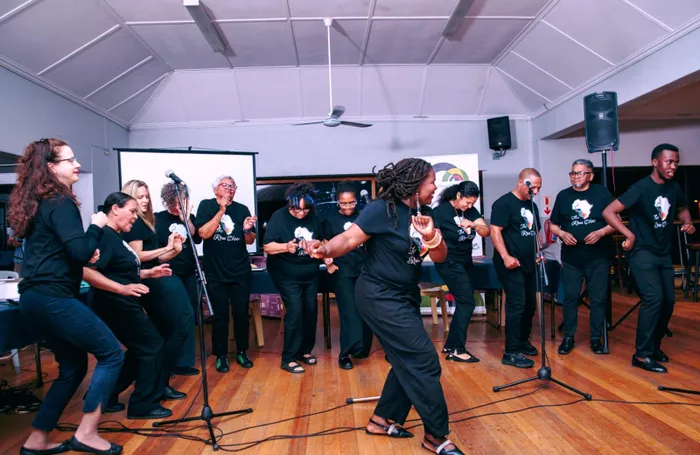
Rosa choir members perform at the Cape Cultural Collective’s 2025 AGM, which took place at Pinelands Bowling Club in October. Choir director Nomathamsanqa Baba keeps up the energy.
Image: Supplied
As South Africa marks Human Rights Month, a Cape Town choir is demonstrating how music can be a powerful force for social cohesion, helping to "break down old barriers and heal decades of trauma". For the Rosa choir, which was started in 2012, singing in unison is a tangible expression of a united South Africa. The Cape Cultural Collective (CCC) initiative represents both the dream of a united country and the struggle to realise it. Despite the challenges of a city still divided by Apartheid's spatial planning, choir members travel long and short distances from their homes to practice at the Artscape Theatre every Saturday afternoon.
For some singers, the journey involves a network of public transport and private lifts, with some having to wait outside police stations for rides due to rampant crime in their neighbourhoods. In addition to safety concerns, the choir grapples with "connectivity Apartheid," as some members lack the data or network connection necessary for communication. Nevertheless, once the music begins, the "healing power of the arts takes over," fostering a "deep sense of dignity, community and respect" among members who render traditional and popular songs in isiXhosa, English, and Afrikaans.
Their wide-ranging repertoire includes tracks such as Suikerbossie, Asimbonanga, and Stand by Me. Kay Jaffer, a founding member from Wynberg, an alto singer, and a member of the planning committee, emphasises the choir's role in unity. Jaffer states that the choir unites people from different cultural and historical experiences and across "all the barriers that still divide us as South Africans". She adds that the art of singing "helps to break down these barriers, and promotes cohesion".
For members like 21-year-old bass singer Aphiwe Magodla of Gugulethu, the choir is a source of personal strength. "Being in the choir contributes a sense of purpose and balance to my life. It gives me a space where I can express myself freely, connect with others and be fully present in the moment," Magodla said. He also finds that "Singing helps me release stress and emotions that I don't always have words for, and it reminds me to slow down and breathe".
Named after the iconic Cape-Malay Dutch song, Rosa, the choir is rooted in cultural inclusivity and evokes "nostalgic feelings of pride, community and home" for many Capetonians. After the Covid-19 pandemic brought the arts to a halt, the choir has been actively rebuilding and aims to reach 40 singers this year. They recently appointed a new musical director, which Jaffer states they are "very excited about," and their goal for the year is to "expand their membership and perform more publicly".
The Rosa choir is an initiative of the Cape Cultural Collective, which is celebrating its 20th anniversary in 2027. They are open to all who love singing and are over the age of 14. The choir is specifically seeking more men and young people between 18 and 34 to join their ranks. Jaffer said: "I want our audience to enjoy the music and see what is possible when people from different backgrounds and experiences come together in a spirit of unified harmony".
*The choir will resume practice every Saturday at the Artscape theatre in April and plans to record a professional video to showcase the choir in May. For more information on the Rosa choir, contact Kay Jaffer on 082 202 3131.