
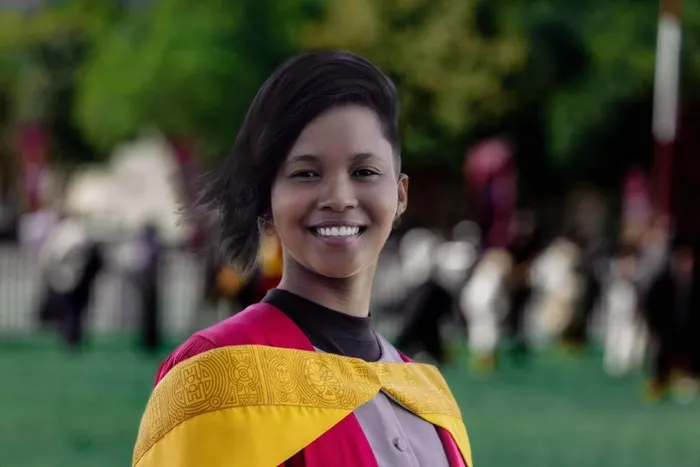
Dr Allison Matroos.
Image: Henk Oets
The West Coast town of Atlantis, often facing the blight of poverty and social issues, is celebrating a beacon of hope and academic excellence. Dr. Allison Matroos from Atlantis reached the pinnacle of academic success on March 23, 2026, receiving her doctorate in Afrikaans and Dutch at Stellenbosch University’s March graduation ceremony.
Matroos's achievement is particularly remarkable as she completed her doctoral studies in just two years. As the first in her family to attend university, her journey was one of significant perseverance, overcoming challenging domestic circumstances and financial difficulties while growing up with her grandmother. "When you grow up in Atlantis you learn at an early age of survival, but also what the word 'perseverance' really means," Matroos said.
"My journey wasn’t easy. I walked a winding path of falling and getting up again in an environment where one's dreams are often overshadowed by violence and feel out of one's reach.” She credits her unwavering determination and the support of her mother, grandmother, and partner, McKenzie, for keeping her focused. "It's not about being the smartest, but about putting in the time and showing up – even in the times you feel like running away."
Currently a postdoctoral fellow and temporary lecturer at the university's Department of Afrikaans and Dutch, Matroos’s research focused on the vital role of literature; specifically short stories and poems in promoting the macro skills (reading, speaking, listening, and writing) of second language students.
Her model creates a "safe space" to lower students' anxiety and build confidence by actively engaging with the language. Beyond her academic work, Matroos is an accomplished short-story writer who published her first collection, Kaleidoskoop, at age 21. Her creative and academic work is deeply personal and purposeful, driven by a desire to reflect the experiences of communities like Atlantis.
"By telling stories that reflect the reality of our communities, we acknowledge our own existence," she explained. "It’s important to capture the experiences of people of colour in particular, so that their voices can be heard."
Looking ahead, Matroos intends to further develop her literary model for use in teacher training and curriculum development to address gaps in Afrikaans education nationally. She will continue to write both academically and creatively to ensure that the voices from Atlantis and similar places remain strong in the classroom. "Take control of your life and write your own story," she advises young people. "Ask for help if you need help. Being shy or embarrassed won’t get you anything."