
A groundbreaking study published this week in the journal People and Nature reveals that managing the encroachment of people and wildlife requires looking far beyond traditional ecological data.
Image: AI generated/Gemini
As human populations expand further into the world’s remaining wild spaces, he traditional boundaries between people and animals are collapsing. But what truly drives the changing relationship between humans and wildlife?
A groundbreaking study published this week in the journal People and Nature reveals that managing these increasingly tense frontiers requires looking far beyond traditional ecological data. Instead, conservationists must navigate a complex web of human emotions, shifting cultural values, and global media storms.
The research, led by Dr Dian Spear from the Centre for Sustainability Transitions at Stellenbosch University, warns that traditional, rigid wildlife management is no longer fit for purpose. By examining nine case studies across Southern Africa—a region mirroring global conservation challenges with its rich biodiversity, fragmented landscapes, and intense human pressures—Dr Spear maps out the invisible forces rewriting the rules of coexistence.
According to the study, relationships between humans and animals are shaped by the fluid interplay of four core drivers: what animals do, what people do, what people think, and the rules society puts in place. These factors determine not only how often humans and wildlife cross paths, but how those volatile encounters unfold.
The Southern African examples highlight just how dynamic and deeply contested these relationships have become. Dr Spear said that a single species is rarely viewed in isolation; it can simultaneously be feared as a threat, revered as a cultural symbol, relied upon as a source of income, or cherished as a neighbour.
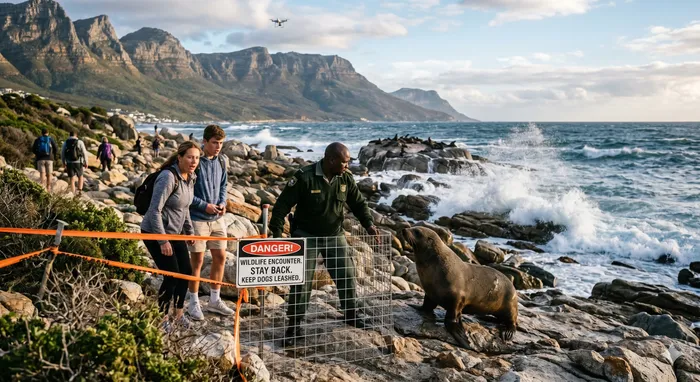
In the coastal waters of Cape Town, sudden ecological disruptions have forced immediate shifts in human behaviour. A recent rabies outbreak among Cape fur seals transformed casual coastal encounters into public health risks. Meanwhile, the sudden disappearance of great white sharks from local waters—driven by killer whale predation—fundamentally altered the marine ecosystem and the local ecotourism economy.
Crucially, the study highlights that human-wildlife relationships are no longer shaped solely by direct physical encounters. In the modern age, distant actors and global media wield unprecedented power over local conservation.
The global outrage following the killing of Cecil the lion in Zimbabwe demonstrated how international social media sentiment can clash with local management realities. Conversely, the Oscar-winning documentary My Octopus Teacher, filmed near Cape Town, showed the positive power of storytelling, fundamentally shifting public perceptions and fostering a deep emotional connection to marine life.
Cultural practices are also adapting to modern conservation realities. In South Africa and Zambia, the traditional use of leopard skins in cultural ceremonies is increasingly being replaced by faux leopard fur, balancing the preservation of heritage with the protection of endangered predators.
The study further reveals how fragmented human attitudes can complicate management strategies. In Cape Town, urban baboons are a deeply polarizing issue, pitting residents who view them as cherished neighbours against those who see them as destructive pests. In rural South Africa, the conflict takes on an entirely different dimension, directly impacting agricultural livelihoods.
Where conflicts escalate, the consequences can be severe. In the Kruger National Park, rampant rhino poaching has led to highly militarized conservation tactics, creating a deeply tense atmosphere governed by strict enforcement and institutional pressure.
To successfully navigate these increasingly volatile relationships, Dr Spear argues that the conservation sector must abandon rigid, one-size-fits-all strategies. Instead, future frameworks must be flexible, transparent, and context-sensitive.
"In contested areas, these dynamics require transparent, context-sensitive decision-making, effective communication, stakeholder engagement, and conflict-resolution mechanisms that consider both local and global perspectives," Dr Spear said.
Ultimately, the study serves as a vital reminder that saving wildlife is as much about understanding human institutions, values, and emotions as it is about managing animal populations. With major gaps in research remaining for many of these case studies, Dr Spear is calling for an urgent increase in research to help societies anticipate and navigate the shifting tides of human-wildlife coexistence.