
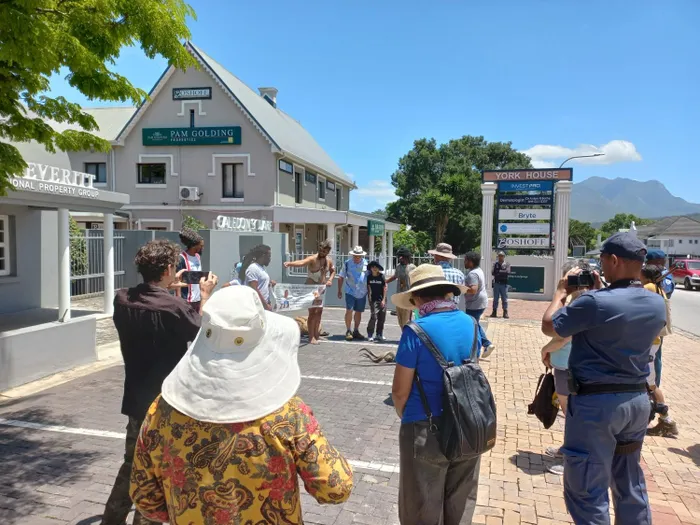
George held a slavery emancipating walk recently to celebrate the slave history of the town.
Image: Ras Hein Scheepers
The district of George, resting beneath the Outeniqua Mountains, was once a meticulously engineered landscape of colonial exploitation. By the 1834 emancipation census, the district recorded 1038 enslaved Africans: 592 men and 446 women, including nearly 300 children. Most were Cape-born and Creole, while others arrived from Mozambique, Madagascar, and across the wider Indian Ocean.
They farmed wheat and cattle, cut timber, and built the infrastructure that sustained the colonial economy. Cradock’s Pass, opened in 1822, and Montagu Pass, finished in 1847, survived today as heritage that signify “engineering triumphs.”
Yet on their foundations sits the energy of the oppressed and imprisoned labourers whose names have been forgotten. The lives of oppressed Khoi and San were governed by a web of restrictive laws: the Hottentot Proclamation of 1798, the Caledon Code of 1809, the Apprentice Laws of 1812, and the Masters and Servants Ordinance of 1841.
These codes destroyed bloodlines, restricted movement, and vanquished cultural identity, creating what Orlando Patterson described as “social death.” - Rebel Slave in the Cape: From George to the Kouebokkeveld.
Uprisings in the Cape were neither isolated nor accidental. Among the most effective was the 1825 uprising on the farm Houdenbek in the Koue Bokkeveld, which shook the colony. Slaves and indigene labourers in the Ceres district rose in plotted defiance, directly confronting the system that held them captive. Their rebellion heightened colonial anxiety and resulted in greater brutality against slaves in the Cape Colony, including in George. In George, this atmosphere of fear and violence shaped daily life.
Those who became aware of the Kouebokkeveld revolt gained confidence of potential uprisings in George. Although the large-scale uprising occurred in Ceres, the political landscape it produced intensified oppression of slaves in George, contributing to currents of resistance.
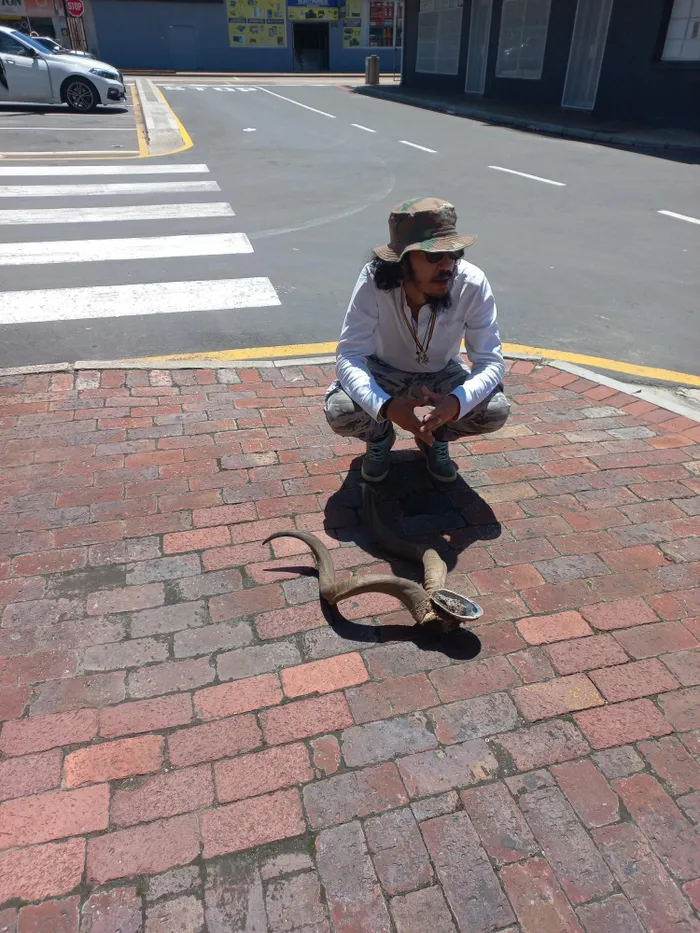
Participants performed rituals to honour the slaves.
Image: Ras Hein Scheepers
Centuries before Pacaltsdorp became a mission station, it was shaped by the authority of Kaptein Dikkop, the Khoikhoi leader of Hoogekraal. In 1813 he travelled by ox-wagon to bring missionary Charles Pacalt to the kraal, not as an act of religious conversion but as a strategy of political protection in the face of growing colonial dispossession.
Dikkop resisted being converted to a Christian and practiced his cultural traditions even as colonial religious persecution continued to brutally oppress “uncivilised non-believers and unfaithful heathens”. After passing on in 1816, he was buried outside the mission cemetery because he did not get baptised into a European belief-system. His grave, close to the Dikkop amphitheatre national heritage site, stands as a monument of indigenous resilience, continuity and endurance. His son Paul, escorted by missionaries to England in 1819, died in 1824 at about fourteen years old, an historical case study that showcases the levels of disruption and the fragility caused by colonial imposition and domination in George, vestiges that continue to bring about inter-generation landlessness and poverty.
The landscape of George reveals its colonial history through names placed on its places and monuments. Blanco, formerly known as Whitesville, represented a European settlement defined by privilege and colonial entitlement. It embodied a settlement created to benefit European identities at the cost of the oppressed identities in George. Preto (Portuguese word for black), by contrast, emerged as an emancipated slave settlement, a sanctuary for emancipated slaves and self-liberated indigenes who cultivated communities, preserved cultural practices, and asserted autonomy beyond the oversight of colonial authorities.
The contrast between Whitesville (renamed Blanco) and Preto is more than linguistic. It reflects the spatial design of colonialism.
On 30 November 2025, eighteen participants undertook the inaugural Emancipation Walk, tracing the historical layers of slavery and survival in George. Beginning at St Paul’s Chapel,moving to the Slave Protectors’ House and the Old Gaol, and concluding at the site of Preto, the walk weaved together texts of a censored past.The Emancipation Walk is not simply a commemoration or a social event. It is a cultural ceremony and an act of decolonising space and discourse. It calls on residents and visitors to confront the tangible and intangible social fabric of oppression embedded in George's architecture, spatial planning and landmarks. It offers education, healing, and reconnection with narratives that colonisation sought to erase.
Colonialism functioned not only through forced labour and land dispossession but also through psychological domination that created an inferiority complex in those subjected to oppressivesystems. In George, this colonisation took shape through - renaming places discovered centuries before colonialism, the erasure of contributions by slaves and oppressed indigenes, the celebration of colonial landmarks and the marginalisation of communities like Preto. In such a context, heritage preservation becomes a revolutionary praxis.
Restoring gravesites, archiving oral histories, decolonising mission-era texts, and memorialising resistance unerases centuries of deliberate erasure. Cultural production here is not performative; it is a form of progressive emancipatory praxis.
In the annual emancipation walk, the burial grounds of Kaptein Dikkop, the foundations of Preto, and the historical significance of Blanco compels us to rethink popular discourses about Cape Colony heritage. Decolonising the mind requires dismantling inherited prejudice of colonisation and Western civilisation.
The restoration of grave sites, the documenting of stories, the preservation of historical sites, and the mainstreaming of decolonial histories - is an act of restorative justice. To remember is to awaken dormant consciousness. Restorative - is to retrieve and repair roots, mainstream culture and preserve heritage. To walk the long road to genuine emancipation - with knowledge is to restore the dignity that slavery and colonialism stripped.