Rescuers questioned the call but it was real: A hiker was trapped in quicksand
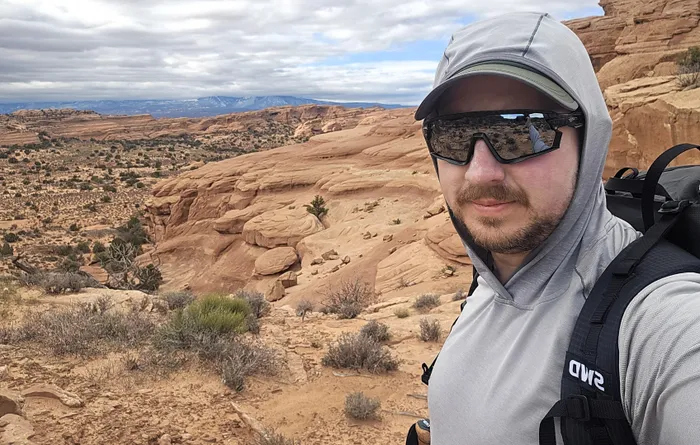
Austin Dirks, 33, began a hike through Utah's Arches National Park on December 6.
Image: Austin Dirks
Kyle Melnick
Austin Dirks walked through a shallow stream of water in a Utah canyon that looked and felt similar to dozens of others the avid hiker has passed.
But during his Sunday hike, his left foot suddenly sank into the ground. He shifted his weight to his right leg, which plunged into the earth to his knee. He freed his left foot but his right leg, submerged in a 45-degree angle, felt like it was stuck in concrete, he told The Washington Post.
After a few minutes of trying and failing to wiggle free, Dirks, 33, realized he was trapped in something he had only heard about in books and movies: quicksand.
When Dirks called for rescue workers, they were almost as shocked to hear about a quicksand trap as he was.
“You have to scratch your head for a second going, ‘What? Did I hear that right?’” said John Marshall, who helped the Grand County Sheriff’s Search and Rescue save Dirks later Sunday morning.
Dirks, who said he has hiked dozens of trails in the West and Midwest in the past six years, began a planned 20-mile hike on the Hayduke Trail. After camping overnight, Dirks hiked through Arches National Park before sunrise Sunday amid temperatures in the 20s. Salt Lake City news station KSTU first reported the story.
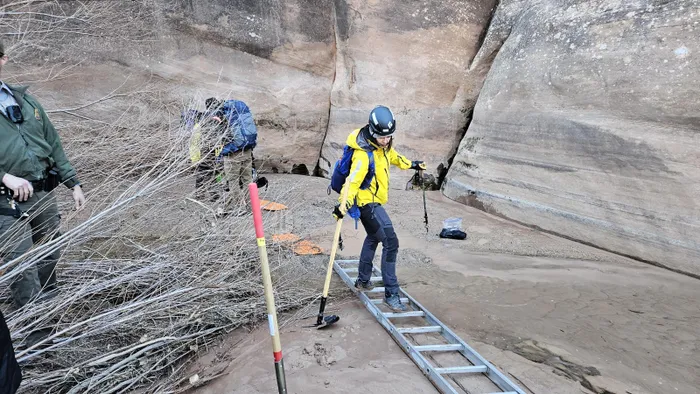
A ladder helped Austin Dirks escape quicksand in Utah on Sunday.
Image: Austin Dirks
The area where he was stuck looked like sand and gravel under a thin layer of clear water, Dirks said. It felt solid until Dirks fell into it around 6:45 a.m., he said.
Dirks wasn’t worried initially. He said he had fallen knee-deep into wet sand and had always escaped without help.
But he realized his predicament was dire when he couldn’t escape after about five minutes of trying to wrest his right leg free.
“In thousands of miles of backpacking,” Dirks said in an email to The Post, “nothing has ever come close to this.”
Quicksand forms when sand becomes so saturated with water that it loses strength and acts more like a liquid than a solid, making it unable to support much weight, according to the Nature journal. Research has found an entire human body can’t get stuck in quicksand due to its buoyancy - despite fictional depictions of that happening in movies like “Lawrence of Arabia” and “The Princess Bride.”
Dirks attempted to climb out by using his trekking poles for leverage, but they sank up to their handles. He still tried to carve space around his right leg with them. But he said sand and small stones instantly filled every hole he created. His fingers went numb after about a half-hour, he said, and the water streaming around his leg felt piercing cold.
If he hadn’t called for help, Dirks said he feared he would have lost his right leg in the best case scenario or died of hypothermia.

Grand County, Utah, officials carry equipment after rescuing Austin Dirks from quicksand Sunday.
Image: Austin Dirks
Around 7:15 a.m., Dirks grabbed his Garmin communication device from his backpack that he set beside him and sent a saved SOS message: “I have an emergency, and I need you to send help.” When Grand County emergency responders replied by asking what his emergency was, Dirks typed slowly with his nearly frozen fingers.
“Stuk Quiksand hiker,” Dirks wrote.
Officials said a few minutes later that the Grand County Sheriff’s Search and Rescue unit in Moab, Utah, was on its way.
Marshall, who had not rescued someone from quicksand since 2014, initially thought a tourist’s foot might’ve gotten stuck in mud. But he and his team came prepared, loading a 12-foot ladder and orange and tan traction boards into trailers. They dispatched a drone to locate Dirks.
While Dirks waited for the group to arrive, he slipped on a dry green fleece and mittens from his pack to help withstand the cold. He worried his right knee would tear or dislocate. He compared the pressure on his right knee to leaning forward on skis for hours.
“Knee Twisting very uncomfortable position Cold Water,” Dirks wrote on his Garmin device at 8:15 a.m.
Around 8:40 a.m., Dirks saw the rescue group’s drone in the clear sky. A few minutes later, a ranger from Arches National Park arrived and handed Dirks a shovel, which didn’t help free him.
The Grand County Sheriff’s Search and Rescue members parked a few hundred yards from Dirks to ensure their vehicles didn’t get stuck. When they reached Dirks around 9 a.m., a few rescuers shoveled around Dirks’s right leg while standing atop traction boards, and another member built a path across the sand with the ladder.
After several minutes of shoveling, rescuers pulled Dirks free; his right trail shoe almost came off his foot. Dirks said he couldn’t feel his leg - he almost collapsed when he tried to put weight on it. Using a shovel as a crutch in each hand, Dirks crossed the ladder to solid ground.
Paramedics wrapped Dirks’s right leg in a heated blanket. He said he could feel his leg again after about 15 minutes.
Dirks was able to climb out of the canyon and over a dirt road to reach the rescuers’ trucks. A park ranger drove him to his car in Moab before Dirks drove about 140 miles northeast to his Glenwood Springs, Colorado, home.
There, he dipped his sore - but uninjured - legs into a relaxing bath at local hot springs.
“Physically, I recovered far better than I expected,” Dirks said. “Mentally, I’m still processing the experience.”