
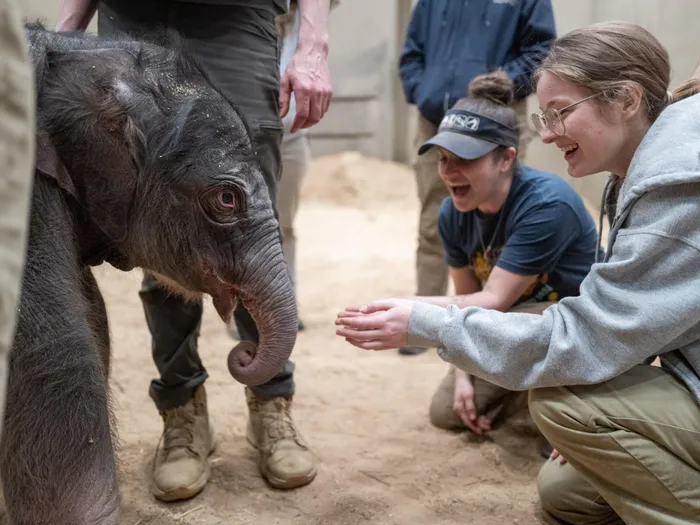
Zookeepers greet a baby elephant born Monday at the Smithsonian’s National Zoo and Conservation Biology Institute in Washington.
Image: Roshan Patel — Smithsonian’s National Zoo and Conservation Biology Institute
Michael E. Ruane
A 300-pound Asian elephant calf was born at the National Zoo early Monday, the zoo announced Tuesday morning.
The calf, a female, is the first elephant to be born at the zoo in almost 25 years, and only the third born there in the zoo’s 136-year history.
The baby, covered in fuzzy hair and unable to walk at first, arrived at 1:15 a.m. to 12-year-old mother Nhi Linh and 44-year-old father Spike, the zoo said in a statement.
“Oh, my God, I am so thrilled,” the zoo’s director, Brandie Smith, said in a phone interview Tuesday. “This is the first Asian elephant calf we’ve had here in more than two decades.”
“She’s so adorable,” Smith said. “It is nothing but pure joy to look at this little baby elephant. And I know I say this all the time, but we could all use a little pure joy right now.”
The calf won’t make her public debut for up to a month while she bonds with her mother, the other elephants and the keepers, the zoo said. The zoo, in Northwest Washington, now has seven elephants, including the baby.
The zoo said the calf weighs 308 pounds (140 kg) and stands about 3 feet tall. “She’s a big girl,” Smith said.
The animal care team began 24-hour watches on the evening of January 25 to look for signs of Nhi Linh’s labour. “The entire team has been sleeping in the [Elephant] Barn,” she said. “We have been here 24-7.”
Early Monday morning, “we saw that she was having contractions,” Smith said. “In elephants, there’s this telltale kind of bulge at the back of their tail as the [baby] makes its way through the birth canal.”
“So we saw the bulge,” she said. “Eventually, her water broke. And then she gave birth. A little miracle.”
The calf was born in a birthing suite in the Elephant Barn, an off-exhibit area adjacent to the Elephant Community Center. Her grandmother, Trong Nhi, 22, and herd mate Bozie, 51, were in suites nearby, the zoo said.
“As both Trong Nhi and Bozie are closely bonded with Nhi Linh, it was important for them to be present and share in her experience,” the zoo’s statement said.
After the birth, zoo veterinarians performed a comprehensive neonatal exam on the calf, who appeared healthy and alert.
“They’re so solid,” Smith said. “You look at a baby elephant, and they seem so tiny. She was 300 pounds. She’s a little tank. And they’re so hairy. They come out … and they’re covered with this dark hair.”
At first, the calf was unable to walk. So keepers put straps under her belly to help her get up and start walking.
The calf also uttered what Smith said sounded like a “prehistoric” call.
There were some tense moments right after the baby was born.
First-time elephant mothers often become agitated and will kick the calf in confusion, or to rouse it.
“Even an experienced mom will kick the baby around to stimulate it,” Tony Barthel, the zoo’s senior curator, said in a phone interview Tuesday.
“In her case, it was maybe inappropriate stimulation,” he said. “When she was knocking the baby around, she knocked it within our reach and out of her reach briefly. And we were … immediately able to take advantage of that and pulled the calf to safety.”
The calf has not immediately been put together with her mother to nurse. “I’m not sure when we’ll try to introduce them,” Don Neiffer, the zoo’s chief veterinarian, said. “We’re hoping in the shorter time than long.”
Meanwhile, the baby has been getting nutrients via a bottle.
The calf has not been named. But the elephant care team has selected four possibilities:
Linh Mai [LIN-my]: spirit blossom. Linh means “spirit” or soul”; Mai refers to the apricot blossom, a flower associated with Tết (Lunar New Year), which begins February 17.
Thảo Nhi [TOW-nee]: gentle and beloved. Thảo means gentle or kind and is associated with nature; Nhi means small, little one, or beloved.
Tú Anh [TOO-ahng]: Tú means talented or gifted; Anh means bright and intelligent.
Tuyết [TWET]: Traditionally means “snow,” referring to her winter birth.
Fans can vote for their favorite name by making a donation of $5 or more on the zoo’s website.
The zoo said the polls will close at noon February 13, and the name that receives the most donations will be selected. All funds raised will support Asian elephant care and conservation.
Last year, the zoo had been anticipating the arrival of two elephant babies. Nhi Linh’s mother, Trong Nhi, had also been pregnant, but her pregnancy ended prematurely. Her stillborn calf was delivered December 12.
Monday’s birth is the culmination of the zoo’s more than 15-year project to build a multigenerational herd that could produce offspring and aid in the survival of the endangered Asian elephant.
Fewer than 50,000 remain in the wild.
The birth could also be a cultural happening in the Washington region, rivaling the attraction of the zoo’s rock-star giant pandas.
“Anybody who’s seen [a baby elephant] knows that you could just watch them for hours,” Smith, the zoo’s director, said last year. “It’s just so much fun.”
The zoo owns all its elephants - including the calf - except for Spike, who is owned by the Miami zoo, where he was born, National Zoo spokeswoman Annalisa Meyer has said.
The zoo, which has had elephants since 1891, hasn’t had one born since the November 25, 2001, the birth of its male, Kandula, now at the Oklahoma City Zoo.
The first elephant born at the zoo, a female named Kumari, collapsed and died in 1995 of the lethal elephant endotheliotropic virus. She was 16 months old. The virus has been responsible for about half of the deaths of young elephants in zoos.
Three adult elephants at the zoo have been euthanised in recent years because of old age and painful medical issues
The zoo’s Elephant Cam went offline January 23 as Nhi Linh entered her birth window.
When the elephant calf makes her debut, she will also make her first public appearance on camera, the zoo said.