
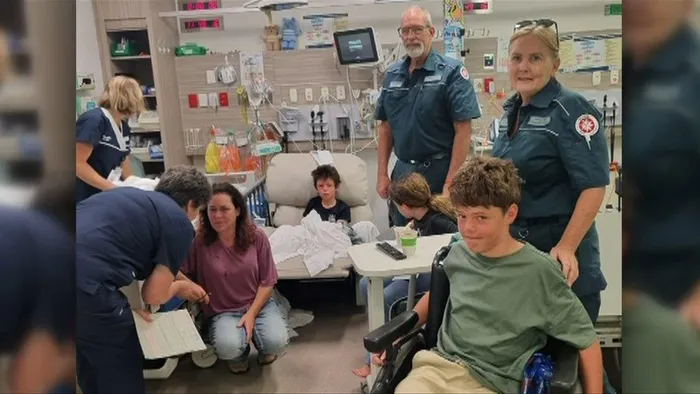
Austin Appelbee, right, swam to save his younger brother Beau, sister Grace and mum Joanne.
Image: 7NEWS
Adela Suliman
A 13-year-old Australian boy is being hailed as a hero for his sheer endurance and bravery after swimming about 4kms in rough waters, then running about a 1.5km to rescue his family, who had been swept out to sea.
Austin Appelbee, his mother, Joanne, and two siblings, Beau, 12, and Grace, 8, were on vacation kayaking and paddleboarding off the coast of Quindalup, in Geographe Bay, in southwestern Australia, when the weather deteriorated, according to local authorities and Australian media reports.
Fearing for her family, Joanne made the difficult choice to send Austin to get help, she told Australia’s national broadcaster, ABC News, calling it “one of the hardest decisions I ever had to make.”
“I knew he was the strongest and he could do it,” she said of her teenage son. “I have three babies. All three of them made it. That was all that mattered,” she added of the family ordeal, in which she spent more than eight hours clinging to a paddleboard in the ocean.
The Western Australia Police Force said it received an emergency call about 6pm last Friday that a woman and her two children had been swept out to sea in rough conditions.
Austin paddled to get help before his kayak took on water and failed him, police said. He then swam nearly 4kms in fading light and rough conditions before reaching land to ring the alarm.
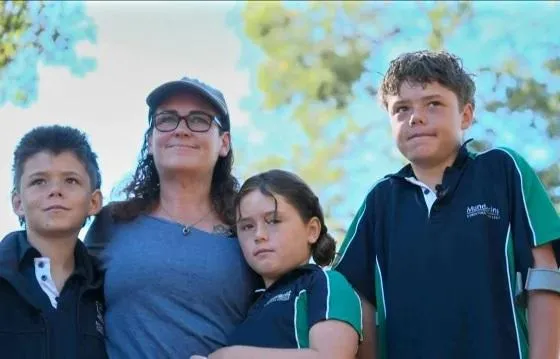
Austin Appelbee, right, with his family in Quindalup, Western Australia this week
Image: ABC via AFP
“The actions of the 13-year-old boy cannot be praised highly enough - his determination and courage ultimately saved the lives of his mother and siblings,” Inspector James Bradley of the South West District office said this week. “This incident is a reminder that ocean conditions can change rapidly. Thankfully, all three people were wearing life jackets, which contributed to their survival.”
Austin, in an interview with the Australian Broadcasting Corp., recalled that his mother had directed him to “go get help” while she stayed with his siblings.
“I knew it would be a long way … but the kayak kept taking in water; I was fighting rough seas,” he said. “I was very puffed out but I couldn’t feel how tired I was,” he added. “The waves were massive.”
Austin said he decided to ditch the kayak and remove his life jacket, which were making it difficult for him to swim, and alternated between swimming breaststroke, freestyle and survival backstroke - an energy-preserving stroke for long distances. “Just keep swimming, just keep swimming,” he told himself, putting happier thoughts about his family and school friends into his mind to pull through, he said.
“I just said, ‘All right, not today, not today, not today.’ I have to keep on going.”
Finally, he made it to shore.
“I hit the bottom of the beach and I just collapsed,” he said. But his feat of endurance was not over. He then sprinted over another 1.5km to find a phone, where he called emergency services and told them his family was stranded at sea, he said.
“A multiagency search and rescue response was initiated,” police said, involving multiple marine sea rescue services and a rescue helicopter.
The family did not immediately reply to a request for comment from The Washington Post.
“This is what a true West Aussie hero looks like,” Roger Cook, the premier of Western Australia, said, calling Austin’s feat of endurance an “extraordinary act of courage,” to save his family.
“Austin’s bravery is beyond his years, showing remarkable courage, resilience and determination in the face of real danger. Well done, Austin - we’re so proud of what you’ve done.”
Mike Tipton, a survival expert and professor of human and applied physiology at Britain’s University of Portsmouth, said Austin’s survival was a “remarkable achievement.”
“He must be an accomplished swimmer, but even then, the water was cold enough to incapacitate him without unrelenting effort. He was clearly driven on by the desire to save his family - this is a common and critical factor in such survival scenarios,” he said.
The Naturaliste Volunteer Marine Rescue group, which was among the first responders, said the weekend’s rescue had the “best possible outcome, one we won’t forget in a hurry.”
“The bravery, strength, and courage shown by this family were extraordinary,” it said. Naturaliste Volunteer Marine Rescue commander Paul Bresland told the Australian Broadcasting Corp. that the teenager’s efforts were “superhuman” and that his description of the kayak and paddleboards meant that his family was found “within an hour.”
“Fantastic effort from all involved in trying conditions. A great outcome,” Marine Rescue Busselton, a volunteer organization also involved with the incident, said in a social media post. “Please be mindful of the strong offshore winds that can occur this time of year.”