
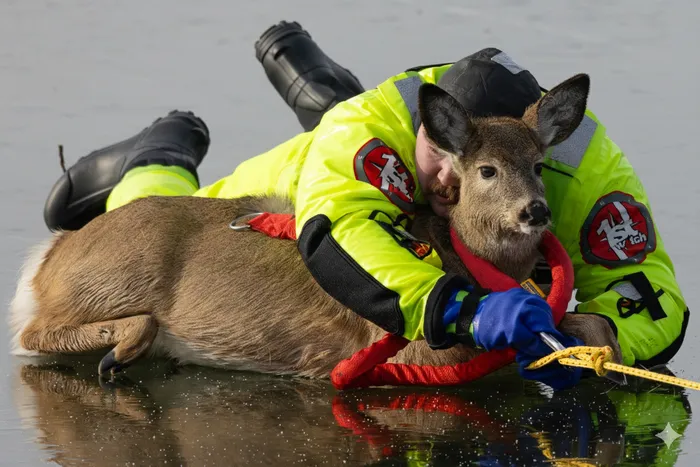
Firefighter Gavyn Gallagher holds a deer from behind as both are pulled across an icy lake by the rest of the rescue team.
Image: Courtesy of Ginger Poleschook
Maggie Penman
Daniel Poleschook Jr. looked out of his window at Washington state’s Loon Lake and saw something unusual: A deer was stranded in the middle of it.
It looked like the deer was trying to stand, but much like Bambi, was having trouble getting traction on the ice.
“I knew my day was about to change,” said Poleschook, 81.
He and his wife, Ginger, 83, aren’t strangers to wildlife rescues: The two helped rescue a moose that fell through the lake more than a decade ago. But this deer was much farther out from shore - about 150 metres, they estimated.
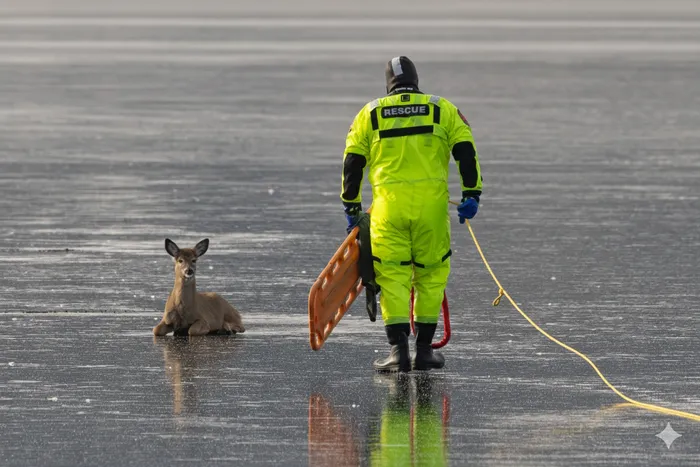
Firefighter Gavyn Gallagher gingerly makes his way across the thin ice to rescue the deer. Gallagher was trained in ice rescues, but not with wild animals.
Image: Courtesy of Ginger Poleschook
The Poleschooks called Washington’s Department of Fish and Wildlife and the local fire department, and then they went outside to see if they could do anything to help the deer that morning, January 27.
Other neighbours had gathered and a teenager was about to attempt rescuing the deer himself.
That’s when firefighter Gavyn Gallagher, 26, and his team arrived. Gallagher had been trained in ice rescues, but not with a wild animal.
“That day the ice was particularly thin,” said Gallagher, who was wearing a technical suit that would protect him from the cold if he went through the ice. “It’s been a pretty warm winter.”
He started scooting toward the deer on his belly using a backboard flotation device, trying to distribute his weight as much as possible on the ice.
“But at a certain point the deer was so far out that it made more sense to try and walk, which isn’t ideal when the ice is thin,” said Gallagher, who had a rope tethered to him that was connected to a tree on the shore.
So he stood up and walked to the deer. When he approached, he tried to cover her eyes to bring down the deer’s stress and reduce the possibility of her injuring herself.
This proved easier said than done.
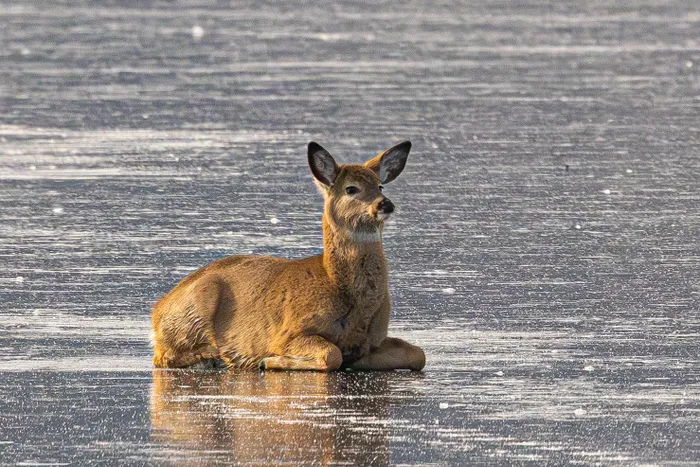
The white-tailed yearling seems to have wandered onto the ice and become stranded. After being checked to ensure she was not injured or hypothermic, she was released in a nearby wooded area.
Image: Courtesy of Ginger Poleschook
“She was obviously very frightened and didn’t want anything to do with me,” Gallagher said.
He managed to lasso her with a rope, then splayed his body on the ice and hugged her from behind, holding on tight. On his signal, the team on the beach pulled them toward shore.
Grant Samsill from the Washington Department of Fish and Wildlife was on the scene, and said that if Gallagher had tried to pick the deer up and carry her, they probably would have both fallen into the lake.
When the deer was back on land, Samsill quickly covered her eyes to calm her while he took her temperature and checked her for injuries. Once Fish and Wildlife workers were confident the white-tailed yearling wasn’t injured or hypothermic, they took her to a nearby wooded area away from the highway and released her.
“She ran off as, as expected,” Samsill said, “to do deer things.”